
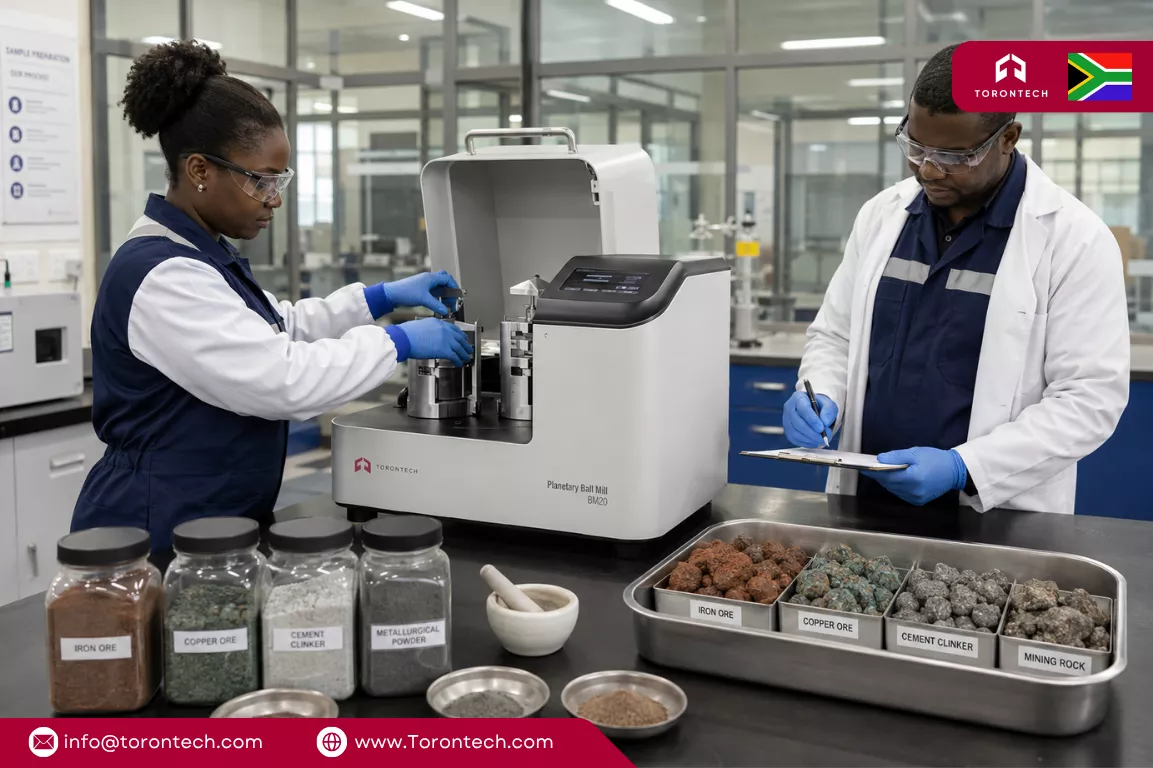
Planetary Ball Mill in South Africa for Mining, Metallurgy, and Cement Sample Preparation
Planetary ball mills are versatile solutions for grinding and mixing both dry and wet materials, producing the high degree of fineness required for consistent sample preparation. For mining, metallurgy, and cement laboratories in South Africa, reproducible grinding results support reliable downstream analysis and quality decisions across raw materials, process materials, and finished products. These instruments provide the high-energy impact necessary to reduce sample size to the sub-micron level quickly and efficiently.
Torontech planetary ball mills are designed to process soft, hard, brittle, and fibrous samples and also meet technical requirements for colloidal grinding. With BM6Pro, BM20, BM40, and BM20Plus models, labs can match capacity, speed, and throughput needs to real-world sample preparation workflows. As a Top Brand and Trusted Brand in the field, we provide the technology required to achieve nano-level fineness across diverse industrial applications.
Planetary Ball Milling for Mining, Metallurgy, and Cement Sample Preparation
Grinding and mixing dry or wet materials requires equipment that can maintain strict standards of fineness. The BM Series allows laboratories to achieve analysis-ready powders through high-energy impacts and friction. These mills are built to provide the reproducible results needed for precision and consistency in high-stakes testing environments. Advanced workflows also benefit from the colloidal grinding readiness of these units, enabling the production of extremely fine dispersions and mixtures.
Sample Types and Typical Materials Processed
The BM Series handles soft, hard, brittle, and fibrous samples with equal efficiency. Typical materials processed in mining, metallurgy, and cement sectors include:
- Cement clinker, concrete, limestone, gypsum, and quartz
- Metal oxides (including iron ore), metals, and carbon fiber
- Ceramics, bentonite, and other mineral components
- Glass and various geological specimens
The BM series supports broad cross-industry sample preparation, providing the versatility needed for geology and metallurgy labs that handle varied material compositions.
Common South Africa Use Cases (High-Intent)
- Cement and building materials QC: processing clinker and mineral additives to verify chemical composition
- Mining lab preparation: grinding ores, minerals, and process samples for elemental analysis
- Metallurgy workflows: preparing metal oxides and composite materials for structural and chemical testing
- Glass and ceramic sample preparation: facilitating R&D and production checks through consistent particle size reduction
Precision, Performance, and Efficiency for Consistent Results
- Automatic direction reversal: reduces agglomeration and maintains sample homogeneity during long grinding cycles
- Robust, quick grinding: achieves nano-level fineness through high-energy impacts
- Programmable parameters: allows users to save grinding settings to guarantee reproducibility across different batches
- Maintenance-free drive system: maintains a constant speed under load to provide uniform energy input
- Continuous operation: engineered for long-term and heavy-duty use in busy industrial laboratories
User-Friendly Operation and Safety
- Ergonomic design: features a safety-focused workflow that simplifies jar handling and operation
- Secure jar clamping: utilizes specialized tools to maintain jar stability during high-speed rotation
- Digital LED display: provides operational clarity by showing real-time speed and time parameters
- One-button operation: simplifies the starting process on BM20, BM20Plus, BM40, and BM6Pro models
Versatility in Jars, Materials, and Speed Ratio
- Customizable speed ratio: offers ratios from 1:1 to 1:3.5 to control the energy input for different materials
- Multiple grinding stations: configurations available with 1, 2, or 4 stations depending on volume needs
- Multi-sample processing: the BM40 model supports processing 2, 4, or 8 samples simultaneously
- Wide jar selection: includes six different jar types with volumes ranging from 12 mL to 4000 mL
- Diverse jar materials: available in agate, aluminum oxide, zirconium oxide, and tungsten carbide to prevent cross-contamination
Advanced Monitoring and Safety for Wet and Colloidal Grinding
- Integrated monitoring system: tracks internal pressure and temperature to manage safe operation during high-energy runs
- Automatic ventilation: maintains jar cooling through dedicated airflow and high-power motor cooling fans
- Intelligent security: incorporates security locks and gas-tight, dust-proof closures to protect the operator and the environment
Practical Grinding Setup Examples
- Glass: uses zirconium oxide balls (10 mm and 3 mm) for 30 minutes to process this hard sample type
- Granite: utilizes stainless steel balls (10 mm) for 15 minutes to achieve the desired fineness
- Pearl powder: requires zirconium oxide balls (3 mm) for 6 hours; liquid must be added properly to handle this brittle material
Grinding jars must be placed symmetrically to maintain balanced operation and protect the drive system.
Grinding Jar Filling Guidelines
Jar rated volume | Sample quantity | Sample feeding size | 10 mm balls | 20 mm balls | 30 mm balls | 40 mm balls |
50 mL | 5-20 mL | < 3 mm | 10 pcs | 2 pcs | -- | -- |
80 mL | 10-35 mL | < 4 mm | 25 pcs | 4 pcs | -- | -- |
125 mL | 15-50 mL | < 4 mm | 30 pcs | 6 pcs | -- | -- |
250 mL | 25-120 mL | < 6 mm | 60 pcs | 13 pcs | 6 pcs | -- |
500 mL | 75-225 mL | < 10 mm | 100 pcs | 22 pcs | 9 pcs | 5 pcs |
How a Planetary Ball Mill Works
The sun wheel drives the grinding jars in a circular path. The jars rotate on their own axes while revolving in the opposite direction around the sun wheel. This dual motion creates strong Coriolis forces and high impact energy. The grinding balls continuously impact and crush the samples against the jar walls, resulting in rapid size reduction.
Customizable Speed Ratio for Tailored Energy Input
Laboratories can choose between 1, 2, or 4 stations depending on their specific batch volume requirements. The speed ratio (typically between 1:1 and 1:3.5) controls the energy input and final grinding outcomes. Selecting the correct jar material and ball size based on sample hardness and contamination sensitivity is necessary for successful sample preparation.
BM Series Technical Specifications
Parameter | BM40 | BM6Pro | BM20 | BM20Plus |
Feed size | < 10 mm | < 20 mm | < 20 mm | < 20 mm |
Final fineness | < 0.1 um | < 0.1 um | < 0.1 um | < 0.1 um |
Speed | 30-400 rpm | 100-650 rpm | 50-650 rpm | 30-300 rpm |
Speed ratio | 1:-2.2 | 1:-2 | 1:-2 | 1:-1.9 |
Time | 0-99 min | 0-99 min | 0-99 min | 0-99 min |
Sun wheel dia. | 360 mm | 260 mm | 290 mm | 384 mm |
Rated power | 1.5 kW | 750 W | 750 W | 2.2 kW |
Instrument size | 784 x 598 x 577 mm | 685 x 510 x 506 mm | 685 x 510 x 506 mm | 610 x 820 x 625 mm |
Weight | 190 kg | 125 kg | 145 kg | 195 kg |
Choose your model based on feed size, desired speed range, batch throughput (including multi-sample needs), and the required jar volume.
A Top Brand and Trusted Brand Source for Planetary Ball Mills in South Africa
Torontech is recognized as a Top Brand option for reproducible sample preparation in high-demand industrial environments across South Africa. As a Trusted Brand for mining, metallurgy, and cement workflows, we provide the consistent fineness required for reliable analysis. We remain a dependable Source for flexible jar materials and various model configurations carefully matched to real laboratory requirements and material challenges.
Talk to Torontech About Planetary Ball Mill Selection in South Africa
Need help selecting a planetary ball mill in South Africa for mining, metallurgy, or cement sample preparation? Share your typical materials (ores, clinker, minerals, or metal oxides), target fineness, feed size, batch volume, and whether you require wet or colloidal grinding. The Torontech team can recommend the best-fit BM model, jar material, and grinding ball setup for reliable, reproducible results.