Mortar Grinder Solutions for US Pharmaceutical and Materials Labs
A quality control lab that cannot reduce a rock, tablet, or clinker sample to consistent fineness risks flawed results downstream. Analysts and QC managers across US industries need repeatable sample prep, not manual guesswork with a hand mortar and pestle.
A mortar grinder in USA laboratories closes that gap, delivering adjustable feed size reduction down to micron-level fineness for hard, soft, brittle, and pasty materials. Torontech supplies the MG200 Mortar Grinder to meet exactly this demand.
Where US Laboratories Depend on Mortar Grinding
Demand for reliable sample prep spans several US sectors right now, each with its own reason to standardize grinding instead of relying on hand tools.
- Pharmaceutical manufacturing: the current wave of API and finished-dose reshoring, backed by hundreds of billions in announced US investment and FDA's PreCheck Pilot for new domestic facilities, is pushing QC labs to add repeatable grinding capacity for tablets, herbs, and excipients.
- Cement and construction materials: labs supporting the ASTM Cement and Concrete Reference Laboratory (CCRL) proficiency program need consistent clinker and aggregate fines for chemical analysis.
- Geotechnical and soil testing: firms holding AASHTO Accreditation Program or A2LA credentials prepare soil, slag, and mineral samples ahead of compaction and classification testing.
- Materials science and mining: metallurgical and mineral processing labs grind ores, ceramics, and glass to uniform particle size before spectroscopy or XRF analysis.
- Food, botanical, and academic research: chemistry and materials science departments prepare grain, seed, and organic samples for coursework, applied research, and quality testing.
A mortar grinder in USA facilities handling any of these sample types replaces inconsistent hand grinding with a documented, repeatable process that supports both throughput and traceability.
How the MG200 Handles Diverse Sample Types
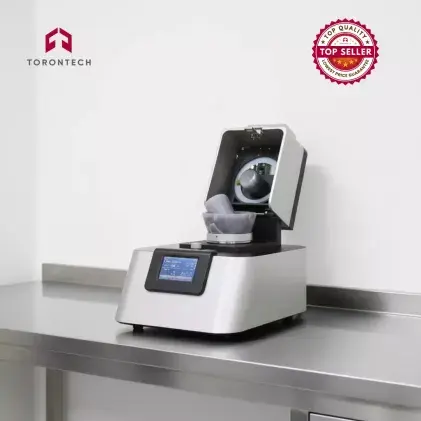
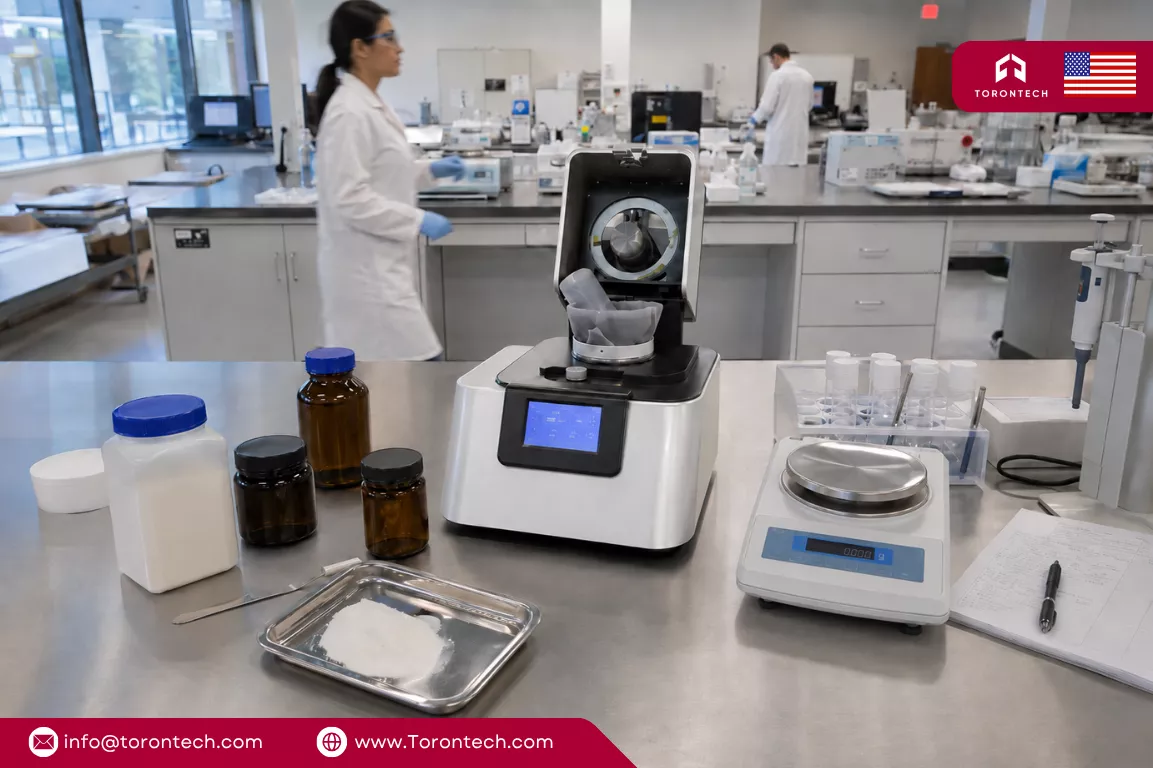
The MG200 pulls material through a hopper into the grinding space between mortar and pestle, where pressure and friction reduce particle size. A scraper continuously feeds the sample back into the grinding zone for uniform coverage.
Speed is adjustable from 50 to 130 rpm, and pestle pressure is set with a knob and scale. Operators can match the grind to each material's hardness and moisture content without swapping equipment.
The system accepts feed sizes up to 15mm and reaches a final fineness of 5 micrometers or finer, depending on sample properties. Batch volumes from 10 to 200mL cover most bench-scale QC and research runs.
Labs running mixed workloads benefit from three scraper materials: polyurethane, PTFE, and beech wood, each suited to different sample chemistry. Cryogenic grinding with liquid nitrogen is supported for heat-sensitive organics, a common need in food, botanical, and pharmaceutical testing.
An external helix-screw lock secures the mortar during operation, and a digital display tracks grind time down to the second. The MG200 ships configured for 220V, 50/60Hz operation, with 110V available on request, a detail that matters for US labs standardizing power across benches.
Sample Prep Expectations Across US Regulatory Frameworks
US laboratories operate under overlapping quality frameworks that shape how sample prep gets documented, even when the grinding step itself is not a certified procedure.
Pharmaceutical QC groups commonly reference USP General Chapter <429> for representative sample splitting ahead of particle size analysis, and USP <788> for particulate limits in injectable products. Cement testing labs align sample handling with ASTM's CCRL inspection framework.
Geotechnical labs pursuing AASHTO or A2LA accreditation document grinding and reduction steps as part of their broader quality system. These frameworks describe the market's expectations for traceable sample handling, not a certification carried by any specific grinder.
Torontech configures the Mortar Grinder MG200 so labs can build a documented, repeatable grinding step into their own validated procedures, regardless of which accreditation body they answer to.
Choosing the Right Configuration for Your Application
Selecting the right setup depends on sample hardness, batch size, and the fineness your downstream analysis requires. Use the table below as a starting point for common US lab applications.
| Sample Type | Typical Industry | Recommended Scraper |
|---|---|---|
| Tablets, herbs, excipients | Pharmaceutical QC | PTFE or Polyurethane |
| Cement clinker, slag, ore | Construction, mining | Beech wood or Polyurethane |
| Soils, sediments | Geotechnical testing | Polyurethane |
| Cryogenic and heat-sensitive samples | Food, botanical, biotech | PTFE |
Cleanup between samples takes minutes, since the mortar, pestle, and scraper detach for quick rinsing. That turnaround matters most for labs running back-to-back batches under tight project deadlines.
Equip Your Lab with a Mortar Grinder in USA Labs Trust
US labs scaling up for pharmaceutical reshoring, infrastructure testing, or materials research need sample prep equipment that keeps pace with tighter deadlines and stricter documentation. Manual grinding does not scale with that pressure.
Torontech North America LLC supports US customers directly from Miami with application guidance on scraper selection, batch sizing, and fineness targets for your specific material. The team can also advise on integrating the MG200 into an existing validated QC workflow.
Ready to add repeatable grinding to your lab? Reach out to Torontech at +1 866 383 7919 or info@torontech.com to discuss your sample types and request a quote for the MG200.