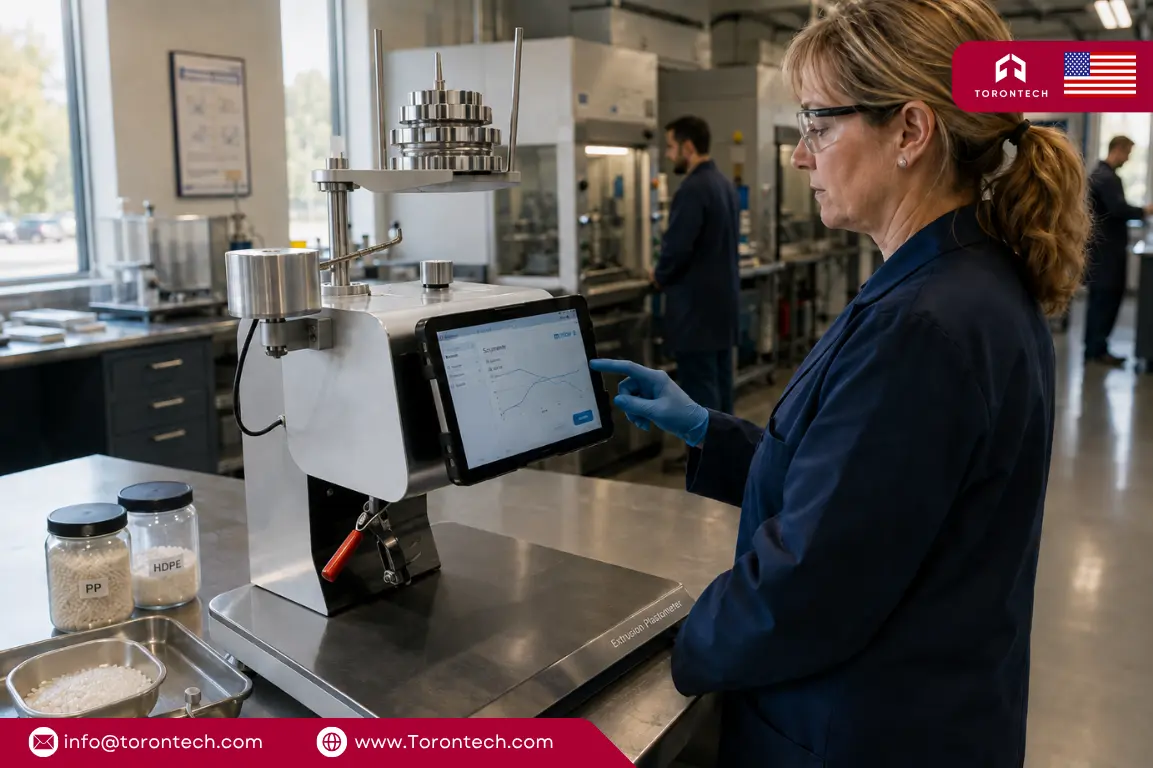
Melt Flow Indexers in USA: Catch Resin Variation Before Molding
One off-spec resin lot can cost an extrusion line an entire shift. Short shots, gels, sagging parison, and uneven wall thickness usually trace back to melt viscosity, not to the tooling or the operator.
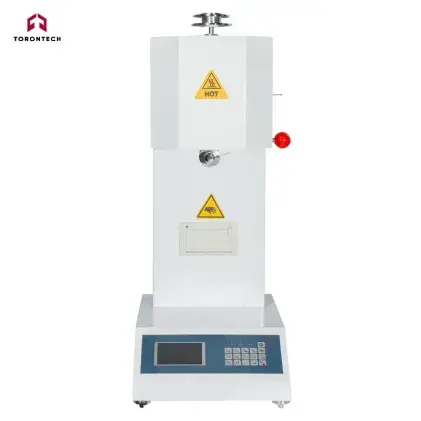
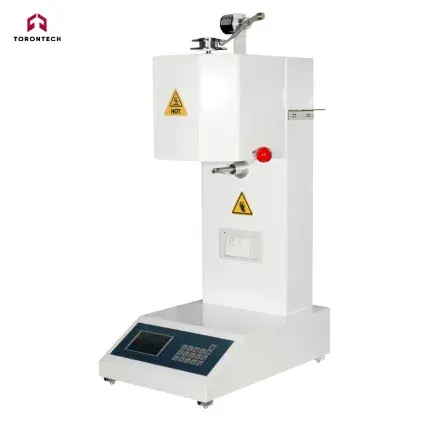
Melt Flow Indexers in USA plants flag that variation in about ten minutes, before the material reaches the hopper. Torontech supplies the ToronMFI melt flow indexer series, built to ASTM D1238 and ISO 1133.
Where American Processors Depend on Melt Flow Data
The domestic plastics sector is large, dispersed, and equipment-hungry. In 2024, U.S. plastics manufacturing operated more than 11,600 facilities and invested $17.5 billion in new facilities and equipment. Nearly every one of those plants runs incoming-material checks.
Texas employed the most plastics workers in 2024, followed by Ohio, Michigan, California, and Pennsylvania. That map explains where melt flow testing concentrates:
- Gulf Coast resin producers verify polyethylene and polypropylene grades before shipment. Texas alone accounts for over $23 billion in plastics export value.
- Midwest automotive molders in Ohio and Michigan confirm that reinforced thermoplastics will fill thin-wall tooling consistently.
- Packaging converters screen film, sheet, and blow-molding resin for lot-to-lot drift.
- Medical and electronics molders characterize engineering polymers for precision-molded housings and connectors.
- Compounders and recyclers compare filled against unfilled formulations after additive changes.
Recycled Content Rules Are Reshaping US Quality Labs
Regulation now pushes post-consumer resin into products that once ran on virgin material only. California's permanent SB 54 regulations took effect on May 1, 2026, with CalRecycle estimating more than 5,700 producers in scope.
Beverage packaging faces a harder number. Under AB 793, plastic beverage containers must contain 25 percent postconsumer recycled content as of January 1, 2025, rising to 50 percent by 2030. Colorado, Oregon, Minnesota, Washington, and Maine run their own packaging programs.
Recycled streams behave differently from virgin pellets. Contamination, mixed grades, and repeated heat history all shift viscosity, so processors screen every incoming lot rather than trusting a supplier certificate.
Brand owners increasingly push that requirement down the supply chain. Converters bidding on packaging contracts now submit melt flow data alongside color and thickness records, which turns a bench instrument into a commercial credential.
Melt volume-flow rate matters here. MVR compares materials with different filler content and evaluates filled against unfilled thermoplastics, which is exactly the problem a compounder faces when swapping in reclaimed feedstock.
ASTM D1238 and ISO 1133 in Practice
Both standards describe the same physical test. The instrument heats a barrel to a set temperature, a dead weight drives a piston, and molten polymer extrudes through a calibrated die.
ASTM D1238, maintained by ASTM International, defines the American reference method. Procedure A determines flow by weighing the extrudate; Procedure B derives it from piston displacement. ISO 1133 covers the same measurement for laboratories reporting to international customers.
Each resin family carries its own condition. Polyethylene typically runs at 190 degrees C with a 2.16 kg load, while polypropylene runs at 230 degrees C. Reporting a result without stating temperature and load makes the number meaningless to a customer.
Temperature discipline decides whether the numbers hold up. ToronMFI instruments control to within plus or minus 0.5 degrees C, with a scraper that cuts extrudate at preset intervals adjustable to 0.1 second.
Laboratories holding ISO/IEC 17025 accreditation through A2LA or ANAB also need documented calibration records and traceable measurement practice. Consistent temperature recovery between cuts supports that documentation.
Specifying Melt Flow Indexers in USA Laboratories
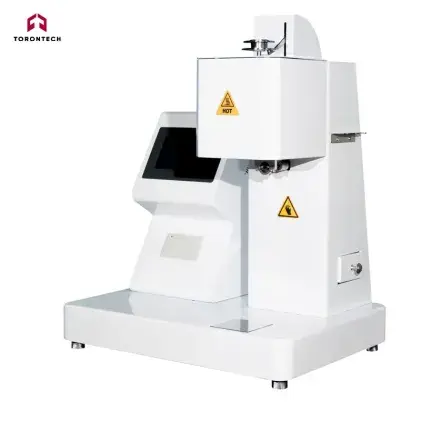
Four ToronMFI models cover the range from single-grade quality control to filled-compound development:
| Model | Measures | Typical Fit |
|---|---|---|
| ToronMFI-A | MFR | Entry-level QC on granules and film strips |
| ToronMFI-B | MFR and MVR | Labs needing viscosity insight at moderate volume |
| ToronMFI-D | MFR and MVR, touchscreen and PC control | High-throughput labs and filled compounds |
| ToronMFI-V | MFR, compact footprint | Space-limited benches near production |
Before you order, settle these points with your process engineers:
- Temperature range. All models operate from 50 to 450 degrees C, which covers commodity polyolefins through most engineering resins.
- MFR only, or MFR and MVR. The ToronMFI-A extrusion plastometer handles routine mass-flow work; filler comparison calls for volume measurement.
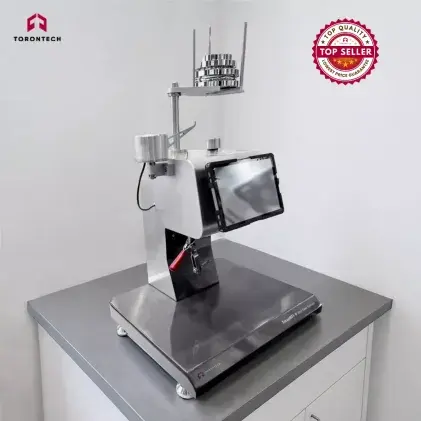
- Data handling. The ToronMFI-D melt flow indexer runs from a 7 inch color touchscreen or a PC, with RS485 and USB export and password protection on critical settings.
- Power supply. Units ship at 220V by default, and a 110V configuration is available for standard North American bench circuits.
Get a Configuration Quote for Your Plant
Whether you screen virgin polyolefin at a Gulf Coast terminal or qualify recycled feedstock for a packaging contract, your lab needs melt flow numbers that hold up under customer audit and internal process review.
Torontech supports North American customers through Torontech North America LLC in Miami, alongside the Toronto head office. Our team can match pendant weights, die sets, and software options to the resins you actually run, and confirm voltage and accessory requirements before shipment.
Tell us your material mix, test volume, and reporting standard, and reach out to the Torontech team for a configured quote on a melt flow indexer sized to your operation.