
LIBS Analyzers for Alloy Sorting and Lithium Recovery in the USA
A carbon steel fitting welded into a stainless line can thin under sulfidation and fail under pressure. A load of mixed aluminum grades loses its premium at the scale. For American fabricators and recyclers, a misread alloy hits both safety and margin.
A LIBS analyzer in the USA closes the blind spot that X-ray fluorescence leaves open. It reads carbon, lithium, and other light elements in about one second. Torontech supplies handheld LIBS analyzers built for scrap yards, refineries, and battery plants.
The Carbon and Light-Element Edge
Laser-Induced Breakdown Spectroscopy (LIBS) fires a focused laser pulse at the sample surface. The pulse forms a brief plasma, and the light it emits carries a wavelength fingerprint for every element present. A spectrometer reads that light and reports composition in seconds.
The method's real value is what it sees that X-ray fluorescence cannot. LIBS measures carbon, lithium, beryllium, and boron directly. That capability lets operators separate 304 from 304L and 316 from 316L, then confirm carbon equivalent before a weldability decision.
That distinction is routine in US fabrication QA, where low-carbon L grades and standard grades look identical to an X-ray analyzer.
LIBS also uses a laser rather than a radioactive or X-ray source. As a result, units avoid the state radiation registration and operator licensing that many X-ray instruments require, which simplifies rollout across multiple US sites.
Each measurement removes only a microscopic amount of material, so crews can check in-service valves and structural parts without leaving visible damage.
Where a LIBS Analyzer in the USA Proves Its Value
Demand spans several core American industries, and each one brings its own verification framework. The common thread is fast, defensible composition data taken where the material sits.
- Oil, gas, and petrochemical: Positive Material Identification (PMI) programs built on API RP 578 verify alloy piping and welds. LIBS supports these workflows and adds the carbon reading that separates alloy steels from plain carbon steel.
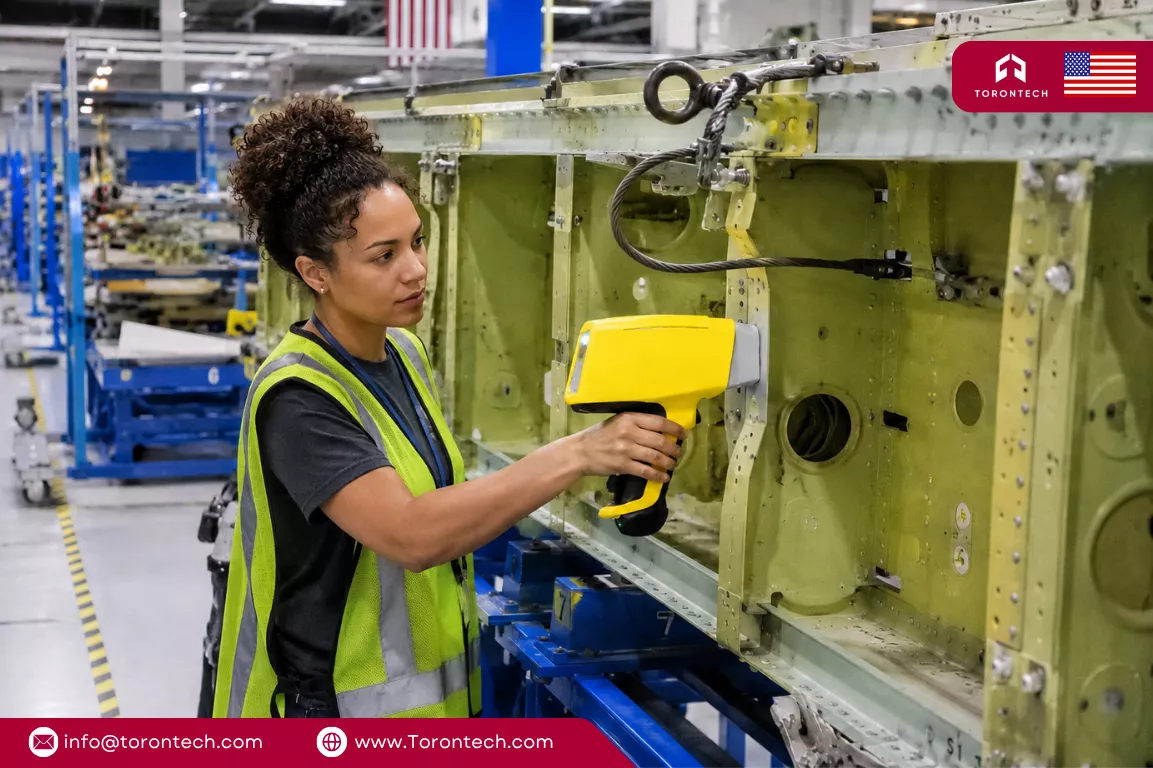
- Aerospace and metalworking: Manufacturers confirm aluminum, titanium, and magnesium grades where light elements drive performance. The Handheld LIBS Alloy Analyzer reads Mg, Al, Si, and Ti among many others.
- Scrap and nonferrous recycling: A multi-billion-dollar US sector sorts copper, aluminum, and stainless against ReMA specifications. Strong electrification demand keeps copper and aluminum prices high, so accurate grade calls at intake protect recovered value.
PMI acceptance still rests on standards such as ASTM E1476 and ASTM E1916, and OSHA treats material verification as recognized good engineering practice.
Refiners repeat these checks at new construction and during turnarounds to guard against sulfidation failures. A handheld analyzer brings that check to the pipe, the bar, and the conveyor belt.
Lithium, Batteries, and Critical Minerals
The drive to build a domestic battery supply chain has reshaped what US buyers test. The Inflation Reduction Act ties incentives to domestic sourcing, and lithium sits on the Department of Energy critical minerals list. That demand now reaches from the mine to the recycling line.
LIBS detects lithium directly, which X-ray methods cannot do. Explorers screen ore grade in the field at sites such as Nevada's Thacker Pass, while a growing base of US recyclers recovers lithium from spent cells and production scrap.
For these recyclers, a direct lithium reading speeds grade checks on incoming feed and black mass, where X-ray sorting falls short.
The Handheld LIBS Lithium Analyzer targets this work. An argon atmosphere and a 450 to 750 nm spectral range tune it for raw ores, pressed tablets, and cathode materials.
Choosing Between Torontech's Two Configurations
Both handheld units share a Class 3B laser with a sensor safety interlock and an IP54 rating for dusty, wet field conditions. The right choice depends on the material in front of you.
| Factor | Alloy Analyzer | Lithium Analyzer |
|---|---|---|
| Primary use | Alloy ID, PMI, scrap sorting | Lithium ore and battery materials |
| Key elements | Mg, Al, Cr, Cu, Fe, Li, Ni, Si, Ti | Lithium grade screening |
| Sample types | Plates, wires, foils, fragments | Raw ores, pressed tablets |
| Atmosphere | Ambient air | Argon (portable bottle) |
Each model skips sample preparation, stores results on board, and runs about eight hours on swappable smart batteries. The software manages grade libraries, calibration files, and test reports, so every reading leaves a traceable record.
Buyers who handle both metals and battery feedstock often deploy one of each to cover the full workflow.
Talk to Torontech North America
US operations cannot afford a wrong alloy call, whether the risk is a failed weld in a refinery or a downgraded load at the scale. The right handheld analyzer turns that risk into a one-second decision at the point of work.
Torontech North America supports US buyers from its Miami office, and our team will match the alloy or lithium configuration to your materials, throughput, and reporting needs. You can reach us directly at +1 866 383 7919 or info@torontech.com.
To scope a unit for your application, contact the Torontech team and we will help you specify the right LIBS analyzer in the USA for your operation.