Karl Fischer Moisture Titrators for Brazil's Fuel and Pharma Labs
A tank of anhydrous ethanol that drifts above its water limit gets rejected at the distribution gate. A pharmaceutical batch with high residual moisture fails release testing. For Brazilian producers, water content is a pass-or-fail number.
A Karl Fischer moisture titrator in Brazil gives quality teams the precise water data they need to meet ANP fuel specifications and Farmacopeia Brasileira methods. Torontech supplies both coulometric and volumetric titrators configured for these demanding applications.
Where Brazilian Industry Depends on Moisture Testing
Water is the most common contaminant Brazilian laboratories track. It degrades fuel, destabilizes drugs, and damages electrical equipment. Several sectors drive steady demand for accurate moisture determination.
Biofuels and Petroleum
Brazil ranks among the world's largest biofuel producers. The ANP sets strict water limits, capping anhydrous ethanol near 0.5% and tightening biodiesel specifications as mandatory blends climb toward B15.
Producers verify moisture in ethanol, biodiesel, and feedstock oils before shipment. Petrobras fabrication chains and refineries also test fuels, lubricants, and crude streams, where free water signals process upsets or storage problems.
Sugarcane ethanol remains the flagship product, and fast-growing corn ethanol plants in the Center-West add new testing volume. Each grade carries its own water limit, so reliable moisture determination protects both product quality and blend compliance.
Pharmaceuticals
Brazil operates one of Latin America's largest pharmaceutical industries. ANVISA enforces quality control aligned with the Farmacopeia Brasileira, which prescribes Karl Fischer titration for water in active ingredients, excipients, and finished products.
Residual moisture controls drug stability and shelf life. Coulometric titration suits the trace levels found in lyophilized biologics and hygroscopic powders, where even small water gains accelerate degradation.
Generic and biosimilar manufacturers concentrated around São Paulo and Minas Gerais run high sample volumes, which makes automated titration a practical fit for daily release testing.
Power and Chemicals
Transformer oil must stay dry to insulate high-voltage equipment across Brazil's expanding grid. Coulometric titration to ASTM D1533 measures trace water in insulating liquids before energization and during service.
Chemical and agrochemical manufacturers test solvents, pesticides, and reaction intermediates, where moisture affects reactivity and product quality. Brazil's large crop-protection sector makes this a routine quality-control analysis.
Free water also drives corrosion and microbial growth in stored fuels and oils, so catching it early protects entire tank farms and downstream production lines.
Choosing the Right Karl Fischer Moisture Titrator in Brazil
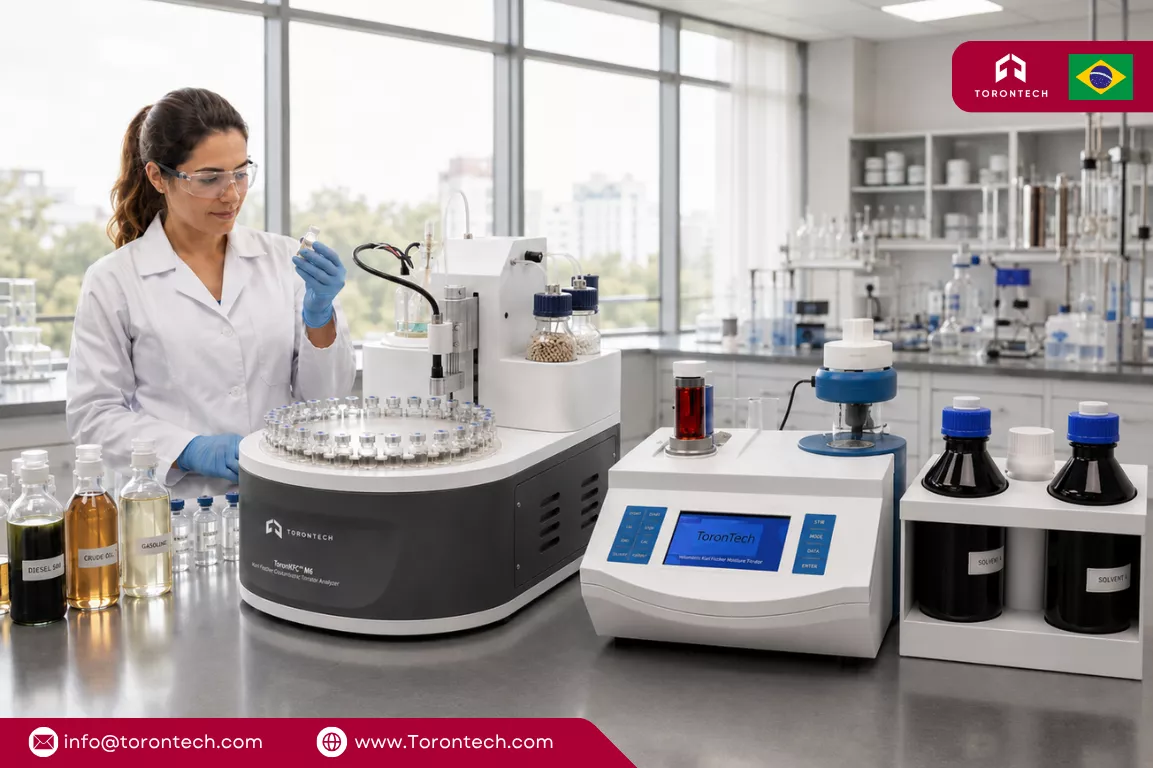
The method depends on how much water your samples contain. Coulometric titration excels at trace levels, while volumetric titration handles higher concentrations. Many Brazilian laboratories operate both to cover their full sample range.
| Factor | Coulometric (ToronKFC™ MA) | Volumetric (TT-203) |
|---|---|---|
| Water range | 1 µg to 100 mg | 100 ppm to 100% |
| Best suited for | Trace moisture | Higher water content |
| Typical samples | Solvents, oils, APIs, gases | Fuels, foods, chemicals |
| Verified standards | ASTM D1533, ISO 760, USP <921> | ASTM E203 |
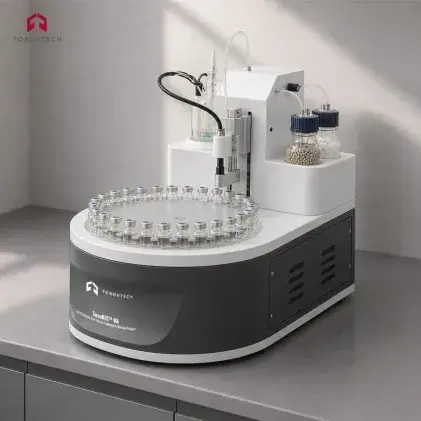
The coulometric Karl Fischer analyzer automates a 28-position tray with independent per-position heating, suited to high-throughput trace work. It detects water from 1 µg to 100 mg and connects directly to LIMS for batch reporting.
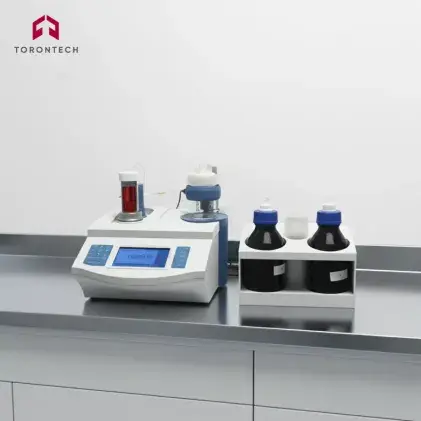
For samples with higher moisture, the volumetric Karl Fischer titrator measures water from 100 ppm to 100%. It auto-dispenses titrant, detects the endpoint, and stores GLP-compliant data sets for routine batch control.
High-volume Brazilian labs value unattended operation. The coulometric system runs batches across its sample tray with automated reagent balance and carrier-gas control, while real-time stirring monitoring keeps the titration cell stable through long sequences.
Standards and Laboratory Accreditation
Specifying a Karl Fischer moisture titrator in Brazil means matching verified methods to local requirements. Torontech titrators meet recognized international standards for water determination:
- ASTM E203: water using volumetric Karl Fischer titration
- ASTM D1533: water in insulating liquids by coulometric titration
- ISO 760: determination of water, the Karl Fischer method
- USP <921> and EP 2.5.12: pharmacopeial water determination
- IEC 61010-1: electrical safety for laboratory measurement equipment
These methods give Brazilian labs a defensible basis for their results. Many facilities pursue ISO/IEC 17025 accreditation through Cgcre, the accreditation arm of INMETRO. That framework rewards instruments with documented calibration and reproducible measurement.
Laboratories serving regulated buyers map their testing to both global methods and local frameworks such as ABNT NBR norms and ANP resolutions. Equipment that produces traceable, repeatable water values supports every step of that audit trail.
Equip Your Brazilian Laboratory With Reliable Moisture Analysis
From biodiesel plants in the Center-West to pharmaceutical labs in São Paulo, Brazilian operations need moisture data they can defend during audits and product release. The right titrator turns water content into a controlled, documented number.
Torontech serves Latin America with Karl Fischer titrators configured for the correct water range, sample type, and throughput. Our team helps match coulometric or volumetric methods to your specific samples, whether that means trace moisture in transformer oil or percent-level water in fuel.
To specify the right instrument for your samples and standards, reach out to the Torontech team for a consultation on configuration, reagents, and method setup.