On-Site Material Verification With an XRF Machine in Libya
A shipment of imported tubing lands at a Sirte Basin site carrying a mill certificate that nobody on the ground can independently check. Months later, the wrong chrome-moly grade fails in a pressure line. Libyan operators absorb that risk on nearly every delivery.
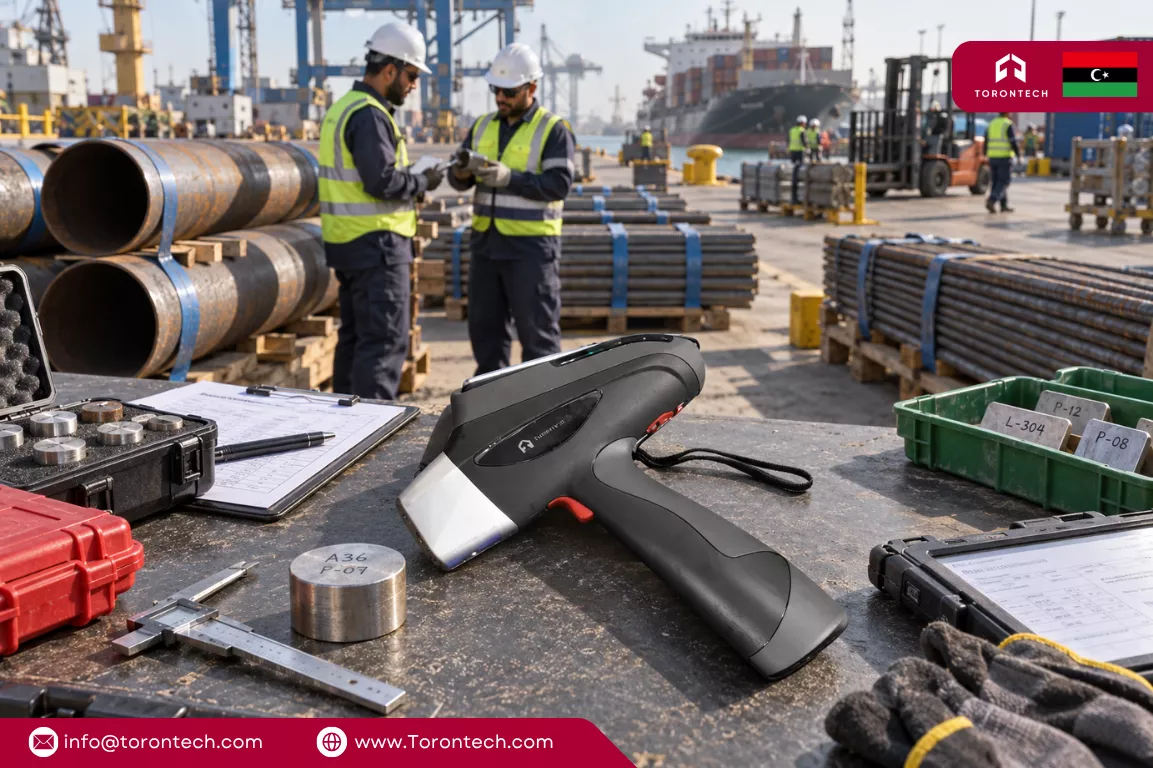
An XRF machine in Libya closes the gap at the receiving bay. Handheld energy dispersive X-ray fluorescence confirms elemental composition in seconds, with no cutting and no overseas laboratory queue. Torontech supplies handheld portable XRF analyzers built for that job.
Libya Imports the Material It Cannot Easily Test
The Libyan Iron and Steel Company in Misrata anchors domestic steelmaking with a nominal capacity near 1.7 million tonnes per year. It does not roll OCTG, so oilfield tubing arrives from Turkey, China, and the European Union.
Each of those shipments travels with a supplier document rather than an independent result. Meanwhile, accredited domestic testing capacity remains limited, and the Libyan National Centre for Standardization and Metrology administers national standards and accreditation from Tripoli.
Handheld analysis moves verification forward to the gate. Inspectors confirm grade before material enters a weld procedure, a pressure system, or a structural assembly, instead of discovering a mismatch after commissioning.
Construction demand adds to the pressure. Analysts expect Libyan steel consumption to climb toward 1.4 to 1.5 million tonnes by the end of 2026, the highest level in roughly 15 years. Scrap yards and rebar buyers face the same sorting problem.
Elemental Data for the Oil and Gas Rebuild
Libya reached roughly 1.49 million barrels per day in mid-2026, its strongest output since 2013. The National Oil Corporation targets 2 million bpd and estimates a capital requirement between $30 billion and $40 billion.
That spending lands on wells, gathering lines, storage, and terminals that absorbed years of deferred maintenance. Downstream, the NOC recovered full control of the 220,000 bpd Ras Lanuf refinery in May 2026 and set aside roughly $60 million to restart it.
Positive material identification protects every one of those rehabilitations. Field teams use it at several points:
- Incoming inspection of imported tubing, flanges, fittings, and valves before installation
- Chrome and molybdenum steel checks on furnaces, vessels, and heat exchangers during refinery overhauls
- Base metal and consumable verification along in-field pipelines and export lines
- Asset integrity surveys on aging equipment across Waha, Akakus, and Mellitah operations
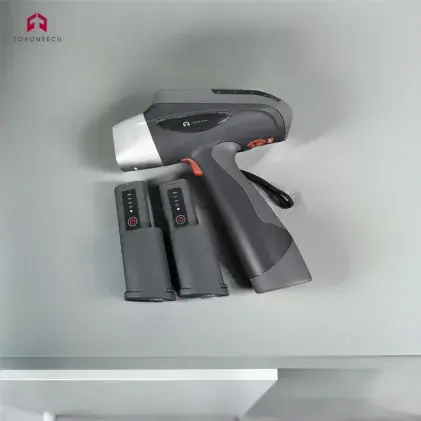
The handheld XRF alloy analyzer resolves stainless steel, tool steel, nickel and cobalt alloys, titanium, and copper alloys in as little as two seconds. Operators run it on the pipe rack rather than in a lab.
Exploration Work Far From the Nearest Laboratory
The National Mining Corporation is pushing diversification beyond hydrocarbons. Wadi ash-Shati holds one of the world's larger iron ore deposits, while the Murzuq Basin carries substantial phosphate reserves.
Distance drives the operational problem. Wadi ash-Shati sits roughly 900 kilometers from the port at Misrata, so shipping samples for assay costs weeks that a drilling program cannot spare.
Field analysis changes that arithmetic. The handheld XRF mineral analyzer reports elemental content at the outcrop and tags each reading with altitude, latitude, and longitude for direct import into mapping software.
Exploration teams also screen soil around active and legacy sites for heavy metals. Because results arrive immediately, geologists prioritize which cores actually justify laboratory assay.
Matching the Right XRF Machine in Libya to Your Work
Three ToronXRF models share the same silicon drift detector and digital processing platform. Calibration and software decide which configuration fits your samples.
| Model | Primary Use in Libya | Distinguishing Capability |
|---|---|---|
| ToronXRF 3000R | Restricted substance screening for imported electronics, packaging, and consumer goods | Detects lead, cadmium, and mercury across up to 40 simultaneous elements |
| ToronXRF 3000A | Alloy identification for refineries, pipelines, fabrication yards, and scrap sorting | Two-second grade matching that extends to aluminum and magnesium |
| ToronXRF 3000M | Ore, drill core, tailings, and soil analysis in the field | Built-in GPS tagging plus multiple calibration modes for mining matrices |
Shared specifications suit Libyan conditions. Every model works between -20°C and +50°C, weighs 1.7 kg, survives dust and water, and runs up to 12 hours on a standard charge.
Buyers who report against a specific test method should confirm calibration scope and supporting documentation with Torontech before ordering. Requirements differ by client, sector, and contract.
Specify Your Analyzer Through the Regional Office
Libya's industrial recovery rewards teams that answer material questions immediately. An XRF machine in Libya converts a multi-week laboratory question into a field result delivered in seconds, which keeps rehabilitation schedules intact.
Torontech ME FZE serves the Middle East and Africa from Dubai. That proximity shortens lead times and support response for Libyan projects. Our team also helps match calibration, accessories, and documentation to your application.
Tell us whether your priority is PMI on imported piping, ore grade control, or restricted substance screening. Call +971 488 19252 or email me@torontech.com for pricing and lead times.
You can also reach out to the Torontech team online. Our regional office sits at Meydan Grandstand, 6th floor, Meydan Road, Nad Al Sheba, Dubai-261440, UAE.