FTIR Spectrometers for Canada's Pharmaceutical and Polymer Testing Labs
A mislabeled raw material or an unverified resin batch can stall a production line for days. Quality teams in Canadian pharmaceutical plants and polymer recyclers cannot release a lot until its molecular identity is confirmed against a known reference.
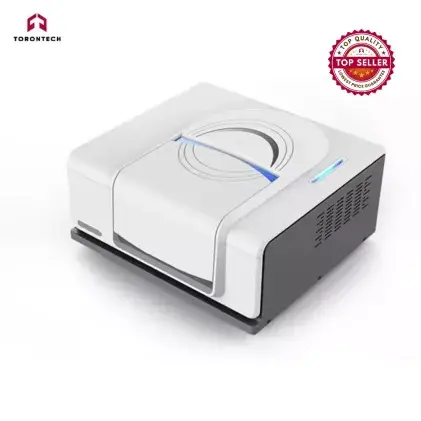
An FTIR spectrometer in Canada gives those labs a fast, non-destructive way to confirm identity before material moves downstream. Torontech supplies FTIR spectrometers built for routine identity testing, quality control, and formulation work across Canadian industry.
Material Identification Across Canadian Industry
FTIR spectroscopy works by measuring how a sample absorbs infrared light. Every chemical bond has a characteristic vibration, so the resulting spectrum functions as a molecular fingerprint that a technician can match against a reference library.
That capability supports a wide range of Canadian laboratory work:
- Raw material and excipient verification against pharmacopeial references
- Polymer and resin identification for recycling and manufacturing quality control
- Contamination and degradation investigation in incoming inspection
- Failure analysis and unknown identification in research and forensic labs
The National Research Council Canada operates its own FTIR facilities for exactly these applications, reflecting how embedded the technique already is in the country's analytical infrastructure. Universities and provincial crime labs rely on the same underlying method for unknown substance identification, which keeps demand for well-supported instruments steady across academic, government, and private-sector buyers.
Because the technique measures every infrared wavelength at once through a Michelson interferometer, a single scan takes seconds rather than the minutes older dispersive instruments required. That throughput matters in labs running high sample volumes during shift work, where a slow identity check becomes the bottleneck for the entire release process.
Pharmaceutical Quality Control Under Health Canada's GMP Framework
Canada's pharmaceutical sector, valued at roughly 43 billion US dollars in 2026, operates under Health Canada's Good Manufacturing Practices guidance and the Food and Drug Regulations. Every incoming raw material, excipient, and finished product needs a documented identity check before it clears quality release.
Labs typically run that identity check against methods such as USP <197> infrared identification tests, comparing sample spectra to certified reference standards. An FTIR spectrometer in Canada with a searchable pharmaceutical library speeds that comparison and keeps a defensible record for inspection.
Torontech's spectrometer includes an optional software workstation with FDA 21 CFR Part 11 support, useful for labs that need electronic records and audit trails alongside their Health Canada documentation. The instrument's built-in library covers pharmaceutical ingredients and excipients directly, so a QC technician can run a match without building a reference set from scratch.
Generic manufacturers, who account for close to three-quarters of prescriptions dispensed in Canada, face particularly tight qualification timelines when switching raw material suppliers. A dependable FTIR spectrometer in Canada shortens that qualification step and reduces the risk of a delayed batch release while a new supplier's materials are cleared for use.
Verifying Polymers for Canada's Plastics Recycling Sector
Alberta's petrochemical base and the federal push toward zero plastic waste by 2030 have pushed chemical and mechanical recycling capacity higher across Canada. Facilities under the Federal Plastics Registry must now track and report the resins they place on the market, which raises the bar for accurate material sorting.
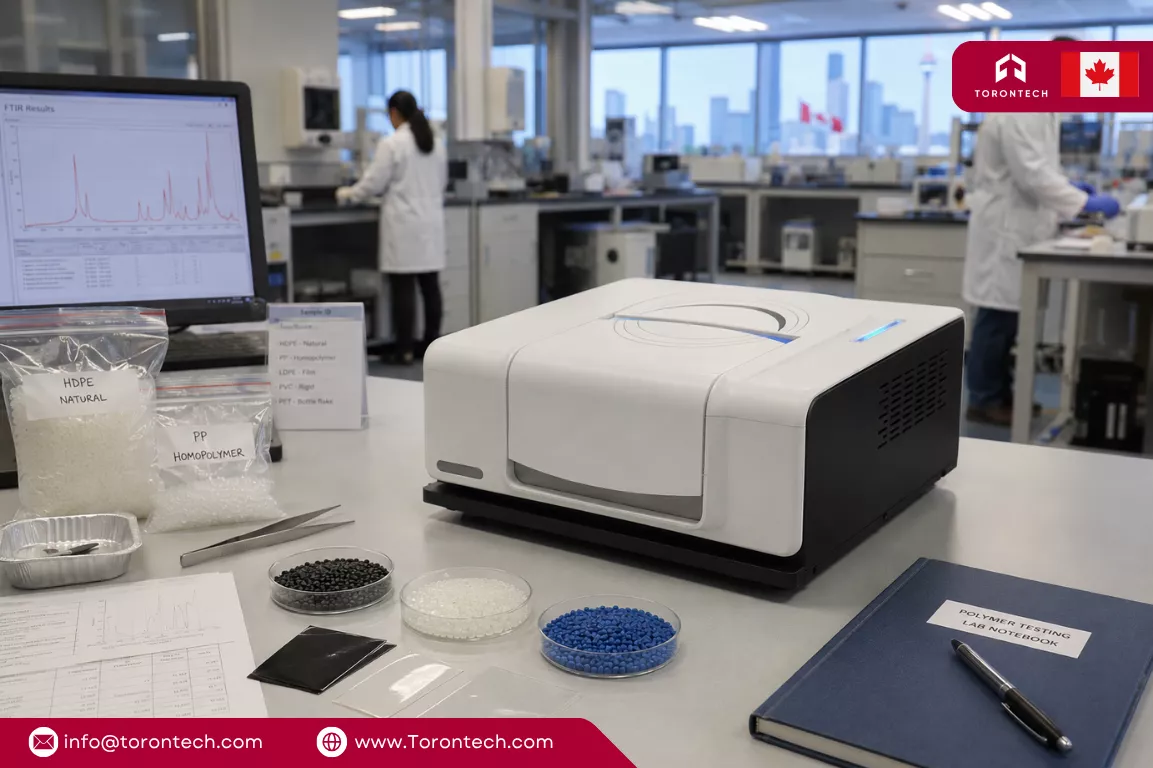
Mixed bales of polyethylene, polypropylene, and polystyrene look identical to the eye but scan differently under infrared light. An FTIR spectrometer in Canada lets recyclers confirm resin type before reprocessing, catching contamination that would otherwise degrade a finished pellet batch.
Buyers evaluating an FTIR spectrometer for this application should confirm the instrument covers the full mid-infrared range needed to separate common packaging resins from additives and coatings.
Ontario, Quebec, and British Columbia host most of Canada's secondary plastics processing, largely because those provinces sit closest to the packaging waste that feeds recycling streams. Labs in those hubs use infrared identification to support both mechanical recycling sorting and the newer chemical recycling lines that convert hard-to-recycle plastics back into usable feedstock.
Choosing the Right FTIR Configuration
Detector choice affects both sensitivity and budget. The table below outlines the options available on Torontech's platform and where each fits.
| Detector Type | Typical Use | Relative Sensitivity |
|---|---|---|
| Standard pyroelectric | Routine identity and QC testing | Standard |
| Temperature-stabilized pyroelectric | Extended runs, drift-sensitive labs | Improved stability |
| Semiconductor-cooled MCT | Trace contamination, research work | Highest |
Sample chamber size matters as much as detector class. A chamber that accepts liquid cells, ATR accessories, and microscope attachments lets one instrument serve pharmaceutical, polymer, and general QC work without swapping platforms. Wired and wireless connectivity also matters for labs running multiple instruments on a shared network.
Signal-to-noise ratio and wavenumber accuracy determine how confidently a lab can distinguish closely related materials, such as two polymer grades with similar formulations. A resolution near 1 wavenumber is generally sufficient for identity testing, while research applications tracking subtle spectral shifts benefit from tighter resolution and the cooled MCT option.
Equip Your Lab for Canadian Testing Demands
Whether the application is pharmaceutical raw material release or polymer sorting for a recycling line, the underlying requirement is the same: a fast, repeatable identity check that a lab can defend during an audit or a customer complaint investigation.
Torontech's Canadian headquarters in Toronto supports labs across the country with configuration guidance, from detector selection to accessory fit for ATR or liquid cell sampling. Our team can match a spectrometer to your throughput and reference library needs, whether the lab runs occasional identity checks or continuous production-line sampling.
To discuss an FTIR spectrometer in Canada configured for your lab, contact the Torontech team with your sample types and testing volume.