Colorimeters Built for Mexico's Color-Critical Industries
A shipment of automotive trim gets rejected at the border because the gray does not match the OEM master. A plastics batch ships in the wrong shade and the order comes back. In Mexico's export economy, off-spec color costs money and contracts.
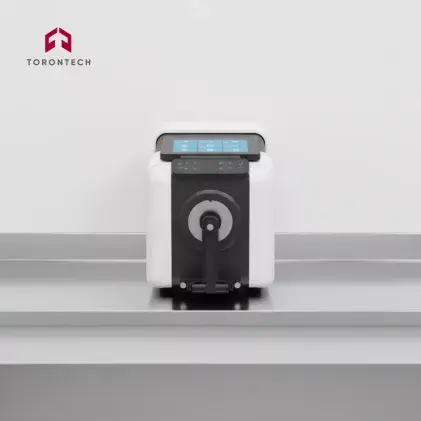
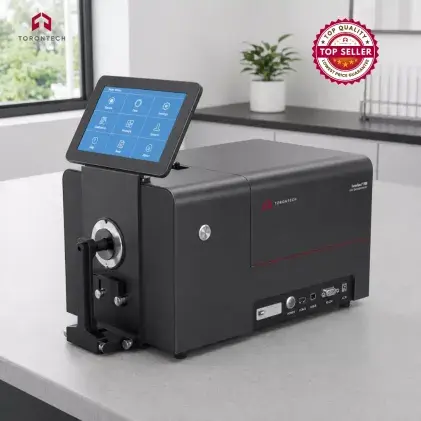
A colorimeter in Mexico gives manufacturers the numerical color data to catch these problems before products leave the plant. Torontech supplies benchtop color spectrophotometers and portable instruments configured for CIELAB control and tight ΔE tolerances.
Color Control Across Mexico's Export Industries
Mexican manufacturers ship to demanding buyers, and color is often the first thing those buyers inspect. Several sectors now depend on instrument-based color measurement to protect their contracts. Nearshoring keeps pulling more color-sensitive production into the country.
- Automotive coatings: Mexico ranks among the world's largest vehicle producers, and roughly 89% of output is exported. Suppliers must match OEM color masters within tight ΔE limits across paint, plastics, and trim.
- Plastics and polymers: ANIPAC reports plastic goods exports above 12 billion dollars. Compounders control pigment loading and batch shade for automotive, packaging, and appliance components.
- Food, beverage, and coffee: Mexico produces close to 3.9 million bags of coffee each year, led by Chiapas and Veracruz. Roasters and food processors grade color to meet retail and buyer specifications.
- Textiles and printing: Dye houses and packaging printers verify color fastness and brand color reproduction under several illuminants.
In January 2025, Volkswagen opened a fully electric paint shop in Puebla that runs on automated, data-driven quality control. That level of automation depends on objective color numbers, not visual judgment.
What a Colorimeter Measures
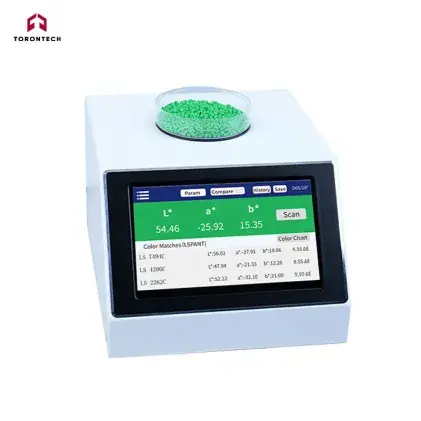
A colorimeter converts what the eye sees into numbers. It measures how a sample reflects or transmits light, then expresses the result as tristimulus values and CIELAB coordinates.
From those coordinates, the instrument calculates ΔE, the single value that tells a quality team whether two samples match. Standardized illuminants such as D65 and observer angles of 2° or 10° keep readings consistent between operators and sites.
Geometry matters too. A d/8 integrating sphere with selectable SCI and SCE modes separates true color from surface gloss effects. Reflection mode handles solids and powders, while transmission mode reads films and clear liquids.
Spectrophotometers extend this with full spectral curves for formulation work. For routine pass or fail control on a production line, a dedicated colorimeter runs faster and stays simpler to operate.
Standards and Accreditation for Color Testing in Mexico
Anyone specifying a colorimeter in Mexico works within a layered framework. The instrument must meet international color standards, and the laboratory must earn national accreditation.
Torontech ToronSpec colorimeters and spectrophotometers conform to internationally recognized methods, including:
- CIE No. 15 and ISO 7724/1 for colorimetric geometry and illuminants
- ASTM E1164 for spectrophotometric object-color data
- ASTM E313 and ASTM D1925 for whiteness and yellowness indices
- ASTM D1003 for haze and transmittance of transparent plastics
- DIN 5033 and JIS Z8722 for color measurement practice
On the regulatory side, the Entidad Mexicana de Acreditación (EMA) accredits Mexican calibration and testing laboratories under ISO/IEC 17025, adopted nationally as NMX-EC-17025. EMA specifically accredits spectrophotometer calibration, which underpins traceable color results.
For food and pharmaceutical color, COFEPRIS oversees product safety and labeling, while automotive plants run color control inside IATF 16949 quality systems. The portable ToronSpec series ships with a calibration report to support these programs.
Choosing the Right Colorimeter in Mexico
The right instrument depends on where you measure and what you measure. A laboratory needs different capabilities than a production floor or a coffee roastery.
| Model | Best suited for | Standout feature |
|---|---|---|
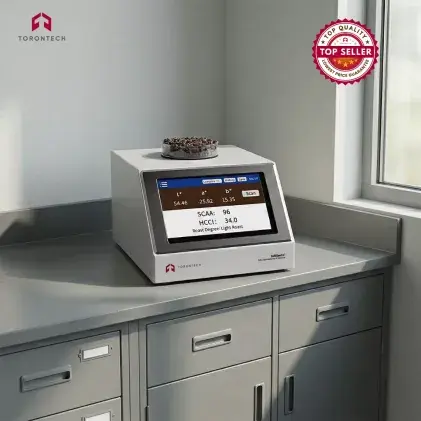
| ToronSpec benchtop (36D to 39D) | Lab QC and formulation | 152 mm sphere, SCI/SCE, reflection and transmission |
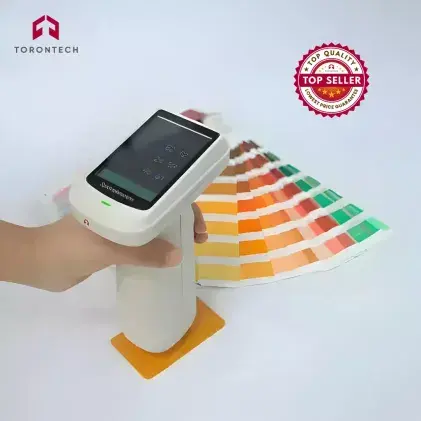
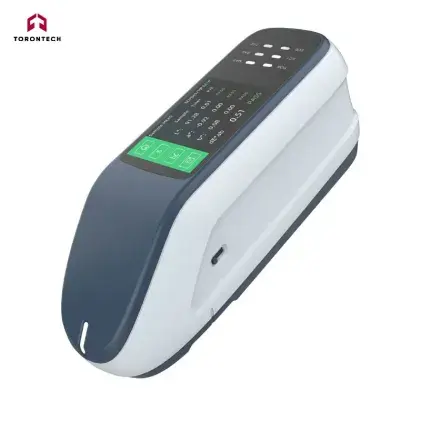
| Portable ToronSpec (23D to 26D) | On-site and line checks | Handheld use, 360 to 780 nm range |
| ToronSpec LA | Large or uneven samples | Large-aperture measurement |
| CafféSpectra | Roasted coffee | SCAA Agtron and HCCI roast values |
For most factory work, aperture size, geometry, and SCI/SCE options drive the decision. Larger apertures suit textured plastics and fabrics, while smaller ports target trim and printed detail. Transmission capability matters once clear plastics or liquids enter the mix.
Coffee is a special case here. With specialty and soluble exports both rising, roasters need repeatable roast color. The CafféSpectra coffee colorimeter reports SCAA Agtron and HCCI values, so a roast profile stays consistent from batch to batch.
Match the Instrument to Your Operation
From automotive coatings in the Bajío to coffee roasting in the south, Mexican producers compete on consistency. A colorimeter in Mexico that delivers traceable data protects both export contracts and domestic brand quality.
Torontech supports customers across Mexico and Latin America from its North America operation, with instruments backed by calibration documentation and application guidance. The team can match a configuration to your samples, throughput, and accreditation goals. Regional support shortens lead times for delivery, training, and service.
Tell us what you measure and where, and we will recommend the right setup. Reach out to the Torontech team to discuss your color measurement requirements and request a quote.