
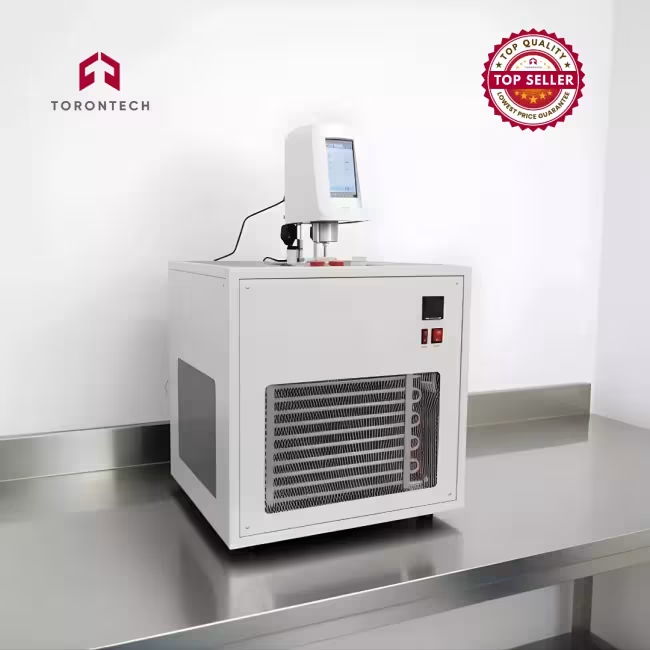
Low Temperature Brookfield Viscometer - TT-2983
The Low Temperature Brookfield Viscometer TT-2983 measures the low-shear-rate viscosity of automatic transmission fluids, hydraulic fluids, and other lubricants at controlled sub-zero temperatures. The instrument complies with ASTM D2983, the standard test method for low-temperature viscosity of these fluids using a rotational viscometer. It applies rotational viscometry with a matched torque range and spindle to cover the 500 to 900,000 mPa·s scope defined by the standard. Lubricant blenders, automotive testing labs, and additive developers use the TT-2983 to confirm cold-temperature performance against OEM specifications.
Low-temperature, low-shear-rate viscosity data is important to the proper operation of transmissions, hydraulic systems, and drivetrains that must start and run in cold climates. Fluids that thicken too much at low temperature can starve pumps and bearings of lubrication during cold starts, so measuring this property is a common qualification step before a fluid reaches the field. The TT-2983 addresses this need directly by combining a semiconductor-cooled sample chamber with a digital rotational viscometer in a single bench-top unit.
The TT-2983 also reports a broader instrument detection range of 1,000 to 1,000,000 mPa·s, reflecting the full torque and speed capability built into its rotational viscometer head. This wider hardware range gives the instrument margin above and below the ASTM D2983 test scope, so the same unit can also screen fluids that fall slightly outside the standard's core precision range.
Low Temperature Brookfield Viscometer - TT-2983 Applications
The TT-2983 supports low-temperature viscosity qualification wherever cold-start lubrication performance affects equipment reliability.
- Lubricant Manufacturing and Quality Control: blenders use the TT-2983 to certify that automatic transmission fluids, gear oils, and hydraulic fluids meet the low-temperature performance specifications required for release
- Automotive Research and Development: automotive engineers rely on ASTM D2983 data to confirm that transmissions, hydraulic systems, and drivetrains perform reliably in cold-climate operation
- Viscosity Modifier and Additive Development: additive chemists use the test to evaluate how viscosity index improvers and pour point depressants affect the low-temperature behavior of finished lubricants
- Gear Oil and Torque Fluid Testing: verifies that gear oils and torque and tractor fluids stay within a workable viscosity band at cold-start temperatures
- Industrial and Off-Highway Hydraulic Systems: confirms hydraulic oil viscosity stays within operating limits for equipment used in cold outdoor environments
- OEM Specification Compliance Testing: generates the low-shear-rate viscosity data referenced in a number of OEM and industry fluid specifications
- Third-Party and Contract Testing Laboratories: provides an ASTM D2983-compliant method for labs offering low-temperature lubricant testing services to outside clients
Standards
The TT-2983 Low Temperature Brookfield Viscometer conforms to the internationally recognized test method for low-temperature, low-shear-rate viscosity determination.
- ASTM D2983 - Standard Test Method for Low-Temperature Viscosity of Automatic Transmission Fluids, Hydraulic Fluids, and Lubricants using a Rotational Viscometer
Low Temperature Brookfield Viscometer - TT-2983 Key Features
The TT-2983 pairs a fast semiconductor cooling system with a precision rotational viscometer built around the requirements of ASTM D2983.
- Semiconductor Refrigeration Cooling: brings samples to test temperature in about two hours, compared with roughly 18 hours for a traditional air-bath setup, shortening turnaround on cold-temperature test series
- Transparent Cooling Bath with LED Illumination: the observation window and internal LED let operators check spindle position and sample condition throughout the cooling cycle without opening the chamber
- ASTM D2983-Matched Test Tube Stator: a standard glass tube with a 22 to 22.5 mm inner diameter and 120 mm length matches the geometry the standard requires for accurate torque correlation
- Four Standard-Compliant Spindles: spindle geometry and torque range are matched to the standard's requirements, supporting repeatable results across the tested viscosity range
- Seven-Speed Digital Rotational Viscometer: seven selectable gear speeds let operators target the shear rate appropriate to each sample's expected viscosity
- PID Microprocessor Temperature Control: a PT100 sensor feeds a PID controller for accurate, repeatable cooling to the target test temperature, down to -70°C at the chamber level
- Wide Viscosity Detection Range: covers 1,000 to 1,000,000 mPa·s of instrument capability, spanning light hydraulic fluids through heavily cold-soaked gear oils
Theory and Method
The TT-2983 measures viscosity by rotating a spindle inside a stationary sample at a fixed, low speed and reading the torque needed to overcome the fluid's resistance to shear. This resistive torque runs proportional to viscosity for a Newtonian fluid, so the instrument converts torque into a viscosity reading once spindle geometry and speed are known. Testing at low shear rates and cold temperatures reveals how a lubricant behaves at the moment right after a cold start, the condition ASTM D2983 is designed to reproduce.
Sample preparation follows a fixed sequence. The operator preheats the fluid and allows it to stabilize at room temperature, then pours a measured volume into a glass test cell to a specified depth. A spindle, insulated or uninsulated, is inserted through a stopper and suspended by a clip to position it precisely within the sample. The cell then cools to the designated test temperature over two hours, driven by semiconductor refrigeration rather than the far slower air bath used in older test setups.
Once the sample reaches the target temperature, the rotational viscometer engages the spindle and either reads viscosity directly or calculates it from the torque signal, depending on the viscometer head in use. A PID microprocessor controller paired with a PT100 sensor holds the chamber at the set temperature throughout the measurement, so the torque reading corresponds to a known, stable test condition rather than a fluid still in thermal transition.
Low Temperature Brookfield Viscometer - TT-2983 Technical Specifications
| Parameter | Specification |
|---|---|
| Applicable Standard | ASTM D2983 |
| ASTM D2983 Test Scope | 500 to 900,000 mPa·s |
| Instrument Viscosity Detection Range | 1,000 to 1,000,000 mPa·s |
| Refrigeration Method | Semiconductor refrigeration |
| Temperature Control Method | Digital PID temperature controller with PT100 sensor |
| Temperature Control Range | Ambient temperature to -70°C ± 0.1°C |
| Required Lowest Test Temperature | -40°C |
| Rotation Speed | 0.5 to 60 r/min (7 gear speeds) |
| Test Tube Stator (Inner Diameter) | 22 to 22.5 mm |
| Test Tube Stator (Length) | 120 mm |
| Power | 1200W |
| Rated Voltage | AC 220V, 50Hz (110V also available) |
Recommended Cleaning Reagents
| Item | Description |
|---|---|
| Petroleum Ether | Boiling range 60 to 90°C, analytically pure grade |
| Ethyl Alcohol | 95% concentration, analytically pure grade |