
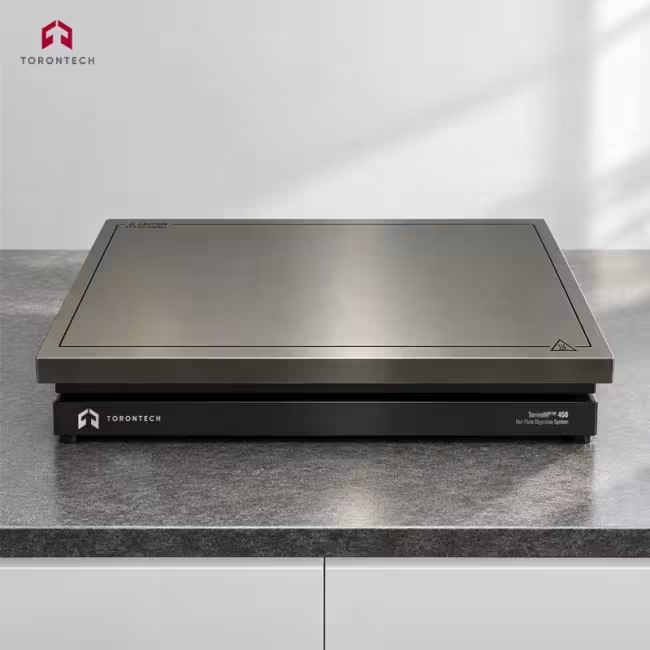
Hot Plate Digestion System - ToronHP™ 450
ToronHP™ 450 hot plate digestion system gives laboratories a 600 x 400 mm high-density graphite heating surface for open-vessel acid digestion, sample drying, and acid removal. Environmental, food, agricultural, and soil testing labs use it to prepare samples ahead of elemental analysis. Research institutes and universities apply it to routine heating work and method development. The graphite worktop carries a maximum design temperature of 450°C. Temperature accuracy holds within ±1°C.
High-density graphite spreads heat across the full plate area and shows minimal thermal shock as the setpoint changes. That combination suits aggressive digestion chemistry, where vessels sit on the surface for hours at elevated temperature. The 600 x 400 mm worktop holds a large batch of beakers, flasks, or digestion tubes at once. Labs running high sample volumes can process a full tray in a single heating cycle. Position-to-position consistency keeps evaporation rates similar across the plate.
A separate control module drives the heater and runs the system in single-point heating mode. Keeping the controller off the heated plate leaves the full worktop available for vessels and gives the operator flexible bench placement. Self-tuning PID regulation maintains the setpoint without manual parameter entry. The electrical control system switches heater power through solid-state relays, which run quietly and resist electrical interference. Segmented power supply and power-failure restart functions reduce operational risk during long runs.
Hot Plate Digestion System - ToronHP™ 450 Applications
The ToronHP™ 450 supports sample preparation wherever labs heat, digest, dry, or concentrate samples in open vessels ahead of analysis.
- Environmental Monitoring: digests soil, sediment, sludge, and wastewater samples in open vessels before heavy metal determination
- Soil and Agricultural Testing: prepares soil, plant tissue, and fertilizer samples for nutrient and trace element analysis
- Food Safety Laboratories: breaks down food and feed matrices so analysts can measure lead, cadmium, and other metal contaminants
- ICP-OES, ICP-MS, and AAS Sample Preparation: converts solid samples into clear acid solutions that spectrometers can aspirate and measure
- Acid Removal and Sample Concentration: evaporates excess acid after digestion to lower the acid load in the final solution before dilution
- Sample Drying and General Heating: dries residues, warms reagents, and concentrates extracts on a wide, evenly heated surface
- Geological and Mineral Analysis: supports multi-acid digestion of rocks, ores, and mineral powders at temperatures up to 450°C
- Research Institutes and Universities: provides a large shared heating platform for teaching labs, method development, and multi-project research groups
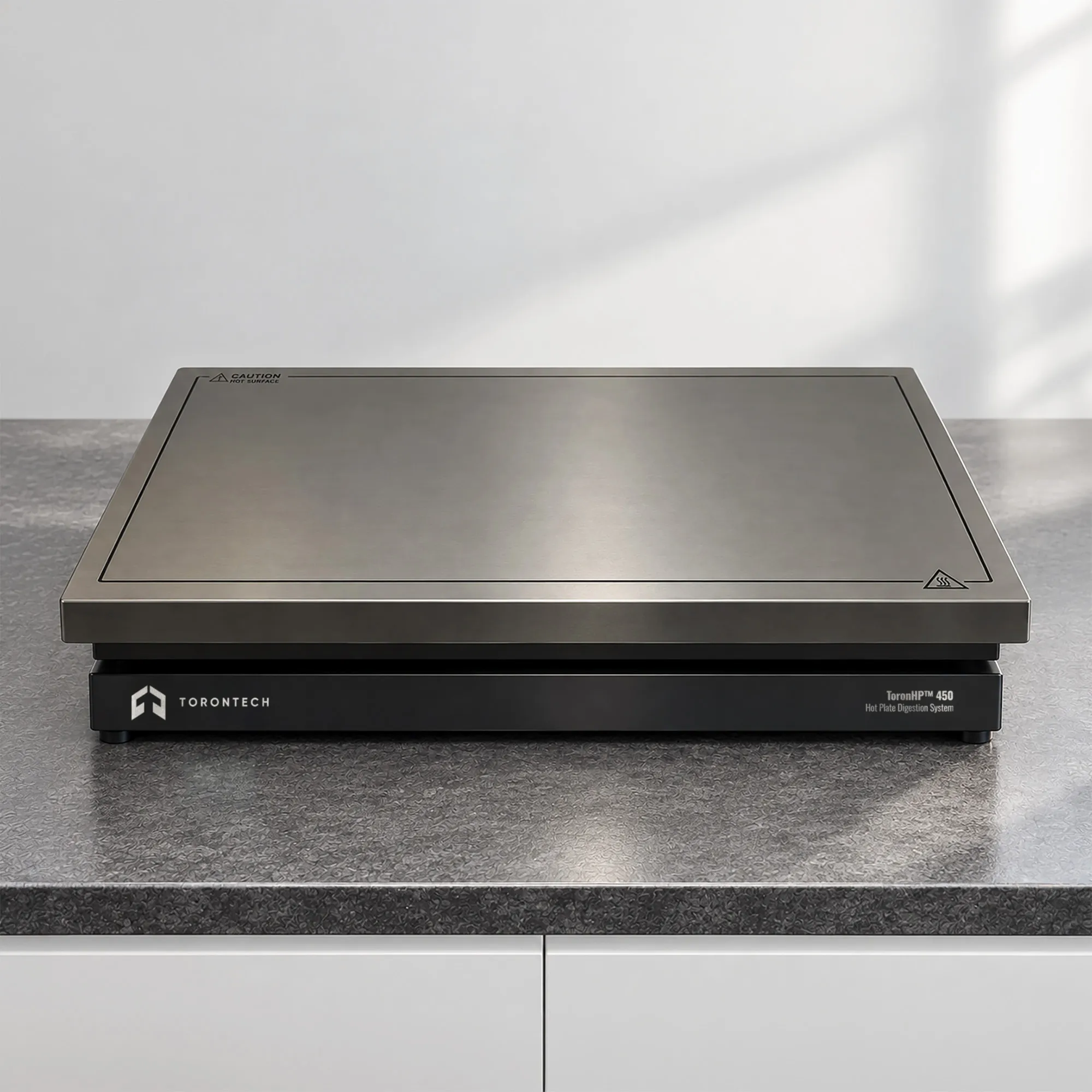
Hot Plate Digestion System - ToronHP™ 450 Key Features
The ToronHP™ 450 pairs a large graphite worktop with digital temperature control built for repeatable acid digestion and evaporation.
- High-Density Graphite Worktop: distributes heat uniformly across the surface and shows minimal thermal shock through heating and cooling cycles
- 450°C Maximum Design Temperature: covers wet acid digestion, acid removal, and drying work that lower-temperature plates cannot reach
- 600 x 400 mm Heating Area: accommodates a large batch of beakers or digestion vessels in one cycle for higher daily throughput
- ±1°C Temperature Accuracy: holds the setpoint closely so digestion conditions repeat run after run
- Separate Control Module: keeps the controller off the heated plate and gives the operator flexible bench placement
- Single-Point Heating Mode: sets one target temperature and holds it, which keeps routine digestion and evaporation work simple
- Self-Tuning PID Control: adjusts control parameters automatically for stable, reliable temperature regulation
- Solid-State Relay Switching: runs quietly and resists electrical interference from nearby laboratory instruments
- Segmented Power Supply: stages heater power delivery to lower electrical risk during operation
- Power-Failure Restart Function: manages system behavior when power returns after an outage, reducing operational risk
Theory and Method
Acid digestion dissolves a solid sample by combining concentrated mineral acids with heat. Nitric acid oxidizes organic matter, while hydrochloric, hydrofluoric, or perchloric acid attacks mineral and siliceous fractions. Heat accelerates these reactions and releases bound metals into solution. The hot plate delivers that heat by conduction through the base of each beaker or digestion vessel. The result is a clear solution ready for dilution and spectroscopic analysis.
Worktop material governs how evenly heat reaches each vessel. High-density graphite conducts heat well in every direction, so the plate surface equalizes rather than developing hot spots under individual heating elements. Graphite also expands very little as it warms, which limits thermal shock when the plate cycles toward 450°C. Vessels near the plate edge therefore track vessels at the center more closely. Consistent surface temperature translates into comparable evaporation rates and recoveries across the batch.
The control module reads plate temperature and compares it against the operator's setpoint. A PID algorithm calculates proportional, integral, and derivative corrections, and self-tuning matches those terms to the thermal mass of the graphite plate. Solid-state relays then switch heater power with no mechanical contacts to wear or chatter. Single-point heating holds one target temperature for the length of the run, which fits digestion and acid-removal steps that call for a steady plate.
Hot Plate Digestion System - ToronHP™ 450 Technical Specifications
| Parameter | Specification |
|---|---|
| Worktop Size | 600 x 400 mm |
| Worktop Material | High-density graphite |
| Maximum Design Temperature | 450°C |
| Temperature Accuracy | ±1°C |
| Temperature Control System | Separate control module |
| Heating Mode | Single-point heating |