

Fully Automatic Pour and Cloud Point Tester
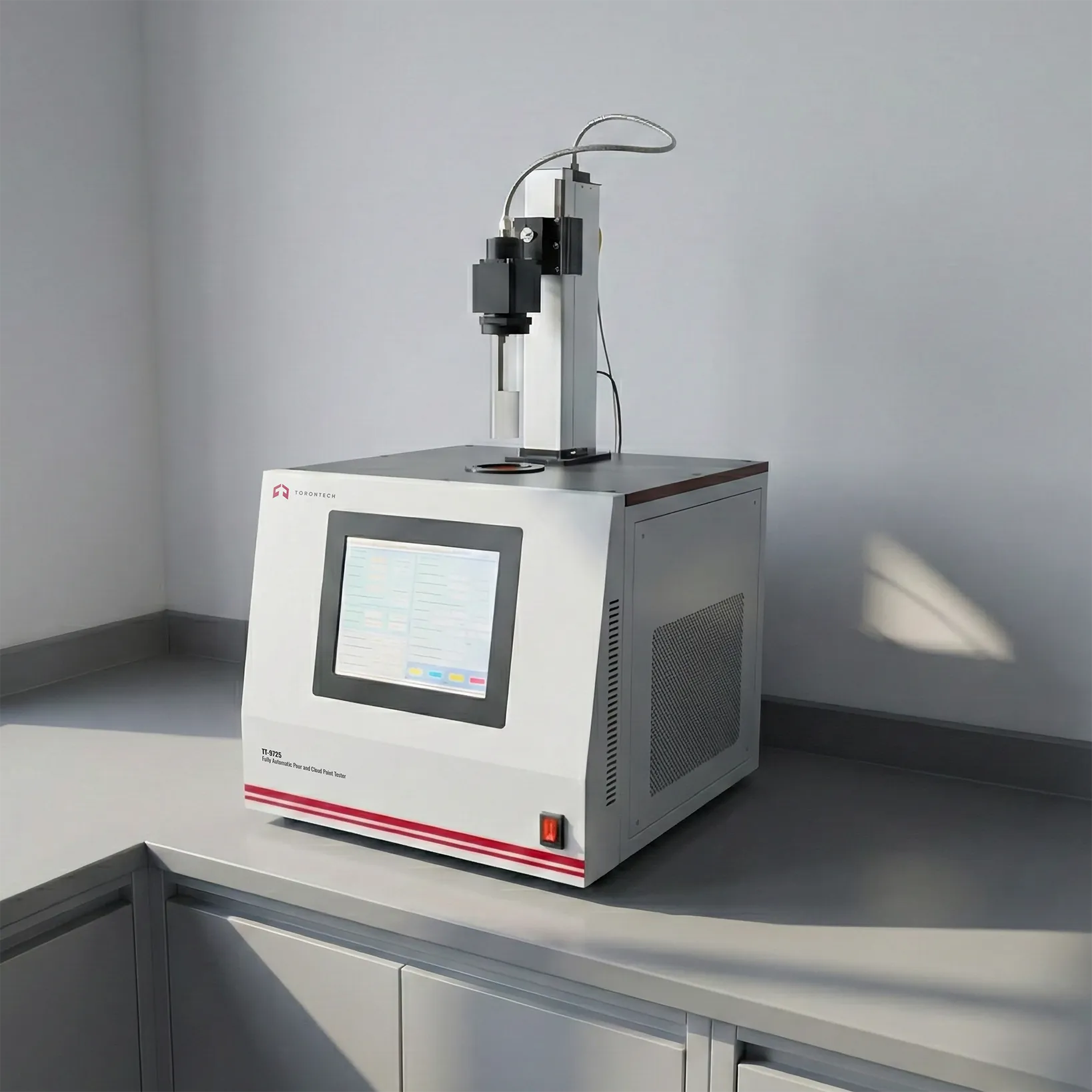
Fully Automatic Pour and Cloud Point Tester TT-9725
Fully Automatic Pour and Cloud Point Tester is designed for precise cloud point (CP) and pour point (PP) testing of petroleum products following standards such as ASTM D97, ASTM D2500, ASTM D5950, EN 23015, ISO 3015, ISO 3016, and IP 15. This advanced tester delivers accurate results in a single test cycle, surpassing manual methods in precision.
Its innovative built-in cooling system efficiently cools samples down to -80°C in a short time, eliminating the need for an external chiller.
The primary application of the Fully Automatic Pour and Cloud Point Tester is to precisely and automatically determine the low-temperature characteristics of petroleum products. It measures the Cloud Point (the temperature at which wax crystals begin to form) and the Pour Point (the lowest temperature at which the oil will still flow). These are critical quality control tests to ensure fuels and lubricants perform reliably in cold weather environments.
Key Industries
- Petroleum Refining and Petrochemical: Refineries use this tester for essential quality control to ensure that fuels like diesel, heating oil, and jet fuel meet specifications for different climates and seasons, preventing issues like fuel line clogging.
- Automotive and Aerospace: This is critical for testing diesel and aviation fuels where low-temperature performance is a matter of safety and operational reliability. Gelled fuel can cause engine failure in vehicles, aircraft, and heavy machinery.
- Third-Party Testing Laboratories: These independent labs provide verification and certification services for producers, distributors, and consumers, making this tester a workhorse instrument for routine analysis.
Standards
The TT-9725 follows international test methods for cloud point and pour point determination in petroleum products.
- ASTM D97 - Standard Test Method for Pour Point of Petroleum Products
- ASTM D2500 - Standard Test Method for Cloud Point of Petroleum Products and Liquid Fuels
- ASTM D5950 - Standard Test Method for Pour Point of Petroleum Products (Automatic Tilt Method)
- EN 23015 - Petroleum Products: Determination of Cloud Point
- ISO 3015 - Petroleum Products: Determination of Cloud Point
- ISO 3016 - Petroleum Products: Determination of Pour Point
- IP 15 - Petroleum Products: Determination of Pour Point
- Fully Automated Testing: Streamlines the entire testing process for accuracy and convenience.
- Integrated Cooling System: Efficiently cools the bath down to -80°C without requiring an external liquid chiller.
- Automated Test Tube Handling: Includes automatic lifting and rotation for seamless operation.
- Dual Measurement Capability: Simultaneously determines cloud point (CP) and pour point (PP) in a single test cycle.
- High Precision: Achieves results with a 0.1°C resolution for superior accuracy.
- Optical Measuring System: Ensures precise data collection.
- Pt-100 Temperature Probe: Delivers accurate temperature readings.
- Built-in Heater: Quickly heats the bath for faster test preparation.
- User-Friendly Interface: Features a large color LCD touch screen for easy operation.
- Extensive Data Storage: Internal memory (8GB) to store test results securely.
- Automatic Diagnostics: Identifies system issues to maintain optimal performance.
- USB Connectivity: Supports external storage devices and printers.
- LAN Port: Enables network connection with LIMS support.
- Network Printer Compatibility: Connects to network printers for streamlined report printing.
- Remote Firmware Updates: Keeps the system up to date without manual intervention.
- Compact & Energy Efficient: Space-saving design with optimized energy consumption.
Theory and Method
Cloud point and pour point both track how wax behaves in cooling oil. Diesel, heating oil, and lubricants contain dissolved paraffin wax. As the temperature falls, the wax solubility drops and crystals begin to form. The cloud point is the temperature at which the first crystals scatter enough light to give the sample a hazy look. Wax can already start to plug filters and small orifices at that point.
Further cooling lets the crystals grow and interlock into a lattice that traps liquid oil. The oil thickens and eventually stops moving under its own weight. The pour point is the lowest temperature at which the sample still flows under the test conditions. Cloud point therefore signals filter problems first, while pour point marks the limit for pumping and pipeline handling.
The TT-9725 automates both observations in one cooling run. The integrated cooling system lowers the bath temperature while a Pt-100 probe records it at 0.1°C resolution. Automated test tube handling lifts and rotates the tube, and the optical measuring system monitors the sample for the onset of cloudiness and the loss of flow. No operator has to pull the tube at fixed temperature steps and judge the result by eye.
Technical Specifications
| Parameter | Specification |
|---|---|
| Temperature Range | -80 to 51 °C |
| Temperature Accuracy | ±0.1 °C |
| Resolution | 0.1 °C |
| Sample Volume | 45 mL |
| Cooling Mode | Integrated cooling system, no external chiller |
| Temperature Sensor | Pt-100 probe |
| Detection | Optical measuring system |
| Display | Color LCD touch screen |
| Internal Memory | 8 GB |
| Interfaces | USB, LAN |
| Power Consumption | 500 W |
| Rated Voltage | 220 V ±10%, 50 Hz (110 V available) |
| Dimensions | 500 × 440 × 770 mm |
| Weight | 35 kg |