
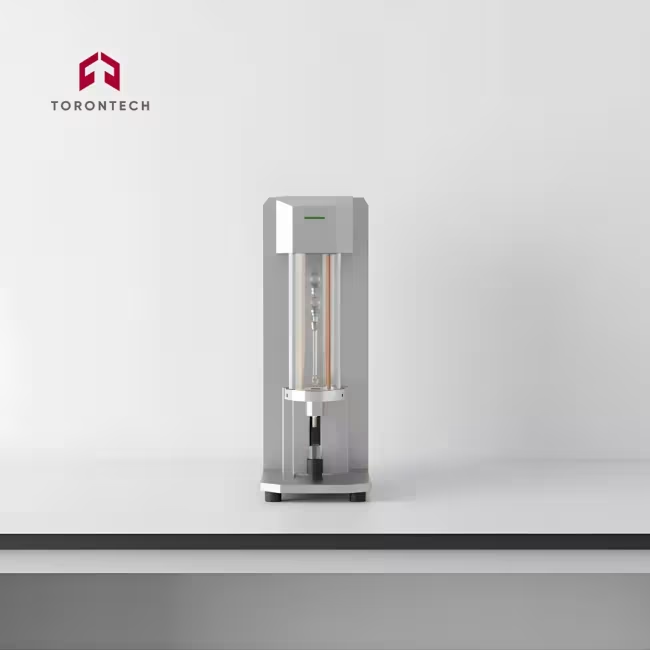
Full Automatic Kinematic Viscosity Tester TT-445Z-2
Full Automatic Kinematic Viscosity Tester TT-445Z-2
Full Automatic Kinematic Viscosity Tester TT-445Z-2 conforms to ASTM D445 Standard Test Method for Kinematic Viscosity of Transparent and Opaque Liquids (and Calculation of Dynamic Viscosity).
Full Automatic Kinematic Viscosity Tester TT-445Z-2 is utilized to test liquid petroleum products, whether transparent or opaque, by gauging the time taken for a volume of liquid to pass under gravity through a precisely calibrated glass capillary viscometer. The dynamic viscosity, represented by η, can be derived by multiplying the kinematic viscosity, represented by ν, by the liquid's density, represented by ρ, under specific constant temperature conditions. The kinematic viscosities encompassed by this apparatus method range from 0.2 to 300,000 mm2/s across all temperatures.
The primary application of the Full Automatic Kinematic Viscosity Tester TT-445Z-2 is the fully automated determination of the kinematic viscosity of both transparent and opaque liquid petroleum products, in compliance with the ASTM D445 standard. Designed for efficiency and high precision, the instrument automates the entire process, including temperature control, sample measurement, and cleaning. The ability to control multiple testers from a single PC makes it an ideal solution for laboratories with a high sample throughput that require reliable and repeatable results for quality control.
Key Industries
- Third-Party Testing Laboratories: This instrument is perfectly suited for high-volume commercial labs. The full automation and the capability to connect multiple units to one computer maximize efficiency, which is necessary for processing a large number of samples for in-service oil analysis and product certification for various clients.
- Lubricant Manufacturing: Viscosity is the most important property of a lubricant. Manufacturers rely on this automated tester for their quality control labs to consistently and efficiently test base oils and finished products (e.g., engine oils, hydraulic fluids) to ensure they meet precise viscosity grades.
- Petroleum Refining: Refineries conduct extensive routine quality control on a wide array of products. The efficiency and reliability of this fully automatic system support their operations and help certify that products like fuels (diesel, kerosene) and lubricant base oils meet all commercial specifications.
- Double-layer bath design ensures a consistently maintained temperature range of 20-100℃ with a precision of ±0.01℃ and a resolution of 0.01℃. Utilizing 10# methyl silicone oil as the bath medium allows for prolonged usage without the need for replacement.
- The apparatus incorporates an ARM single-chip microcomputer for precise temperature and viscosity control, resulting in more accurate test outcomes. Operating on the Windows 7 system, it offers full English/Russian language options for user convenience and provides various communication interfaces (RS-232, USB, and RJ-45, etc.), facilitating connection to LIMS systems and WLAN.
- With a wide kinematic viscosity measurement range, each viscometer uses a two-detection bubble design, offering 20 times the viscosity measurement range. Each tester comes equipped with a calibrated viscometer, and the software includes a calibration function, allowing operators to calibrate the viscometer for an extended measuring range.
- Featuring a fully automatic cleaning process, manual intervention is unnecessary.
- One PC can connect to 1 to 4 testers for simultaneous operation.
Kinematic viscosity measures how readily a liquid flows under the force of gravity. It is one of the most common quality tests for oils, fuels, and lubricants, because viscosity directly affects how a fluid performs in an engine, a pump, or a process line.
The Capillary Flow Method
The test uses a calibrated glass capillary viscometer held at a precisely controlled temperature in a heated bath. A measured volume of sample is drawn into the viscometer, then released to flow down through the narrow capillary under its own weight. The instrument records the time the liquid takes to flow between two timing marks.
From Flow Time to Viscosity
Each viscometer has a known calibration constant. The kinematic viscosity equals the measured flow time multiplied by that constant, with the result reported in centistokes (mm2/s). Because viscosity changes sharply with temperature, the bath must hold the set temperature within tight limits, which is why temperature control is central to the method. The procedure follows ASTM D445 and ISO 3104, so results stay comparable between laboratories.
1. Standard: ASTM D445, D446, ISO3104
2. Rated voltage: AC220V±10%, 50Hz (110V also available)
3. Total power: 1600W
4. Detection mode: Phototube with 0.01s accuracy, thermistor with 0.01s accuracy
5. Cooling mode: Absolute ethanol
6. Temperature measuring element: Pt100
7. Working temperature: 20~100℃
8. Ambient temperature requirement: -20~50℃