
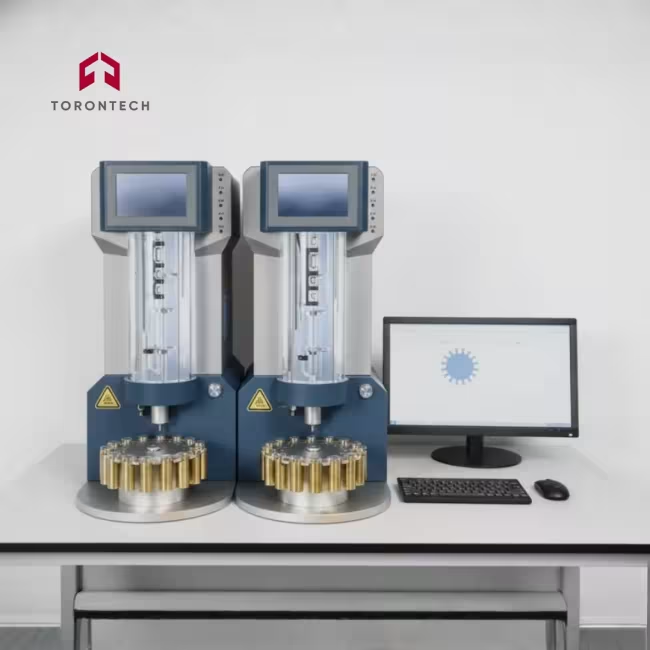
Fully Automatic Kinematic Viscosity Tester (Dual Baths)
Fully Automatic Kinematic Viscosity Tester (Dual Baths) TT-445Z-1
Fully Automatic Kinematic Viscosity Tester (Dual Baths) TT-445Z-1 complies with the ASTM D445 Standard Test Method for Kinematic Viscosity of Transparent and Opaque Liquids (and Calculation of Dynamic Viscosity).
Fully Automatic Kinematic Viscosity Tester (Dual Baths) TT-445Z-1 is utilized to test the viscosity of liquid petroleum products, both transparent and opaque, by measuring the time for a volume of liquid to flow under gravity through a calibrated glass capillary viscometer. The dynamic viscosity, η, can be obtained by multiplying the kinematic viscosity, ν, by the density, ρ, of the liquid, under certain constant temperature conditions. The range of kinematic viscosities covered by this apparatus method spans from 0.2 to 300,000 mm2/s at all temperatures.
The primary application of the Fully Automatic Kinematic Viscosity Tester (Dual Baths) TT-445Z-1 is the high-throughput, fully automated determination of kinematic viscosity for a wide range of petroleum products, in compliance with the ASTM D445 standard. The dual-bath design allows for simultaneous testing at two different temperatures, or a continuous workflow where one bath is testing while the other is cleaning. This makes it an exceptionally efficient instrument for quality control of fuels and lubricants, and for calculating the Viscosity Index (VI), an important parameter that requires viscosity readings at two temperatures.
Key Industries
- Third-Party Testing Laboratories (In-Service Oil Analysis): This is the ideal instrument for high-volume commercial labs. The dual-bath system and complete automation allow for maximum sample throughput, which is necessary for processing hundreds of in-service oil samples daily as part of predictive maintenance programs for industrial, automotive, and aerospace clients.
- Lubricant Manufacturing: Viscosity is the most important property of a lubricant. The dual-bath functionality is perfect for manufacturers who need to measure viscosity at both 40°C and 100°C to calculate the Viscosity Index (VI), a key performance indicator on product data sheets for items like engine oils and hydraulic fluids.
- Petroleum Refining: Refineries with high sample loads benefit from the efficiency of the dual-bath system. It is used for routine quality control on a wide array of products, including fuels (diesel, jet fuel) and base oils, to certify that they meet commercial and regulatory specifications.
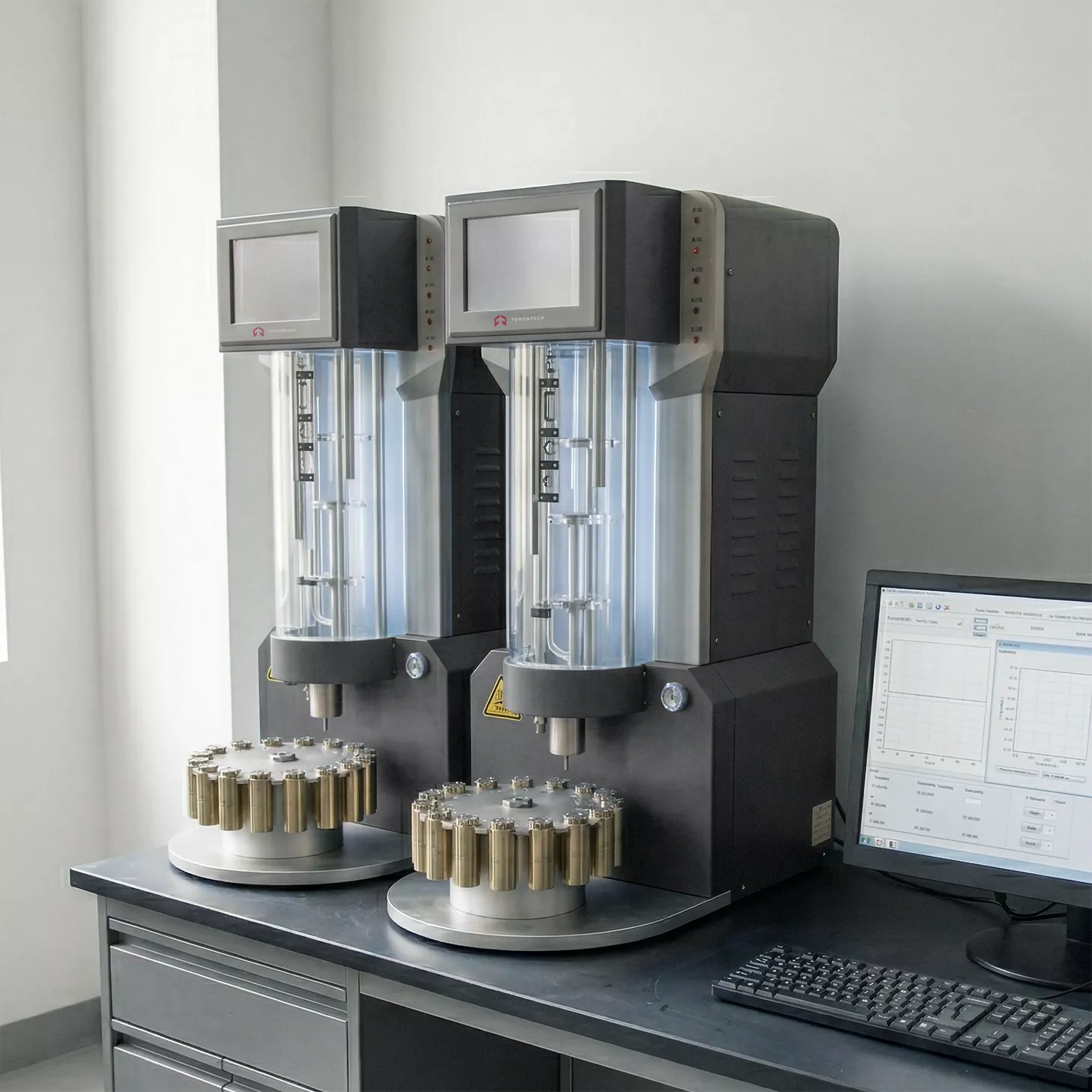
- Equipped with a 16-bit sample tray, capable of continuous operation throughout the day. Features intelligent functions for preheating, injecting, measuring, cleaning, drying, calculating results, and repetitive calculations.
- Provides independent temperature control for each bath, allowing simultaneous testing, cleaning, and drying operations for the corresponding bath.
- The apparatus utilizes photoelectric or thermal detection methods, enabling measurement of both transparent and opaque samples. This includes Newtonian fluids such as gasoline, diesel, kerosene, cutting fluid, heat conducting oil, additives, fresh, and in-use lubricating oils, among others.
- Includes a PTC sample intelligent preheating function, automatically controlling preheating temperature based on the expected temperature of the sample. The preheat temperature range extends from room temperature to 120℃, with a heating rate of 15℃/min, significantly reducing sample thermostatic time during testing.
- Incorporates a built-in Peltier refrigeration system, utilizing thermostatic bath liquid as a cooling medium directly, supporting fast cooling speed.
- Applies self-adaptive liquid level balance technology, capable of adjusting to large-span adjustments of test temperature. This feature automatically increases and decreases thermostatic medium during heating and cooling processes, maintaining the same immersion depth.
- The apparatus features a built-in Windows operating system for easy operation and can be connected to LIMS systems and barcode scanners for automatic input of sample information.
- Includes a system with built-in automatic calibration functions for the viscometer constant and temperature calibration. Additionally, it offers internal clock timing calibration and can convert Kinematic viscosity into Engler viscosity and automatically calculate viscosity Index and other functions.
- Offers overtemperature protection functions for both software and hardware, including over temperature alarm, dry heat protection, cleaning solution insufficient prompt, waste liquid cleaning prompt, and other safety features to ensure safe operation.
- Designed with a double glass bath configuration, PT1000 high precision temperature sensor, and double-blade stirrer, supporting the thermostatic bath remains stable and accurate, with a temperature precision of 0.005℃.
- Features an automatic intelligent dual solvent cleaning function, with customizable cleaning modes.
- Equipped with a timing verification port for accurate time verification through a standard time calibrator.
Kinematic viscosity measures how readily a liquid flows under the force of gravity. It is one of the most common quality tests for oils, fuels, and lubricants, because viscosity directly affects how a fluid performs in an engine, a pump, or a process line.
The Capillary Flow Method
The test uses a calibrated glass capillary viscometer held at a precisely controlled temperature in a heated bath. A measured volume of sample is drawn into the viscometer, then released to flow down through the narrow capillary under its own weight. The instrument records the time the liquid takes to flow between two timing marks.
From Flow Time to Viscosity
Each viscometer has a known calibration constant. The kinematic viscosity equals the measured flow time multiplied by that constant, with the result reported in centistokes (mm2/s). Because viscosity changes sharply with temperature, the bath must hold the set temperature within tight limits, which is why temperature control is central to the method. The procedure follows ASTM D445 and ISO 3104, so results stay comparable between laboratories.
| Specification | Details |
|---|---|
| Applicable Standards | ASTM D445, ASTM D446, ISO 3104 |
| Measuring Range | 0.3 to 10,000 mm²/s (10,000-fold measuring span across two viscometer tubes) |
| Sample Capacity | 16 × 2 samples (32 total) |
| Bath Volume | 3 L × 2 (6 L total) |
| Temperature Control Range | 20°C to 100°C (built-in Peltier cooling) |
| Temperature Control Accuracy | ±0.005°C |
| Timing Accuracy | 0.01 s |
| Repeatability | ≤ 0.4% |
| Total Power | ≤ 1600 W |
| Main Unit Dimensions | (400 × 700 × 800 mm) × 2 |
| Rated Voltage | AC 220V ±10%, 50Hz ±10% (110V optional) |
| Operating Environment | Temperature: 10°C to 28°C Relative Humidity: < 80% RH |
| Operating Conditions | Free from strong vibration, airflow, strong electromagnetic interference, and corrosive gases |