
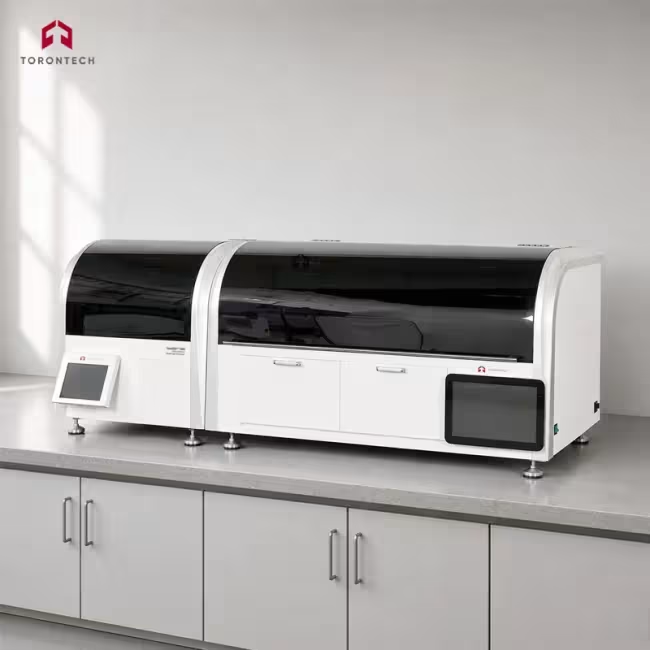
Slide Stainer and Coverslipper Workstation - ToronSSC™ 1000
ToronSSC™ 1000 Slide Stainer and Coverslipper Workstation pairs a 32-station staining module with a glass coverslipping module that can run as one connected line or as two separate instruments. Torontech supplies the modules individually for laboratories that already own one half of the workflow, though the pairing returns the most value. Linked together, they move slides from reagent to finished cover glass with no operator handoff. Staining runs at 720 slides per hour and covering at 800.
Station capacity decides how many methods a laboratory can hold ready at once. The staining module carries three rows of reagent tanks plus one row of multifunction positions, giving up to 28 reagent stations across 32 freely assignable slots. That layout lets routine H&E, rapid frozen sections, and Papanicolaou protocols run at the same time without draining and refilling tanks between methods. Continuous loading keeps the line fed, so an urgent case enters the queue during a scheduled batch.
A 12.1-inch color touchscreen tilts through multiple angles so operators read it from a seated or standing position. Sensors watch for broken or missing cover glass, verify spray needle position, and track the collection basket, which lets a technician pull finished slides without pausing the run. Power-off memory recalls the interrupted step and prompts the operator to continue or restain. Both modules use standard glass coverslips and common mounting media.
Slide Stainer and Coverslipper Workstation - ToronSSC™ 1000 Applications
The ToronSSC™ 1000 fits laboratories running several staining protocols side by side at volumes where a single-instrument stainer becomes the bottleneck.
- High-Volume Surgical Pathology: routine H&E on paraffin sections at 720 slides per hour with automatic coverslipping, sized for departments processing several hundred blocks a day
- Rapid Frozen Section Work: short-cycle staining of cryostat sections for intraoperative consultation, loaded mid-run on dedicated tanks so an urgent case does not disturb the scheduled batch
- Cytology and Papanicolaou Screening: polychrome Pap staining held on its own reagent stations alongside histology methods, giving consistent nuclear and cytoplasmic contrast for screening
- Reference and Contract Laboratories: continuous flow operation across a full shift, where matched staining and covering rates keep slides moving instead of pooling between stages
- Digital Pathology and Whole Slide Imaging: even mountant film with no blank edges or overflow produces clean scans and lowers the rate of tiles rejected by automated slide readers
- Laboratories Upgrading in Stages: the coverslipping module can join an existing stainer, or the staining module can feed a coverslipper already on the bench, spreading capital cost across budget cycles
- Teaching and Research Laboratories: stored programs and free station assignment let departments run standardized teaching protocols beside investigator-specific special stain methods
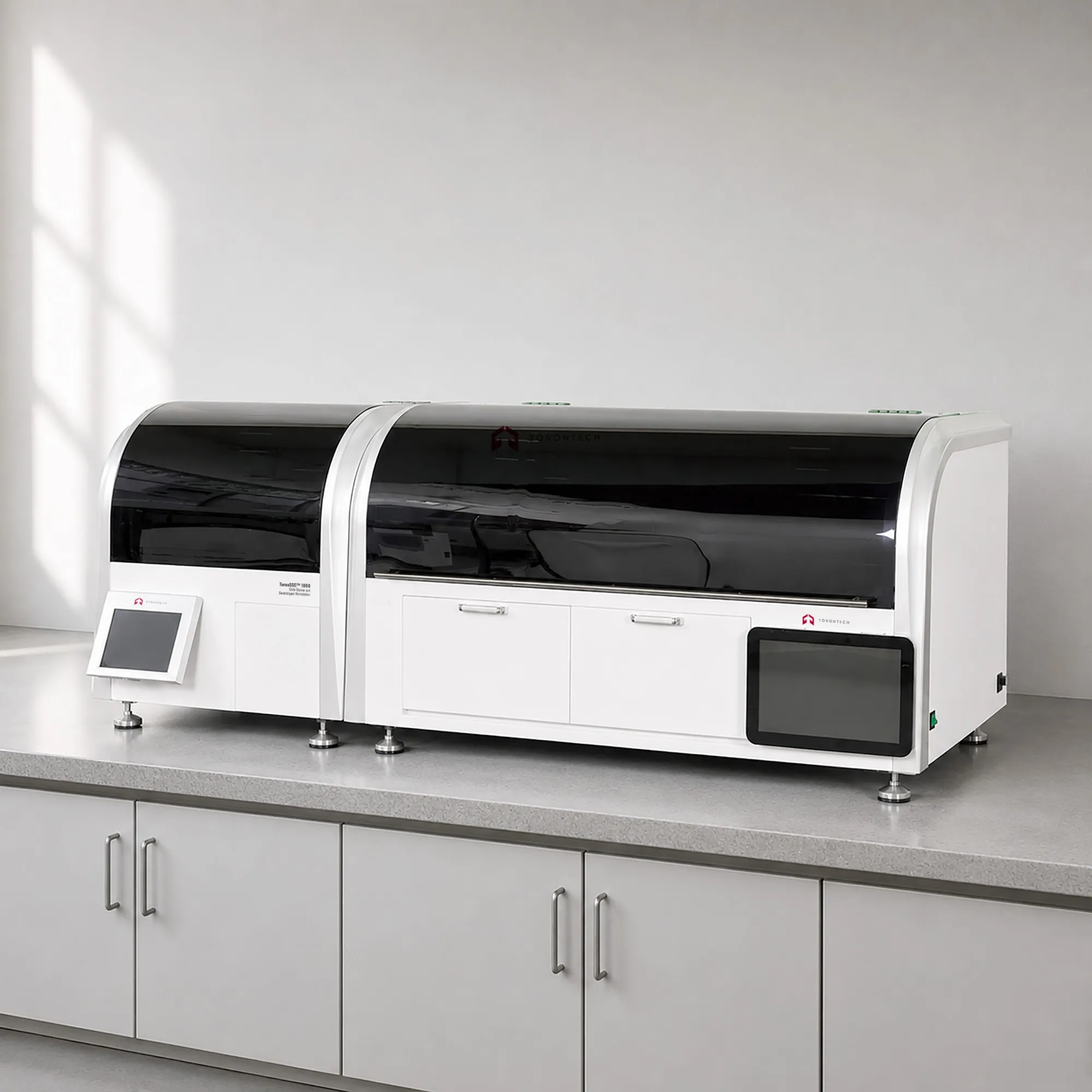
Slide Stainer and Coverslipper Workstation - ToronSSC™ 1000 Key Features
The ToronSSC™ 1000 combines station capacity, matched staining and covering rates, and sensor-driven quality checks in a two-module layout that scales with the laboratory.
- Standalone or Connected Operation: each module works on its own or docks to the other as a single line, so a laboratory can buy one now and add the second later without replacing what it already owns
- 32 Freely Assignable Stations: three rows of reagent tanks plus one multifunction row give up to 28 reagent positions, enough to hold H&E, frozen section, and Papanicolaou protocols loaded at the same time
- 720 Slides per Hour Staining: continuous upload keeps the transport arm working without waiting for a batch to clear, supporting departments with heavy daily block counts
- 800 Slides per Hour Covering: the covering stage runs slightly ahead of staining, so finished slides move straight through instead of pooling at the transfer point
- Adaptive Staining Control: the management system adjusts staining programs against reagent condition, holding color intensity steady from the first rack of the day to the last
- Reagent Management Tracking: days in service and slide counts are tracked per station, flagging solutions that have reached their limit before staining quality drifts
- Broken and Missing Cover Glass Detection: sensors identify a cracked or absent coverslip before the slide reaches the basket, keeping unusable slides out of the finished stack
- Spray Needle Position Monitoring: real-time checks confirm the dispensing needle sits correctly, protecting mountant volume and film consistency across long runs
- Non-Stop Basket Removal: the collection basket is detected and positioned in real time, letting operators take covered slides at any point without pausing the instrument
- Uniform Mountant Film: back-side push-out, linear dispensing, arc press, and flat push produce even coverage with no overflow, no blank edges, and reduced bubble formation
- 12.1-Inch Multi-Angle Touchscreen: a large color display rotates through several viewing angles, so the operator reads status comfortably whether seated or standing at the bench
- Power-Off Memory: the interrupted step is stored and the operator is prompted to resume or restain once power returns, protecting slides caught mid-protocol
- Pressure-Adaptive Water Supply: flow adjusts to incoming line pressure and valves open only when the protocol calls for water, cutting consumption on idle stations
- Enclosed Cabinet with Carbon Filtration: full enclosure plus activated carbon adsorption and exhaust gas extraction treat xylene and alcohol vapor at source for cleaner bench air
- No Dedicated Consumables: classic glass coverslipping runs on standard cover glass and common mounting media, keeping cost per slide low and sourcing open
Theory and Method
Staining chemistry sets the sequence a laboratory must follow. Hematoxylin bound to an aluminum mordant carries positive charge and attaches to the phosphate backbone of nucleic acids, coloring nuclei blue-purple, while anionic eosin Y binds protonated amino groups in cytoplasm and collagen for the pink counterstain. Papanicolaou methods layer Orange G and polychrome EA over the same nuclear stain to separate cell populations by color. Frozen sections skip deparaffinization and run far shorter. Four protocol classes therefore need four reagent sets.
Throughput on a two-module line depends on matching rates. A stainer that outruns its coverslipper builds a queue of wet slides, and a coverslipper that outruns its stainer sits idle. The ToronSSC™ 1000 sets staining at 720 slides per hour against covering at 800, so the covering stage stays slightly ahead and slides never wait in a buffer. Continuous loading holds both stages busy, which turns batch work into steady flow rather than start-stop cycles.
Cover glass placement is an optical problem. Stained tissue and glass both refract light near an index of 1.5, so the mountant must match that range or light scatters at each boundary. The head dispenses resin in a line, then presses the cover glass down in an arc so the fluid front sweeps across the section and pushes air ahead of it. Sensors confirm the glass is intact and seated, which stops a damaged coverslip from reaching the collection basket.
Slide Stainer and Coverslipper Workstation - ToronSSC™ 1000 Technical Specifications
Module Specifications
| Parameter | Staining Module | Coverslipping Module |
|---|---|---|
| Dimensions (W × D × H) | 600 × 600 × 682 mm | 1,180 × 735 × 682 mm |
| Weight | 60 kg | 127 kg |
| Maximum Power | 400 W | 1,500 W |
| Voltage | 110 to 220 V AC, 50/60 Hz | 110 to 220 V AC, 50/60 Hz |
| Total Stations | 32 freely assignable | Not applicable |
| Station Layout | 3 rows of reagent stations plus 1 row of multifunction stations, up to 28 reagent stations | Not applicable |
| Throughput | ≥ 720 slides per hour, continuous loading | 800 slides per hour |
System Specifications
| Parameter | Specification |
|---|---|
| Supported Protocols | Routine tissue H&E, rapid frozen section, and Papanicolaou staining, run simultaneously |
| Coverslipping Mode | Glass cover slip, back-side push-out with linear mountant dispensing, arc press and flat push |
| Display | 12.1-inch color touchscreen, multi-angle rotation |
| Quality Detection | Broken and missing cover glass detection, spray needle position monitoring, collection basket detection and positioning |
| Reagent Control | Adaptive staining program adjustment with reagent day and slide count tracking |
| Power Interruption | Power-off memory with resume or restain prompt |
| Water Supply | Intelligent on-demand supply, protocol-driven valve control, flow adjusted to line pressure |
| Fume Treatment | Fully enclosed cabinet, activated carbon adsorption with exhaust gas extraction |
Configuration Options
| Configuration | Description |
|---|---|
| Staining Module only | 32-station stainer supplied as a standalone unit, suitable for laboratories that already run a separate coverslipper |
| Coverslipping Module only | Standalone glass coverslipper at 800 slides per hour, able to sit alongside an existing stainer |
| Connected Workstation | Both modules docked as one line, with slides passing from staining to covering without operator transfer. Recommended configuration for full walk-away operation |