
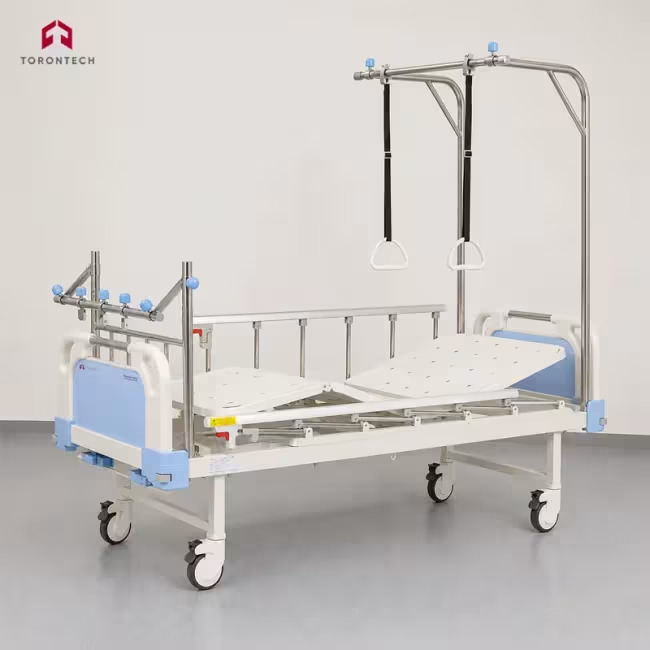
Orthopedic Traction Bed - ToronCare™ 1031O
Orthopedic traction bed ToronCare™ 1031O gives orthopedic wards a manual positioning platform built around a single overhead trapeze frame. Ward nurses and orthopedic staff use the frame's hanging handgrips to help a patient reposition, sit up, and transfer with less caregiver strain. The same mounting point supports a basic limb traction setup when a fracture calls for it. Manual crank controls handle backrest and kneerest positioning for everyday ward use. This combination suits general orthopedic recovery as well as lighter, single-limb traction cases.
The ToronCare™ 1031O adjusts backrest through a 0 to 75-degree range. Kneerest moves through 0 to 45 degrees. Both angles are controlled by hand-crank leading screws. A leading-screw overload protection feature guards the mechanism against damage from over-cranking. Individual brake casters and roller bumpers support routine ward workflow. IV pole holes and a drainage hook keep the bedside organized during longer stays.
Patients recovering from a single-limb fracture, hip surgery, or extended bed rest benefit from a bed that combines positioning support with a light traction option. The trapeze bar lets a patient build upper-body strength during recovery. It also helps a patient move independently as strength returns. Staff can add a rope and pulley to the same frame for basic skin traction of one limb. This avoids the footprint of a full multi-point traction frame.
Orthopedic Traction Bed - ToronCare™ 1031O Applications
The ToronCare™ 1031O suits orthopedic wards managing patients who need general positioning support with the option of light, single-limb traction.
- Single-Limb Fracture Management: basic skin traction of one leg or arm anchored to the overhead trapeze frame while the patient recovers
- Hip and Lower-Limb Surgery Recovery: kneerest and backrest positioning to support a healing limb while the patient regains mobility
- Patient-Assisted Repositioning: the overhead trapeze bar lets patients sit up, shift position, and transfer with less caregiver assistance
- General Orthopedic Ward Care: manual crank positioning, individual brake casters, and IV pole holes for day-to-day ward workflow
- Extended Bed Rest and Rehabilitation: trapeze-assisted movement helps patients maintain upper-body strength during a longer hospital stay
- Post-Operative Recovery: supports patients transitioning from surgical repair to early mobility exercises
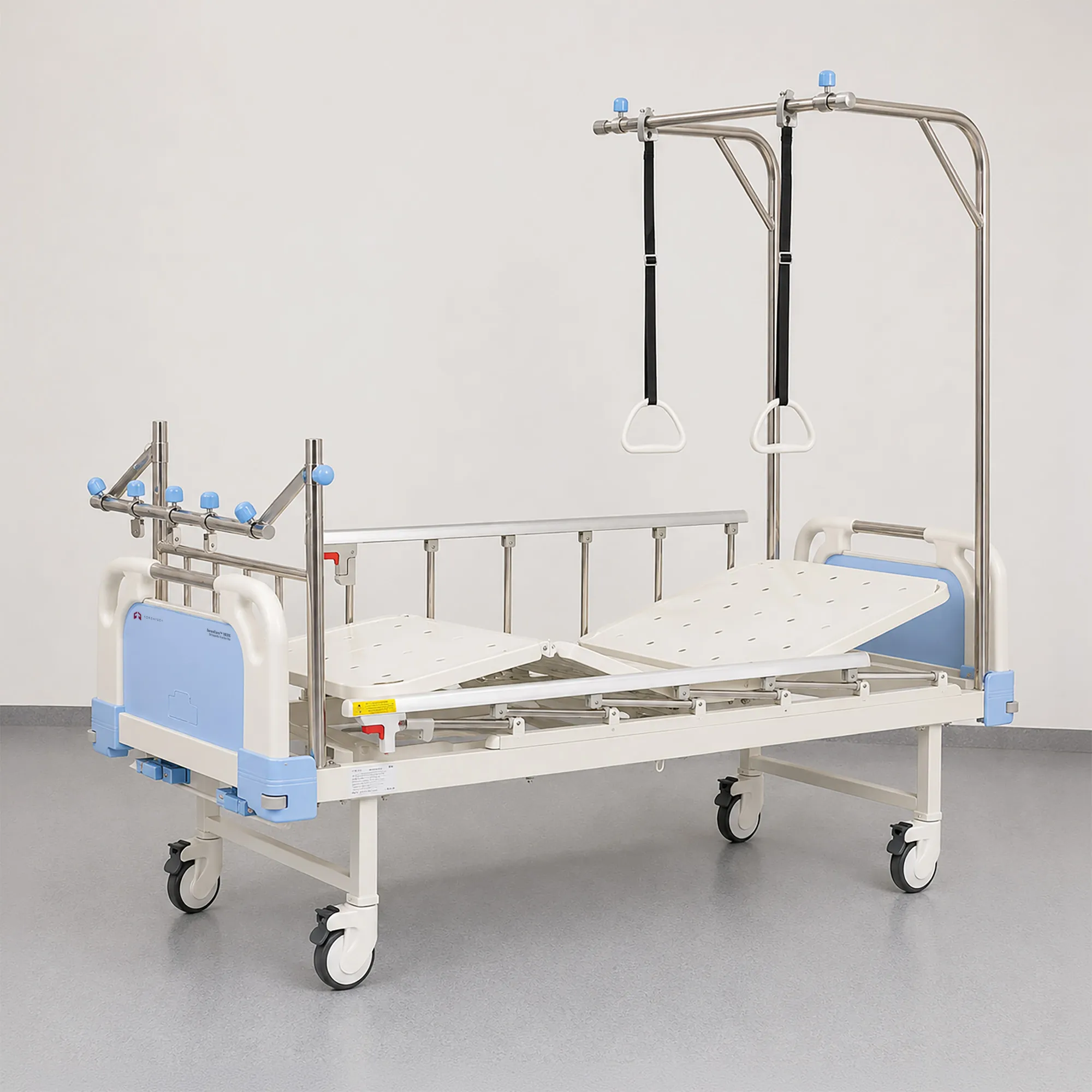
Orthopedic Traction Bed - ToronCare™ 1031O Key Features
The ToronCare™ 1031O pairs a single overhead trapeze frame with manual ward-bed positioning functions.
- Overhead Trapeze Frame: a single-point frame with hanging handgrips lets patients reposition and sit up with less caregiver assistance, and doubles as an anchor for light single-limb traction
- Manual Backrest Adjustment: hand-crank control raises the backrest through 0 to 75 degrees for feeding, breathing, and general comfort
- Manual Kneerest Adjustment: crank-operated kneerest moves through 0 to 45 degrees to relieve pressure on the lower back and legs
- Adjustable Footrest: supports proper foot positioning and helps prevent pressure injury during extended bed rest
- Leading-Screw Overload Protection: guards the crank mechanism against damage if a user cranks past the mechanical limit
- Individual Brake Casters: each of the four 125 mm casters locks independently for stable positioning at the bedside
- Roller Bumpers: protect the bed frame and surrounding equipment from impact during transport and ward use
- IV Pole Holes: four built-in mounts hold IV poles without needing a separate stand
- Drainage Hook: a dedicated hook keeps catheter bags organized and off the floor during longer stays
- Detachable Head and Foot Boards: simplify cleaning and bedside access for nursing staff
Theory and Method
An overhead trapeze frame works on a simple lever principle. The patient grips the hanging bar and pulls against a fixed overhead anchor point. This lets the patient shift weight, sit up, or move toward the edge of the bed using their own upper-body strength. The motion reduces the physical effort a caregiver needs to reposition or transfer the patient. It also helps the patient retain arm and shoulder strength during a long recovery.
The same anchor point supports basic orthopedic traction when a fracture requires it. A rope and pulley run from a sling around the limb to the frame. A hanging weight applies a steady pull along the injured bone's axis. This single-point setup suits lighter, single-limb traction loads. The goal is to maintain alignment and relax the muscle spasm around the fracture, rather than manage a complex multi-limb or pelvic injury.
The bed's manual leading screws work independently of the trapeze and traction line. Backrest and kneerest angles adjust through hand-crank controls without disturbing a traction rope anchored overhead. Leading-screw overload protection prevents damage if a crank is turned past its mechanical limit. Together, these functions let staff manage day-to-day positioning while a lighter traction setup stays in place.
Orthopedic Traction Bed - ToronCare™ 1031O Technical Specifications
| Parameter | Specification |
|---|---|
| External Dimensions | 2,200 mm (L) x 980 mm (W) |
| Mattress Platform Dimensions | 1,900 mm (L) x 900 mm (W) |
| Mattress Platform Ground Clearance | 500 mm |
| Height of Orthopedic (Trapeze) Frame | 2,040 mm |
| Height of Siderail | 350 mm |
| Backrest Angle | 0° to 75° (±5°) |
| Kneerest Angle | 0° to 45° (±5°) |
| Castor Diameter | 125 mm |
| Safe Working Load | 260 kg |
| Configuration Item | Quantity |
| Leading Screw | 2 sets |
| Head/Foot Board | 1 set |
| Siderail | 1 set |
| Orthopedic (Trapeze) Frame | 1 set |
| Individual Brake Castor | 4 pcs |
| Roller Bumper | 4 pcs |
| IV Pole Hole | 4 pcs |
| Drainage Hook | 2 pcs |