
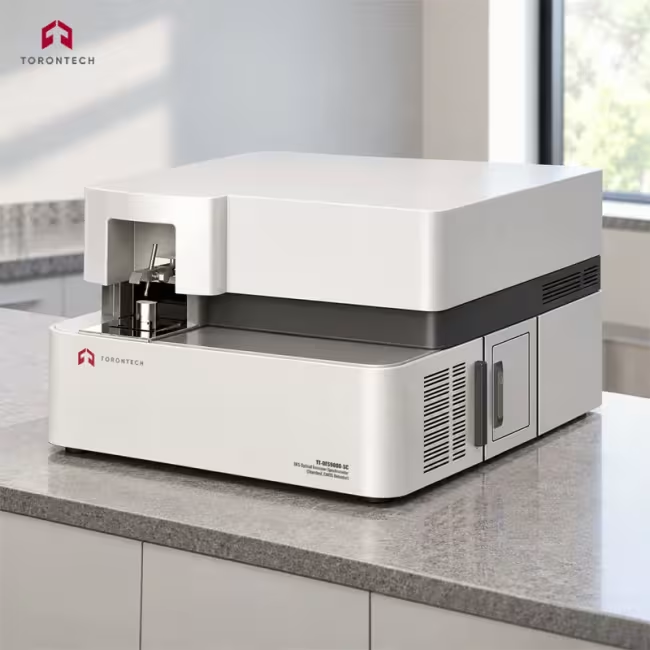
OES Optical Emission Spectrometer (Standard, CMOS Detector)
OES Optical Emission Spectrometer (Standard, CMOS Detector) - TT-OES9000-SC
TT-OES9000-SC is a benchtop CMOS optical emission spectrometer built for analytical laboratories in metallurgy, mechanical engineering, and metal processing. It determines the chemical composition of solid metals and alloys within seconds per burn. Quality teams use it for quantitative elemental analysis and for confirming alloy grades on incoming and outgoing material. The compact footprint fits a standard lab bench, smaller than a floor-standing spectrometer.. Fast, repeatable chemistry data helps plants catch off-grade material before it moves downstream.
The optical core pairs a 400 mm Rowland circle with a Paschen-Runge mount and multiple high-resolution CMOS linear arrays. This layout records the full 130 to 800 nm spectrum on every spark, which covers the lines used for typical ferrous and nonferrous matrices. A vacuum optical chamber keeps short-wavelength lines such as carbon, phosphorus, and sulfur readable. The open spark stand accepts samples of different shapes and sizes. Jet electrode technology also lets operators analyze small parts and wire without sealing the stage.
Day-to-day ownership stays simple. The vacuum system reaches stable operating conditions about 30 minutes after a cold start. Argon flows only during analysis, which lowers gas cost during standby. Automatic drift correction runs on each excitation, so operators spend less time on manual profiling. Software menus are in English and are designed for staff without a spectroscopy background.
OES Optical Emission Spectrometer (Standard, CMOS Detector) - TT-OES9000-SC Applications
Spark OES remains a standard method for verifying metal chemistry at production speed. The TT-OES9000-SC supports these industries and tasks:
- Steel Mills and Metal Producers: checks low alloy and stainless steel chemistry during production to confirm each heat meets grade limits
- Iron and Steel Foundries: verifies cast iron and steel melt composition so operators can adjust charge additions before pouring
- Incoming Material Inspection: confirms the grade of purchased bar, plate, tube, and castings against mill certificates
- Mechanical Engineering and Fabrication: screens shafts, fasteners, and structural parts to prevent alloy mix-ups in assembly
- Metal Recycling Laboratories: verifies carbon-critical grades handheld analyzers cannot read.
- Heat Treatment and Forging Shops: validates alloy content before thermal processing, since chemistry drives the heat-treat response
- Failure Analysis and Contract Laboratories: identifies the base alloy of failed components as a first step in root-cause work
- Universities and Research Centers: supports alloy development and materials science teaching with full-spectrum data
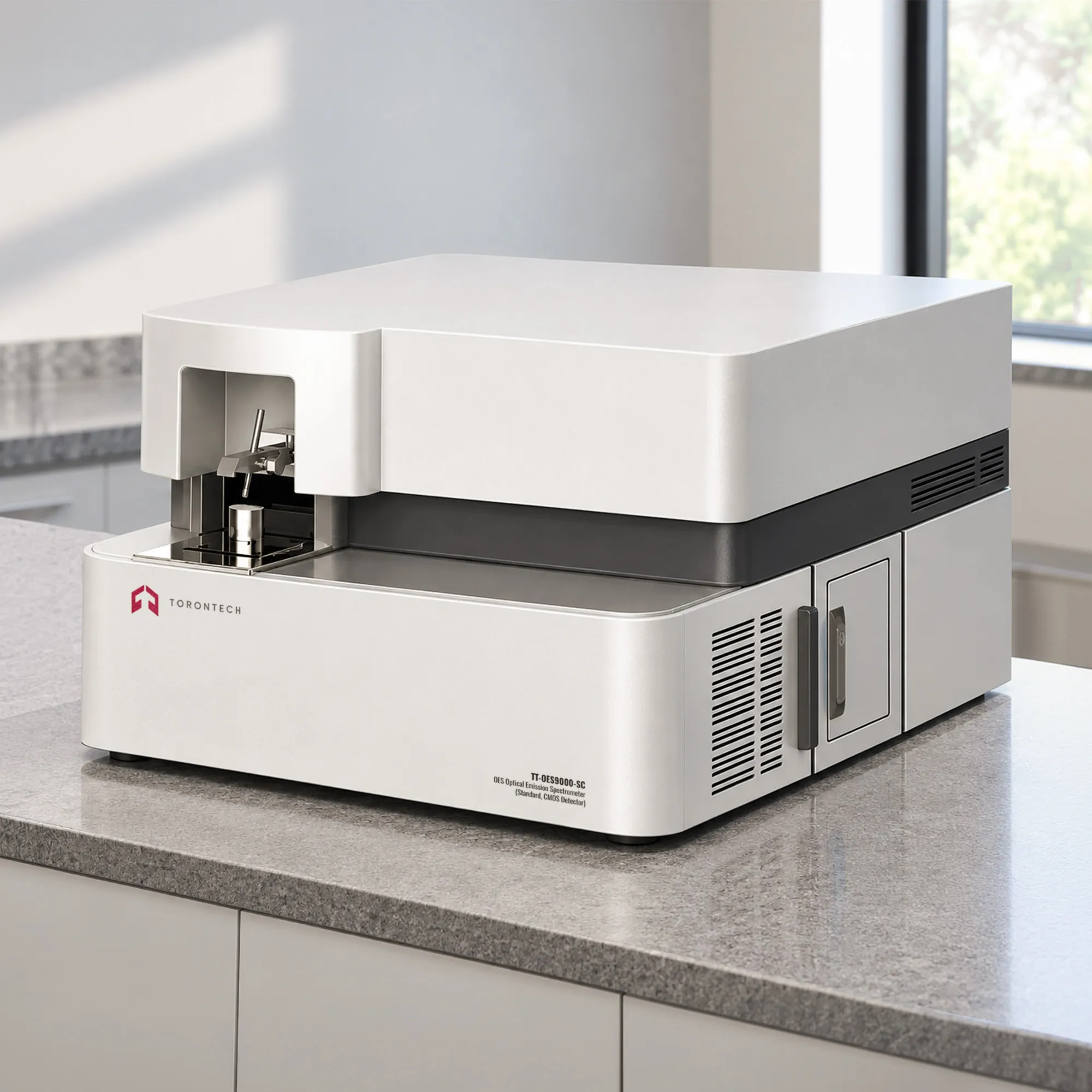
OES Optical Emission Spectrometer (Standard, CMOS Detector) - TT-OES9000-SC Key Features
The TT-OES9000-SC combines a full-spectrum CMOS optic with low-maintenance hardware for routine metal analysis.
- CMOS Detector with Digital Readout: delivers low detection limits for trace elements and stable long-term results compared with older photomultiplier designs
- Full-Spectrum Acquisition: captures the whole spectrum on 2400 x 8 pixels, so the software can read several lines per element and select the best one automatically
- 30-Minute Cold Start: brings the vacuum optics to working condition in about half an hour, compared with the 1 to 2 hours typical of older systems
- No Argon Purge During Standby: cuts gas consumption and operating cost when the instrument sits idle between shifts
- Automatic Drift Correction: scans reference lines on every burn and corrects shifts caused by temperature, pressure, or vibration without manual profiling
- Total Spectrum Analysis (TSA) Software: adds new spectral lines and matrices through software, with no hardware change, as testing needs grow
- Sealed Spark Chamber on an Open Stage: holds stable conditions during spark excitation, while redirected argon flow reduces residue and speeds up cleaning
- Jet Stream Electrode: surrounds the electrode with an argon jet that blocks outside air, saves gas, and lets operators test wire and small parts without sealing the stage
- Tool-Friendly Maintenance Access: a pull-out front cover exposes the spark stand, and a dual-lens light path shields the vacuum optics from dust during cleaning
- Programmable Digital Plasma Source: gives users full software control over excitation parameters to match each alloy matrix
- Synchronous Real-Time Readout: reads all channels at once rather than in sequence, which improves timing stability and data accuracy
- Externally Mounted Electronics: places the circuit system outside the optical housing for better heat dissipation and long-term reliability
- Easy-to-Learn Software: offers an English interface that new operators can learn quickly, even without spectroscopy training
Theory and Method
Optical emission spectrometry identifies elements through the light that excited atoms release. A high-voltage spark jumps between a tungsten electrode and the flat surface of the metal sample inside an argon atmosphere. Each discharge vaporizes a few micrograms of metal and forms a hot plasma. Atoms in this plasma absorb energy, move to higher electron states, and then fall back. Each return releases photons at wavelengths unique to that element.
The emitted light enters the optical chamber through an entrance slit and strikes a concave diffraction grating with 3600 lines/mm. The grating separates the light by wavelength and focuses each line on the Rowland circle, where the CMOS arrays sit. Every pixel records light intensity at one wavelength position. Line intensity rises with the concentration of the element in the sample. The software compares measured intensities with calibration curves built from certified reference materials and reports composition in percent.
Several design choices protect the accuracy of this measurement. Wavelengths below about 200 nm are absorbed by oxygen in air, so the TT-OES9000-SC holds its optics under vacuum at 6 to 15 Pa. A heater stabilizes the optical chamber at 34°C to stop thermal shifts in line position. The digital spark source sets frequency and current for each matrix. High-energy pre-sparking melts and homogenizes the surface before the measurement window opens.
OES Optical Emission Spectrometer (Standard, CMOS Detector) - TT-OES9000-SC Technical Specifications
| Parameter | Specification |
|---|---|
| Model | TT-OES9000-SC |
| Instrument Type | Benchtop spark optical emission spectrometer |
| Optical Structure | Paschen-Runge mount, Rowland circle optical system |
| Rowland Circle Diameter | 400 mm |
| Optical Chamber | Vacuum optics, automatic vacuum control at 6 to 15 Pa |
| Wavelength Range | 130 to 800 nm |
| Detector | Multiple high-resolution CMOS linear array detectors |
| Detector Pixels | 2400 x 8 |
| Pixel Resolution | 30 pm |
| Grating Groove Density | 3600 lines/mm |
| Spectral Dispersion (First Order) | 1.2 nm/mm |
| Optical Temperature Control | Automatic, 34°C ± 0.5°C |
| Excitation Source | All-digital plasma spark source, semiconductor control |
| Pre-Sparking | High-energy pre-spark (HEPS) |
| Spark Frequency | 100 to 1000 Hz, user-defined |
| Spark Current | 1 to 80 A, user-defined |
| Sample Stage | Open stage for samples of various shapes and sizes |
| Analytical Gap | 3.4 mm |
| Electrode | Jet stream (spray) electrode for small and complex samples |
| Argon Consumption | Low; no flow during standby |
| Warm-Up Time | Approximately 30 minutes from cold start |
| Argon Purity | 99.999% |
| Gas Supply Pressure | Above 4 MPa inlet; 0.5 MPa regulated outlet |
| Environment | Air-conditioned room; grounding with voltage not exceeding 0.1 VAC |
| Software Language | English |
| Dimensions (L x W x H) | 830 x 700 x 460 mm |
| Weight | 85 kg |
Standard Delivery
| Item | Quantity | Description |
|---|---|---|
| TT-OES9000-SC Spectrometer | 1 | Main benchtop instrument |
| PC | 1 | Control computer |
| Printer | 1 | Report printing |
| Software | 1 | Operation and analysis software |
| Vacuum System | 1 | Vacuum pump for the optical chamber |
| Calibration Sample | 1 set | Standardization samples |
| Regulator | 1 | Argon pressure regulator |
| Fe Base Program: Fe-001 | 1 | Low alloy steel (without nitrogen) |
| Fe Base Program: Fe-002 | 1 | Cast iron (without nitrogen) |
| Fe Base Program: Fe-003 | 1 | Stainless steel (without nitrogen) |
| Operation Manual | 1 | Operating instructions |
| Warranty Card | 1 | Warranty documentation |
| Certificate of Qualification | 1 | Factory inspection certificate |
Tools and Spare Parts
| Item | Quantity | Description |
|---|---|---|
| Electrode Cleaning Brush | 2 | 4 mm |
| Pole Pitch Gauge | 1 | Sets the analytical gap |
| Long-Handle Phillips Screwdriver | 1 | Maintenance tool |
| Long-Handle Flathead Screwdriver | 1 | Maintenance tool |
| Hex Socket Wrench Set | 1 | Maintenance tool |
| Open-End Wrench | 2 | 10 x 12 mm |
| Hex Socket Countersunk Screws | 4 | 6 x 8 mm |
| O-Ring | 1 | 68 x 2.65 mm |
| O-Ring | 2 | 35 x 2.65 mm |
| O-Ring | 2 | 25 x 1.80 mm |
| O-Ring | 2 | 13 x 1.80 mm |
| Fuse | 2 | 250 V, 10 A |
| Outlet (Large) | 1 | Gas outlet fitting |
| Outlet (Small) | 1 | Gas outlet fitting |
| Exhaust Gas Filter Tank and Fitting | 1 | Exhaust filtration |
| Exhaust Gas Filter Element | 2 | Replacement element |
| Exhaust Gas Filter Tube | 1 | Exhaust filtration |
| Degreasing Cotton | 1 | Cleaning supply |
| Vacuum Adapter | 1 | Vacuum line connection |
| Vacuum Filter Core | 1 | Replacement filter |
| Clamp (KF25) | 2 | Vacuum flange clamp |
| Clamp (KF16) | 6 | Vacuum flange clamp |