

Linear Reciprocating Tribometer - ToronLRT™ 02GL
Linear Reciprocating Tribometer - Reciprocating Wear Tester - ToronLRT™ 02GL
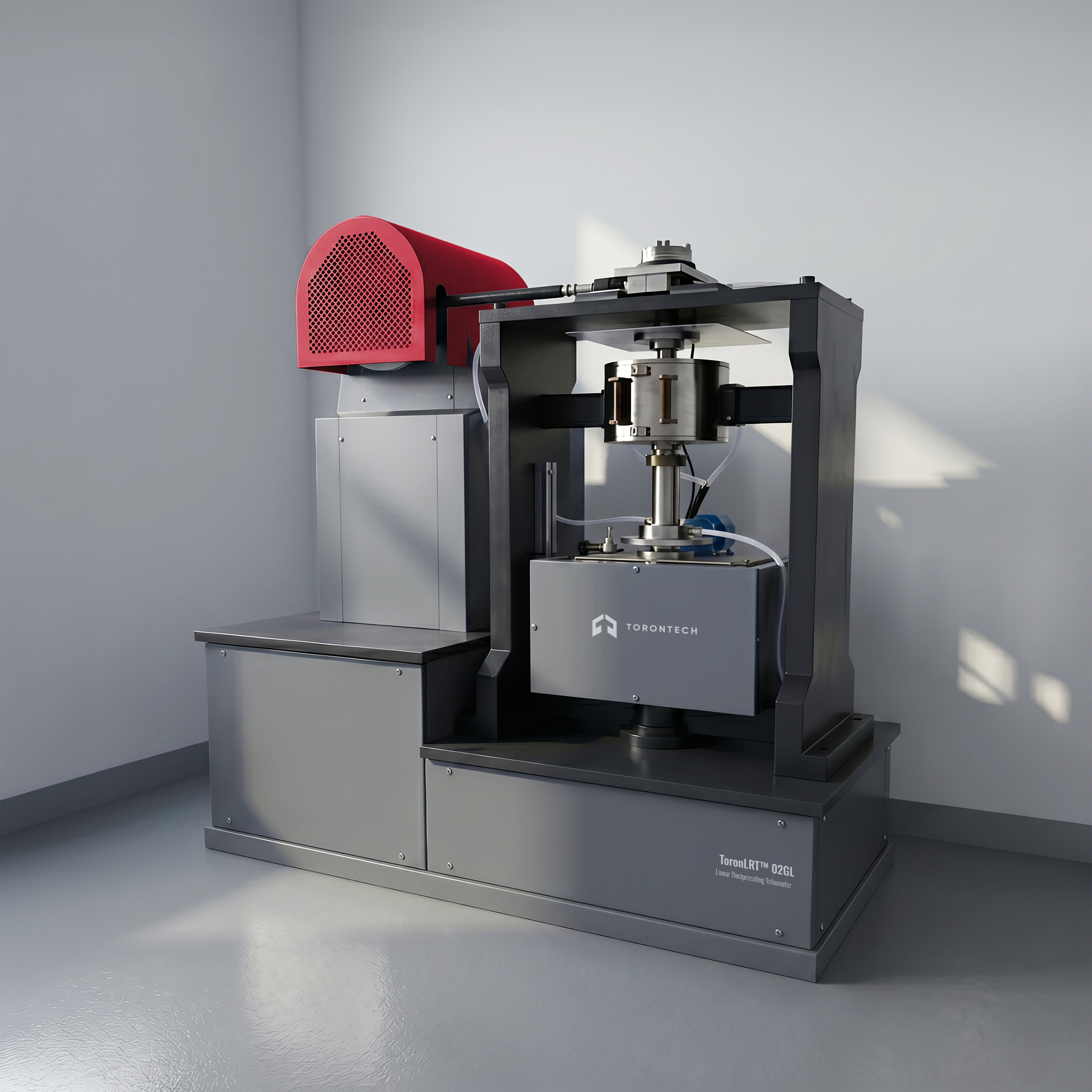
The ToronLRT™ 02GL linear reciprocating tribometer spans a combined temperature range of −120°C to 800°C, delivering service-representative friction and wear data for cryogenic and high-temperature applications in a single platform. Laboratories in energy, aerospace, metallurgy, and lubrication engineering use it to characterize materials, coatings, and lubricants at the thermal conditions their components actually experience. Pin-on-disc and ball-on-disc contact pairs are supported with all specimen materials customizable on request. Automatic load application to 200 N and a 0.1 to 20 Hz stepless frequency range accommodate a broad spectrum of tribological test protocols.
High-temperature testing reaches 800°C, covering ceramics, refractory coatings, and high-temperature lubricants in metallurgical, gas turbine, and furnace environments. Low-temperature testing extends to −120°C for cryogenic materials and lubricants in LNG infrastructure, cold storage, and aerospace cold-zone applications. Stroke length is 40 mm at room temperature and reduces to 10 mm at elevated or low temperature to accommodate the thermal enclosure geometry. Both dry friction and oil-lubricated test setups are supported across the full operating temperature range.
All test parameters display simultaneously on screen throughout each run: normal load, friction force, friction coefficient, reciprocating frequency, elapsed time, and temperature. The control software plots parameter-versus-time curves automatically and stores all data for post-test analysis and report generation. Configurable alarm and auto-stop thresholds on all major parameters protect specimens and the instrument if conditions deviate from preset limits. This protection makes the ToronLRT™ 02GL suitable for long-duration unattended endurance tests at temperature.
Linear Reciprocating Tribometer - ToronLRT™ 02GL Applications
The ToronLRT™ 02 serves research and quality-control laboratories evaluating friction and wear behavior where service temperature is a key variable, from −120°C cryogenic conditions to 800°C elevated-temperature environments.
- High-Temperature Coating Performance: tests PVD, DLC, and thermal spray coatings at temperatures up to 800°C to confirm wear resistance under gas turbine, exhaust, and industrial furnace service conditions before deployment
- Cryogenic Equipment Materials: measures friction coefficient and wear at −120°C for LNG valves, pumps, and pipeline fittings where cold-temperature friction governs seal and bearing service life
- Lubricant Temperature Performance: characterizes friction-reducing effectiveness of oils and greases across the full temperature range, verifying cold-start behavior at −120°C and high-temperature stability at 800°C in the same instrument
- Automotive High-Temperature Tribology: evaluates valve train materials, exhaust valve seat inserts, and piston ring coatings under elevated-temperature contact conditions that replicate engine operating environments
- Ceramic and Advanced Material Characterization: tests friction and wear of advanced ceramics, cermets, and hard coatings at elevated temperatures where thermally driven microstructural changes govern tribological behavior
- Aerospace Surface Treatment Qualification: verifies friction and wear behavior of diffusion coatings, thermal barrier coatings, and specialty alloys under oscillating contact at both cryogenic and high-temperature aerospace conditions
- Refractory and Industrial Hard-Facing Evaluation: assesses wear properties of refractory linings and hard-facing alloys at elevated operating temperatures for furnace and high-heat process equipment applications
- Cold-Climate Lubricant and Seal Qualification: tests lubricants and sealing materials under cryogenic reciprocating contact to qualify components for cold-climate and arctic service environments
Standards
The ToronLRT™ 02 supports friction and wear testing in accordance with internationally recognized tribology standards. The following standards define the test methods and measurement practices applicable to this instrument's reciprocating contact configuration and temperature-controlled test environment:
- ASTM G133 - Standard Test Method for Linearly Reciprocating Ball-on-Flat Sliding Wear
- ASTM G115 - Standard Guide for Measuring and Reporting Friction Coefficients
- ASTM G40 - Standard Terminology Relating to Wear and Erosion
- ASTM D5707 - Standard Test Method for Measuring Friction and Wear Properties of Lubricating Grease Using a High-Frequency, Linear-Oscillation (SRV) Test Machine
- DIN 51834-1 - Testing of Lubricants: Tribological Test in the Translatory Oscillation Apparatus, Part 1: General Working Principles
Linear Reciprocating Tribometer - ToronLRT™ 02GL Key Features
The ToronLRT™ 02 combines a wide thermal operating envelope with automated load control, customizable contact pair configurations, and continuous friction data acquisition, giving tribology laboratories service-representative data from a single instrument.
- High and Low Temperature Range, −120°C to 800°C: covers cryogenic conditions for LNG and aerospace cold-zone testing and temperatures to 800°C for ceramics, refractory coatings, and high-temperature lubricants without a separate instrument for each range
- Stepless Frequency, 0.1 to 20 Hz: frequency control begins at 0.1 Hz for low-speed contact cycle simulation and reaches 20 Hz for high-cycle wear screening, with continuous adjustment and no discrete steps between
- Customizable Contact Pair Materials: pin, ball, and disc specimens are available in user-specified materials on request, allowing the contact pair to exactly replicate the material combination under investigation
- Automated Normal Load to 200 N: motorized loading axis applies and holds constant contact force throughout the test at any temperature within the instrument's operating range
- Dual Stroke Range: 40 mm at room temperature for standard reciprocating wear tracks; 10 mm at elevated or low temperature to fit within the thermal enclosure geometry
- Dry and Lubricated Testing Across the Full Temperature Range: supports dry friction and oil-lubricated conditions from −120°C to 800°C, enabling lubricant performance evaluation at cryogenic cold-start and elevated-temperature service conditions
- Friction-Versus-Temperature Profile: continuous friction force measurement through the temperature ramp and isothermal hold phases generates a complete friction-versus-temperature dataset from each test run
- Industrial PC Control and Automated Reporting: dedicated software manages test setup, displays all parameters in real time, plots parameter-versus-time curves, and produces formatted reports at test completion
- Parameter Threshold Protection: configurable alarm and auto-stop thresholds on all major test parameters protect specimens and the instrument during extended temperature-controlled and long-duration unattended runs
Theory and Method
Linear reciprocating tribometry measures friction coefficient by dividing the lateral friction force at the contact interface by the applied normal load: μ = F/N. A stationary upper specimen presses against a flat lower disc under a set normal load N, and the disc moves back and forth in a straight line. A force transducer perpendicular to the loading axis measures friction force F at each stroke point. All reported tribological parameters, including friction coefficient and wear progression, derive from these two continuously measured quantities.
Friction and wear behavior of engineering materials changes substantially with temperature, making ambient tribometry an incomplete basis for qualification in thermally demanding applications. At elevated temperatures, surface oxide layers alter the contact mechanism and lubricant film-forming capacity shifts with viscosity. At cryogenic temperatures, lubricants stiffen, polymers may embrittle, and metal contact mechanics change as material properties shift. Collecting tribological data at actual service temperature, whether −120°C or 800°C, captures these effects and produces results usable for design and material selection decisions.
The ToronLRT™ 02GL heats or cools the contact zone through a thermal enclosure while the load axis, force transducer, and drive mechanism operate at ambient temperature outside it. Normal load applies through a 25 mm motorized vertical axis, holding contact force constant as the wear surface changes. The stroke reduces from 40 mm at room temperature to 10 mm at high or low temperature to maintain contact accuracy within the enclosure. Friction force measurement continues through both the temperature ramp and isothermal hold phases.
Linear Reciprocating Tribometer - ToronLRT™ 02GL Technical Specifications
| Parameter | Specification |
|---|---|
| Reciprocating Frequency | 0.1–20 Hz, stepless adjustment |
| Max Stroke — Room Temperature | 40 mm |
| Max Stroke — High/Low Temperature | 10 mm |
| Max Normal Load | 200 N |
| Max Friction Force | 100 N |
| Contact Pair Configurations | Pin-on-disc, ball-on-disc |
| Specimen Materials | Pin, ball, and disc — customizable on request |
| Friction Medium | Dry friction or oil lubrication |
| High-Temperature Range | Ambient to 800°C |
| Low-Temperature Range | −120°C to ambient |
| Control System | Industrial PC with dedicated test software |
| Displayed Parameters | Test force, friction force, friction coefficient, frequency, elapsed time, temperature |