
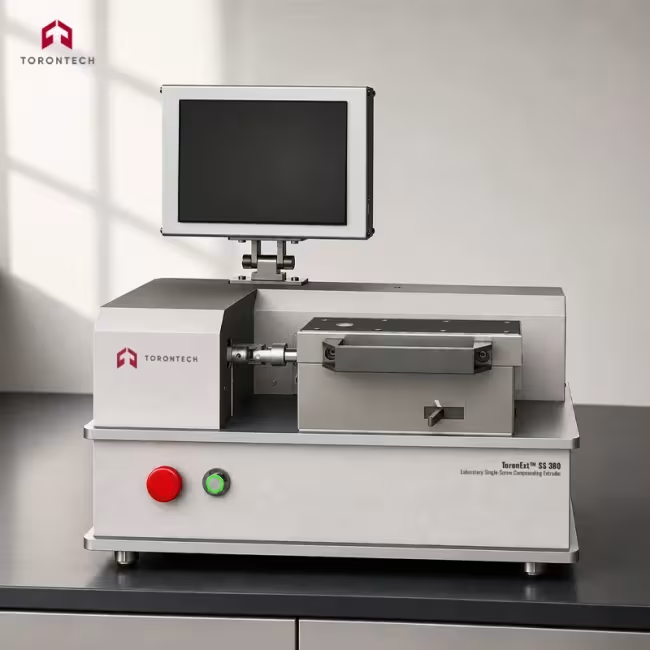
Laboratory Single-Screw Compounding Extruder
Laboratory Single-Screw Compounding Extruder - ToronExt™ SS 380
ToronExt™ SS 380 Laboratory Single-Screw Compounding Extruder runs two modes from one barrel: batch recirculation for mixing, and continuous extrusion for output. A reversing valve routes melt either back through a circulating channel to the feed side or forward through the die. Batch mode works a 30 g charge through as many passes as a formulation needs, while continuous mode delivers up to 2.5 kg/h. Development labs therefore get both formulation trials and small-run material from a single machine.
A Ø20 mm screw with 183 mm of effective length gives a compact processing section, and the barrel hinges open through 120° for cleaning and screw access. Temperature reaches 380°C under ±0.5°C control, which covers commodity resins through high-temperature engineering thermoplastics. Melt pressure and melt temperature record during every run for process traceability. Manual feeding comes as standard, with automatic feeding available as an option.
Weight of 65 kg and a 575 by 320 mm footprint place the SS 380 on a laboratory bench or inside a fume hood, running from a single-phase 220 V supply. Formulation development, quality control, teaching demonstrations, and small-trial production all sit within its range. Uniform dispersion and controlled plasticization make it a practical step between micro-scale compounding and pilot equipment. Compounders can move a promising recipe straight into continuous output without changing machines.
Laboratory Single-Screw Compounding Extruder - ToronExt™ SS 380 Applications
The ToronExt™ SS 380 covers compounding trials and small-volume material production for polymer laboratories.
- Polymer Formulation Development: recirculates a 30 g charge to compare resin, additive, and filler combinations before scale-up
- Masterbatch Compounding: mixes concentrated pigment and additive batches, then extrudes them for evaluation or downstream dilution
- Polymer Color Dispersion: assesses pigment wetting and shade development under repeatable temperature and pass conditions
- Filler Modification Work: incorporates calcium carbonate, talc, glass, and mineral fillers into thermoplastic matrices
- Engineering Plastic Compounding: processes PA, PC, PBT, and similar resins whose melt temperatures need the full 380°C range
- Laboratory Melt Blending: combines two or more resins with compatibilizers to study blend morphology and compatibility
- Small-Sample Extrusion: produces strand, rod, or profile samples for property testing when only grams of material exist
- Biopolymer and Compostable Resin Trials: handles PLA, PBAT, and starch blends within a controlled thermal window
- Recycled Resin Evaluation: tests stabilizer and compatibilizer packages on limited quantities of reclaimed material
- Small-Trial Production: supplies pilot quantities of a validated compound at 2.5 kg/h for customer samples or extended testing
- Quality Control Screening: verifies incoming resin processability against a reference recipe under fixed conditions
- Teaching and Demonstration: shows students melting, plasticization, and extrusion with a machine sized for a teaching bench
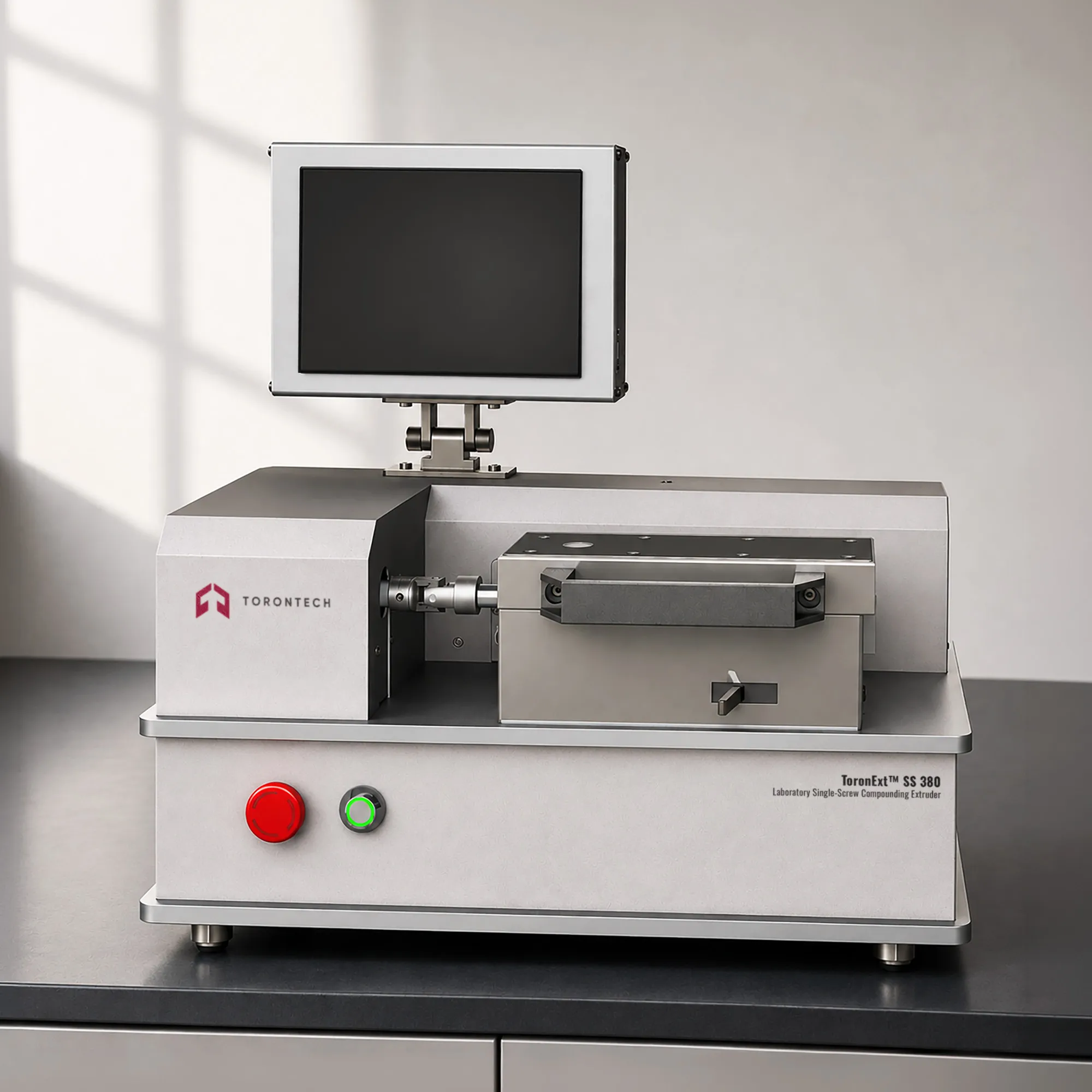
Laboratory Single-Screw Compounding Extruder - ToronExt™ SS 380 Key Features
The ToronExt™ SS 380 pairs batch mixing flexibility with continuous output in a benchtop frame.
- Reversing Valve and Circulating Channel: switches between closed-loop batch mixing and continuous extrusion without a hardware change
- Dual-Function Operation: 30 g recirculating charges for formulation trials, 2.5 kg/h continuous throughput for small-run material
- 120° Hinged Barrel: opens wide for screw removal, inspection, and complete cleanout between formulations
- 380°C Maximum Temperature: reaches the melt range of high-temperature engineering thermoplastics as well as commodity resins
- ±0.5°C Temperature Control: holds the barrel profile steady so viscosity and output stay comparable between runs
- Ø20 mm Screw, 183 mm Effective Length: compact processing section that keeps residual material and cleanout time low
- Melt Pressure and Temperature Logging: records die pressure and melt temperature for traceable process data
- Manual or Automatic Feeding: hand charging as standard, with an optional feeder for uninterrupted continuous running
- Touch-Screen Operation: heating zones, drive, and process readouts managed from one panel
- Single-Phase 220 V Supply: installs on standard laboratory power with no three-phase service needed
- Bench and Fume Hood Compatible: 575 × 320 × 655 mm and 65 kg suit a shared bench or ventilated enclosure
- Precise Plasticization Control: adjustable temperature and pass count give repeatable melt quality for sensitive resins
- Teaching-Ready Layout: accessible controls and a visible process path suit classroom demonstration
- Low Cost per Trial: gram-scale charges and modest power draw keep formulation screening inexpensive
Theory and Method
Single-screw extrusion moves material by drag flow rather than positive displacement. Polymer sticks to the hot barrel wall while sliding more freely against the screw, and that difference in friction drags the charge forward as the screw turns. Melting starts as a thin film against the barrel wall, where shear between wall and solid bed generates most of the heat that turns pellets to melt. Barrel temperature therefore controls the process directly, which is why ±0.5°C stability matters more here than on an intermeshing twin-screw design.
That same mechanism limits mixing per pass. A screw with 183 mm of effective length against a Ø20 mm diameter works out to roughly 9:1 L/D, short by production standards, so one pass alone does not homogenize a demanding formulation. The recirculating channel answers this by returning melt to the feed side, so the same 30 g charge crosses the screw repeatedly. Pass count replaces barrel length as the mixing variable, and an operator sets dispersion by cycle time.
Melt pressure and melt temperature describe what the polymer experienced. Pressure at the die reflects melt viscosity at a given temperature and rate, so a pressure reading compared against a reference recipe flags a viscosity shift from degradation, moisture, or a dosing error. Melt temperature above the set barrel profile indicates shear heating, a warning sign for heat-sensitive polymers. Reading both against the temperature setpoint lets a laboratory separate genuine formulation effects from process artifacts.
Laboratory Single-Screw Compounding Extruder - ToronExt™ SS 380 Technical Specifications
| Parameter | Specification |
|---|---|
| Screw Diameter | Ø20 mm |
| Effective Screw Length | 183 mm (approximately 9:1 L/D) |
| Operating Modes | Batch recirculation or continuous extrusion, selected by reversing valve |
| Single Cycle Material Volume | 30 g per cycle |
| Extrusion Rate | 2.5 kg/h |
| Maximum Temperature | 380°C |
| Temperature Control Accuracy | ±0.5°C |
| Barrel Opening Method | 120° hinged opening |
| Feeding Method | Manual standard, automatic optional |
| Data Acquisition | Melt pressure, melt temperature |
| Voltage | 220 V, 50 Hz (110V is also available) |
| Overall Dimensions | 575 × 320 × 655 mm |
| Net Weight | 65 kg |