
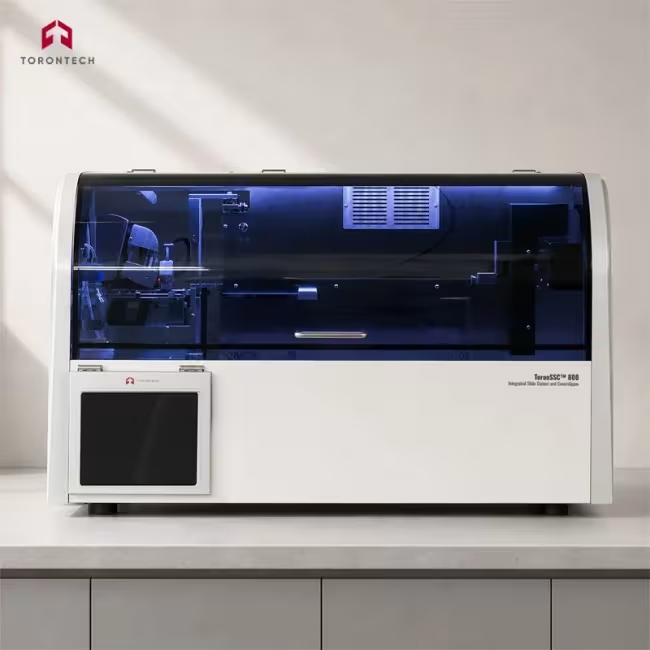
Integrated Slide Stainer and Coverslipper - ToronSSC™ 800
ToronSSC™ 800 Integrated Slide Stainer and Coverslipper handles routine H&E, rapid frozen sections, Papanicolaou, and special stains, then coverslips and stores the finished slides inside one cabinet. Torontech supplies this platform to small and mid-size pathology laboratories that want a single instrument covering the full back end of slide preparation. The unit holds 28 stations, coverslips at 800 slides per hour, and buffers up to 100 finished slides on board. Operators load and walk away.
On-board storage separates the operator from the end of the run. Slides do not need collecting the moment coverslipping finishes, so a technician can start a batch late in the shift and unload it the next morning. A dedicated oven station pre-treats slides ahead of staining, which prepares a larger number of sections per cycle. The 28-tank layout carries parallel reagent sets, so frozen section, Pap, and H&E protocols run without swapping solutions between methods.
Total length stays under one meter, which keeps the footprint inside a standard bench run. A fully enclosed cabinet with activated carbon adsorption and exhaust extraction treats xylene and alcohol vapor before it reaches the room. Glass coverslips and common mounting media serve as the only consumables, and the water valve opens on demand according to the protocol. Program memory holds 200 methods of up to 100 steps each.
Integrated Slide Stainer and Coverslipper - ToronSSC™ 800 Applications
The ToronSSC™ 800 covers the four staining workflows most pathology laboratories run daily, along with the coverslipping and slide handling that follow them.
- Routine Surgical Histology: programmed H&E staining of paraffin sections from biopsies and resection specimens, followed by automatic glass coverslipping with no manual transfer
- Rapid Frozen Section Work: short-cycle staining of cryostat sections for intraoperative consultation, with samples added mid-run so an urgent case does not wait for a batch to clear
- Cytology and Papanicolaou Screening: polychrome Pap staining of gynecologic and non-gynecologic preparations, where consistent nuclear and cytoplasmic contrast supports faster screening
- Special Stains: dedicated tank sets and stored programs for connective tissue, microorganism, pigment, and other special methods without reconfiguring the instrument between runs
- Digital Pathology and Whole Slide Imaging: uniform mountant film and bubble-free cover glass placement produce clean scans and cut the rate of rejected tiles
- Hospital and Reference Laboratories: unattended overnight running with 100-slide on-board storage, letting a shift finish work that starts too late to supervise through to unloading
- Teaching and Research Laboratories: 200 stored programs give students and investigators repeatable protocols across H&E, cytology, and special stain methods
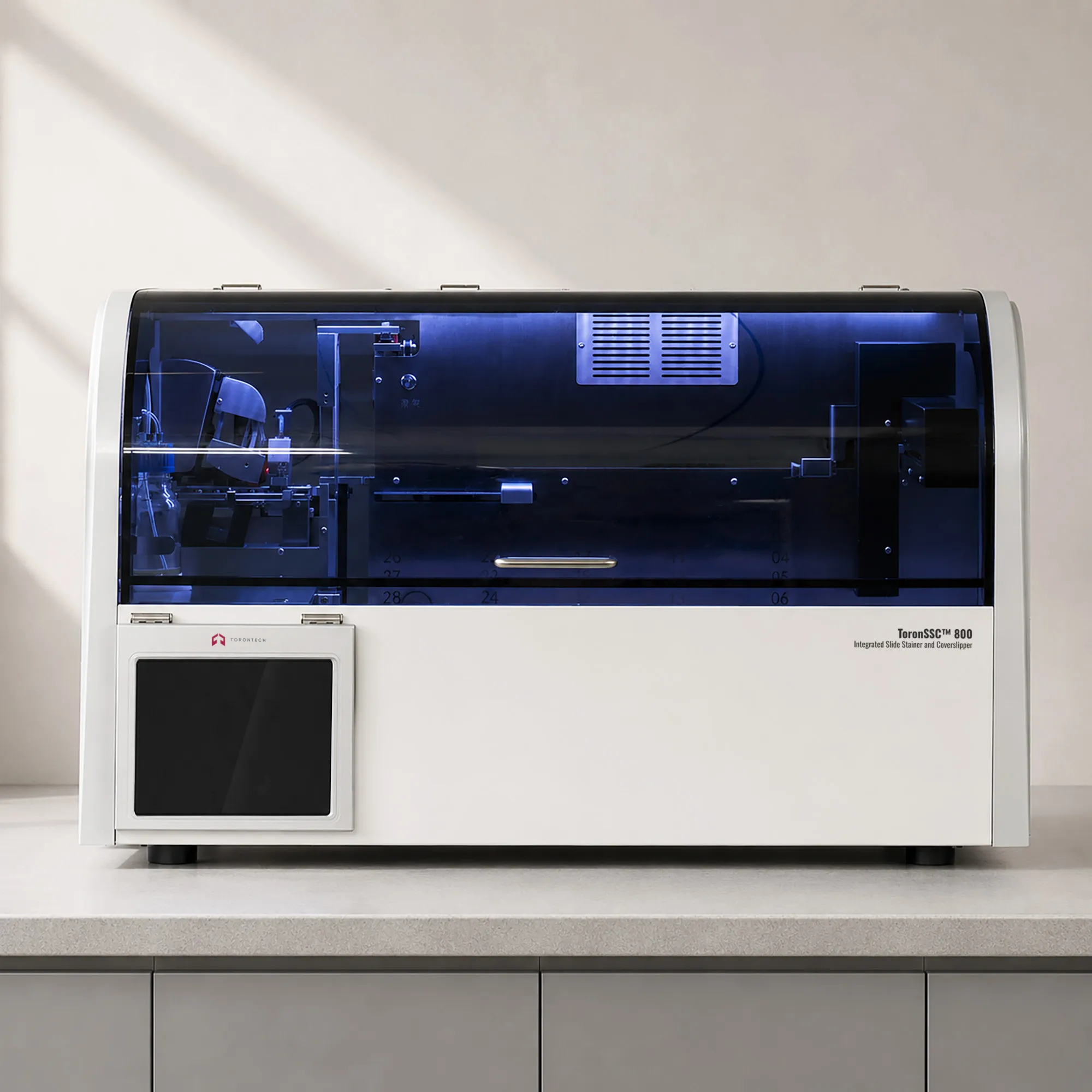
Integrated Slide Stainer and Coverslipper - ToronSSC™ 800 Key Features
The ToronSSC™ 800 pairs a 28-station reagent layout with automatic coverslipping and on-board slide storage, so a run completes without an operator present.
- Staining, Coverslipping, and Storage in One Cabinet: the instrument carries a slide from reagent through cover glass to a finished stack, removing both the transfer to a separate coverslipper and the wait at the unload tray
- 100-Slide On-Board Storage: finished slides collect inside the machine, letting a batch run through the night or across a shift change with no one standing by to receive it
- 28 Reagent Stations: station count covers H&E, Papanicolaou, frozen section, and special stain protocols at the same time, so methods do not compete for the same tanks
- Dedicated Oven Pre-Treatment Tank: an added drying station bakes sections before staining, improving adhesion to the glass and raising the number of slides prepared per cycle
- Optimized Station Layout: tank positions are arranged to shorten the robotic arm travel path, which lifts arm utilization and lets more programs run in parallel
- Continuous Sample Loading: baskets can be added at any point during a run, so intraoperative frozen sections and other urgent cases enter the queue immediately
- Sub-One-Meter Footprint: overall length below 1 m fits standard bench runs and small satellite labs where a separate stainer and coverslipper will not go
- Arc-Press Glass Coverslipping: post-push loading, linear mountant dispensing, arc placement, and flat press give an even resin layer with limited overflow and fewer bubbles
- Classic Glass Cover Slip Format: glass covering delivers the clarity and archival stability pathologists expect for long-term slide retention and digital capture
- 200 Programs at 100 Steps Each: deep program memory stores routine, cytology, frozen, and special stain methods so protocols never need re-entry
- Smart On-Demand Water Supply: the water valve opens and closes according to the running protocol, cutting consumption and avoiding continuous flow through idle stations
- Enclosed Cabinet with Carbon Filtration: full enclosure plus activated carbon adsorption and exhaust gas extraction treat xylene and alcohol vapor at source for cleaner bench air
- No Proprietary Consumables: standard glass coverslips and common mounting media keep cost per slide low and leave supply sourcing open
Theory and Method
Routine histology relies on charge attraction between dye and tissue. Hematoxylin, oxidized to hematein and bound to an aluminum mordant, carries positive charge and attaches to the phosphate groups of nucleic acids, coloring nuclei blue-purple. Eosin Y is anionic and binds protonated amino groups in cytoplasm and collagen, giving the pink counterstain. Papanicolaou work adds Orange G and polychrome EA to separate keratinized and metabolically active cells by color. Each protocol class therefore needs its own reagent sequence and dwell schedule.
Paraffin sections need heat before staining. The oven station warms slides so residual paraffin softens and the section bonds firmly to the glass, which prevents lifting during the aqueous and alcohol steps that follow. Frozen sections skip deparaffinization entirely and run a short sequence, since the tissue was never embedded. Holding both routes on 28 stations lets the ToronSSC™ 800 keep separate reagent sets loaded, so a frozen section can start while an H&E batch is still moving.
Coverslipping closes the optical path. Stained tissue and glass refract light near an index of 1.5, so the mounting resin must sit in the same range or light scatters at every interface. The head dispenses resin along a line, then sets the cover glass down in an arc so the fluid front advances across the section and drives air out ahead of it. Even film thickness and few bubbles matter for whole slide scanners, which reject tiles that fall outside focus.
Integrated Slide Stainer and Coverslipper - ToronSSC™ 800 Technical Specifications
| Parameter | Specification |
|---|---|
| Supported Protocols | Routine tissue H&E, rapid frozen section, Papanicolaou, special stains |
| Total Stations | 28 (including oven pre-treatment tank) |
| Coverslipping Throughput | 800 slides per hour |
| On-Board Slide Storage | 100 slides |
| Editable Programs | 200 sets |
| Editable Steps per Program | 100 steps |
| Slide Size | 25 × 75 mm |
| Cover Glass Size | 20 × 40 mm to 20 × 60 mm |
| Coverslipping Mode | Glass cover slip, linear mountant dispensing with arc press and flat push |
| Water Supply | Intelligent on-demand supply with protocol-driven valve control |
| Fume Treatment | Fully enclosed cabinet, activated carbon adsorption with exhaust gas extraction |
| Maximum Power | 1,400 W |
| Voltage | 110 to 220 V AC, 50/60 Hz |
| Dimensions (W × D × H) | 970 × 670 × 650 mm |
| Weight | 95 kg |