

Fire Damper Reliability Tester - ToronFT™ FD-OCR
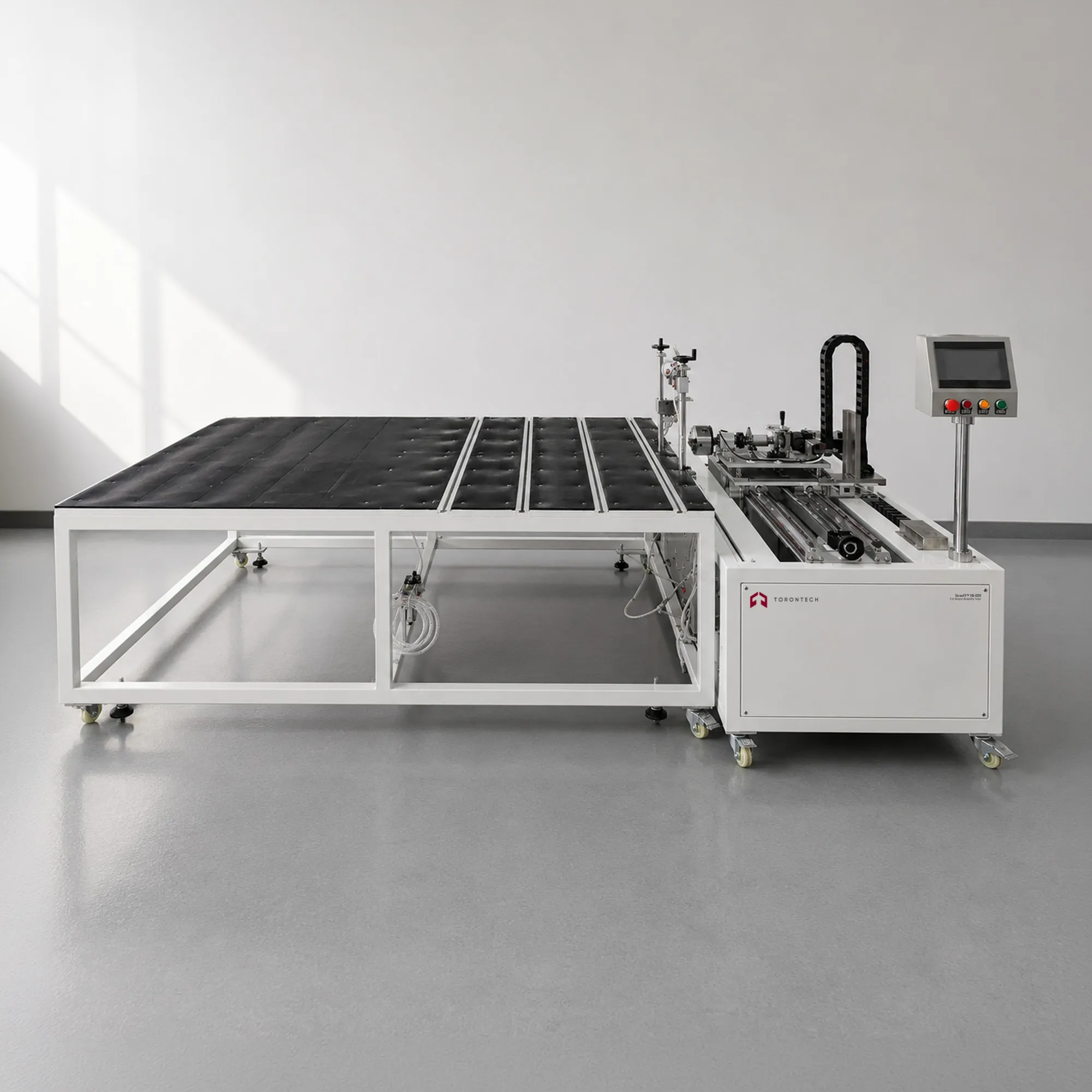
ToronFT™ FD-OCR fire damper opening and closing reliability tester performs automated endurance cycle testing on fire dampers, smoke fire dampers, smoke exhaust dampers, and normally-closed supply air dampers, verifying that each specimen completes the required number of open-close cycles without mechanical failure or functional degradation. The machine provides the cycling data required for pre-fire test qualification under EN 1366-2, durability classification under EN 15650, and product type approval under applicable building fire safety standards. By subjecting damper specimens to repeated actuation under controlled, reproducible conditions, the tester identifies wear patterns, seal deterioration, and actuator fatigue that would otherwise remain undetected until a damper fails in service.
The instrument consists of a steel-frame mounting fixture with a rubber-topped compound worktable, T-slot rails with quick-release clamps that accept damper specimens of varying sizes and configurations, a servo-motor-driven fork mechanism that engages and rotates the damper handle to open the damper, and a pneumatic cylinder assembly that applies pull, push, press, or squeeze closing forces depending on the damper type under test. The opening mechanism is position-adjustable and accommodates both clockwise and counterclockwise rotation, so the tester handles the full range of rotary-actuated fire damper designs. Fully electric fire dampers with their own motorised actuators can also be tested through an integrated electrical control circuit that triggers and monitors the damper's built-in drive.
A PLC controls the complete cycle sequence through a 7-inch colour touchscreen, setting the number of cycles, the dwell time at each end of travel, and the pneumatic supply pressure. An integrated cycle counter accumulates and displays the completed cycle count, with a minimum count capacity of 200 cycles per test run. The compressed air supply to the pneumatic closing actuator is regulated between 0 and 0.6 MPa, giving the operator control over the closing force applied to the damper blade or handle. At 750 W, the servo drive motor delivers consistent torque to the fork mechanism throughout the full cycle count without overheating or speed variation, maintaining test reproducibility from the first cycle to the last.
Fire Damper Reliability Tester - ToronFT™ FD-OCR Applications
The ToronFT™ FD-OCR covers the full range of fire damper endurance and qualification cycling applications, from pre-fire-test conditioning runs to full durability classification programs.
- Fire Damper Manufacturers: pre-production endurance cycling of new damper designs to verify mechanical durability before submitting specimens for fire resistance testing under EN 1366-2, reducing the risk of mechanical failure during the furnace test sequence.
- Accredited Fire Testing Laboratories: pre-fire test cycling of damper specimens per EN 1366-2, which requires 50 open-close cycles before the ambient leakage test and fire resistance test begin, confirming that mechanical cycling does not compromise subsequent fire performance.
- Durability Classification Testing for CE Marking: cycle endurance testing per EN 15650 Annex C to establish the C-class cycle count (C500, C1000, C10000) declared in the damper’s Declaration of Performance, supporting CE marking under the Construction Products Regulation.
- Smoke Fire Damper Qualification: combined open-close reliability testing of fire and smoke combination dampers, confirming that the blade seal assembly and actuator linkage maintain functional integrity after the full cycle count required for their intended duty class.
- Smoke Exhaust Damper Testing: endurance cycling of smoke exhaust dampers used in smoke control systems, verifying that motorised actuators and blade mechanisms operate reliably through the cycles needed to meet the maintenance and service life requirements of the installation.
- Normally-Closed Supply Air Damper Testing: opening and closing cycle tests on normally-closed supply air dampers that must open reliably on a fire signal and close again during regular functional checks, confirming actuator spring-return and handle-reset performance.
- Actuator Integration and Assembly Verification: testing of fire dampers with their associated electrical or pneumatic actuators assembled as a complete unit, confirming that the actuator does not cause the damper to fail any mechanical requirement when operated through its rated cycle count.
- Product Development and Design Optimisation: accelerated wear testing of blade seals, return springs, fusible links, and handle-locking mechanisms during R&D, using the adjustable cycle count and pneumatic force settings to isolate the contribution of individual design variables to long-term reliability.
Fire Damper Reliability Tester - ToronFT™ FD-OCR Key Features
The ToronFT™ FD-OCR combines a servo-driven opening mechanism, a pneumatic closing actuator, and a PLC control system in a rigid steel fixture designed specifically for fire damper open-close endurance cycle testing.
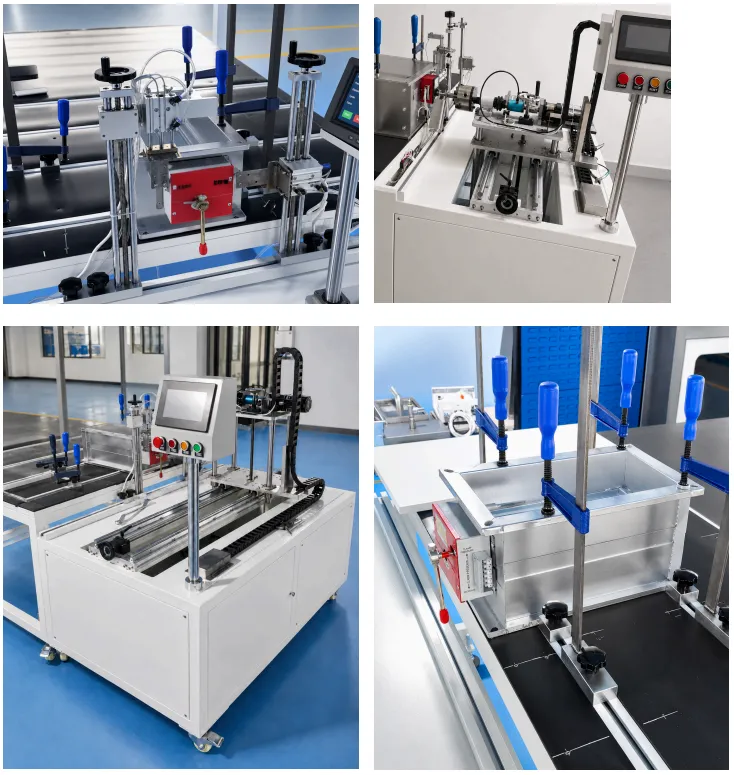
- Universal Quick-Clamp Steel Mounting Fixture: a steel section frame with composite rubber worktable surface and T-slot guide rails accepts dampers of varied sizes via adjustable quick-release clamps, enabling specimen changeover without tools and consistent alignment for every test run.
- Servo-Motor-Driven Fork Opening Mechanism: a 750 W servo motor, gearbox reducer, three-jaw centering chuck, and fork assembly engage the damper handle to rotate it open with controlled, repeatable torque; position and engagement height are adjustable along the fixture rail to accommodate different damper handle geometries.
- Bidirectional Rotation for All Rotary Damper Types: the servo drive supports both clockwise and counterclockwise opening directions, covering the full range of rotary-actuated fire damper and smoke damper designs without hardware changes.
- Pneumatic Cylinder Closing with Four-Mode Force Application: the closing actuator uses an air cylinder that delivers pull, push, press, or squeeze closing action, matching the reset mechanism of thermal-release, spring-return, and electrically-driven damper designs; air pressure adjusts from 0 to 0.6 MPa.
- Integrated Electrical Control Circuit for Fully Electric Dampers: an on-board electrical control circuit powers and commands the damper’s own motorised actuator during cycling, enabling full reliability testing of fully electric fire dampers and combination fire-smoke dampers without external control equipment.
- PLC Control with 7-Inch Colour Touchscreen: a programmable logic controller manages the complete cycle sequence; the 7-inch touchscreen lets the operator set cycle count, dwell times, and pneumatic pressure, then launch and monitor the test from a single interface without manual intervention.
- Cycle Counter with Minimum 200-Cycle Capacity: the integrated counter accumulates completed cycles continuously, displaying the running total on-screen; the minimum counter capacity of 200 cycles meets the pre-fire cycling requirements of EN 1366-2 and supports initial durability screening runs before full C-class testing.
- Fault Detection and Automatic Stop: if the damper fails to complete an opening or closing stroke within the programmed travel time, the PLC registers a fault, stops the test at the failure cycle, and holds all count data, providing the precise cycle number at which mechanical failure occurred for test report documentation.
- Compact AC 220 V Single-Phase Supply: the instrument operates from a standard single-phase 220 V supply at 0.8 kW total power, requiring only a compressed air connection at 0 to 0.6 MPa alongside the electrical supply, keeping laboratory infrastructure requirements minimal.
Theory and Method
Fire damper reliability testing applies the principle that a damper that can close quickly and completely, and then re-open and re-close repeatedly without mechanical degradation, is a damper that will perform correctly when a real fire event demands it. A single closure check after manufacture does not reveal whether the blade-to-frame sealing geometry, the actuator spring loading, the handle locking detent, or the blade linkage will maintain consistent performance after repeated thermal cycling, vibration, or mechanical wear in service.
The EN 1366-2 pre-fire cycling requirement addresses this by mandating 50 open-close cycles before any leakage measurement, so that the specimen presented for the furnace fire test has already demonstrated mechanical repeatability under controlled conditions. EN 15650 extends this logic to declared C-class durability ratings, where a C10000 designation means the damper has completed 10,000 full open-close cycles, each defined as open to closed and back to open, without exceeding the prescribed travel time or showing evidence of structural failure.
The ToronFT™ FD-OCR replicates the actuation sequence the damper experiences in service by driving the opening motion through a servo-motor, reducer, three-jaw centering chuck, and fork assembly that engages the damper’s rotary handle in the same geometric relationship as a real wall-mounted actuator. The servo drive provides consistent torque and position control throughout the rotation arc, with adjustable direction to match clockwise or counterclockwise opening designs.
The fork engagement position is adjustable along the fixture rail, so the correct engagement geometry is maintained regardless of damper body size. For the closing stroke, a pneumatic cylinder drives the relevant closing mechanism, whether pull, push, press, or squeeze, replicating the spring-return or actuator-driven closure that the damper uses in its installed configuration. The 0 to 0.6 MPa adjustable air supply lets the operator set a closing force that matches the design specification of the specimen or the test standard requirement, ensuring that each closing stroke fully engages the blade seal without applying excessive force that would distort results.
The PLC monitors the position and completion of each stroke through the actuation feedback circuit, increments the cycle counter on each completed open-close-open or closed-open-closed sequence, and holds the programmable dwell time at each end of travel before initiating the next stroke. Dwell time is important because it allows the blade seal to fully seat and any spring energy in the actuator to dissipate before the reverse stroke begins, matching the timing of real maintenance test cycles.
If the damper fails to complete either stroke within the travel time limit, the PLC registers a fault, stops the cycle sequence, and holds the count at the failure point for recording in the test report. The accumulated count at fault termination, together with the cycle number at which any visible mechanical degradation is first observed, provides the data from which the declared cycle class of the specimen is established.
Fire Damper Reliability Tester - ToronFT™ FD-OCR Technical Specifications
| Parameter | Specification |
|---|---|
| Product Name | Fire Damper Opening and Closing Reliability Tester |
| Model | ToronFT™ FD-OCR |
| Applicable Standards | EN 1366-2, EN 15650, EN 13501-3, EN 12101-8 |
| Applicable Specimen Types | Fire dampers, smoke fire dampers, smoke exhaust dampers, normally-closed supply air dampers |
| System Composition | Damper mounting fixture; servo-motor fork opening drive; pneumatic cylinder closing mechanism; electrical control circuit; PLC control system |
| Mounting Fixture Frame | Steel section (square hollow section) structural frame |
| Worktable Surface | Composite rubber top surface on steel sub-frame |
| Specimen Clamping | T-slot guide rails with adjustable quick-release clamps; accommodates rectangular and non-standard damper body sizes |
| Opening Drive: Motor | Servo motor, 750 W |
| Opening Drive: Transmission | Gearbox reducer |
| Opening Drive: Engagement | Three-jaw centering chuck with fork; engages damper handle for rotary unlocking |
| Opening Drive: Rotation Direction | Bidirectional: clockwise and counterclockwise; selectable per damper design |
| Opening Drive: Position Adjustment | Position adjustable along fixture rail to match damper handle geometry |
| Closing Mechanism: Type | Pneumatic cylinder drive |
| Closing Mechanism: Force Modes | Pull, push, press, and squeeze; mode selected to match damper reset mechanism |
| Air Supply Pressure Range | 0 to 0.6 MPa |
| Electrical Control Circuit | Integrated circuit for fully electric fire damper actuation and reliability testing |
| Control System | PLC (programmable logic controller) |
| Operator Interface | 7-inch colour touchscreen; cycle count setting, dwell time, pneumatic pressure control, test start/stop |
| Cycle Counter Capacity | Minimum 200 cycles per test run; displays accumulated count continuously |
| Cycle Definition | One open stroke plus one close stroke (open→closed→open or closed→open→closed per EN 15650 Annex C) |
| Fault Detection | Automatic stop and fault register if stroke not completed within programmed travel time; cycle count held at failure point |
| Motor Power | 750 W (servo drive motor) |
| Total Instrument Power | 0.8 kW |
| Power Supply | AC 220 V, single phase (110V is also available) |
Standard Configuration
| Item | Description |
|---|---|
| Damper Mounting Fixture | Steel section frame with composite rubber worktable, T-slot rails, and adjustable quick-release clamps |
| Fork Opening Drive Assembly | 750 W servo motor, gearbox reducer, three-jaw centering chuck, and fork; bidirectional; position-adjustable on fixture rail |
| Pneumatic Closing Assembly | Air cylinder with pull/push/press/squeeze capability; pressure regulated 0–0.6 MPa |
| Electrical Control Circuit | Integrated control wiring for fully electric fire damper actuator testing |
| PLC Control System | PLC with 7-inch colour touchscreen operator interface; cycle programming, counter, fault detection, and display |
Facility Requirements (Customer Supplied)
| Requirement | Specification |
|---|---|
| Electrical Supply | AC 220 V, single phase; rated circuit breaker |
| Compressed Air Supply | 0 to 0.6 MPa clean dry compressed air; suitable connector to instrument inlet |