
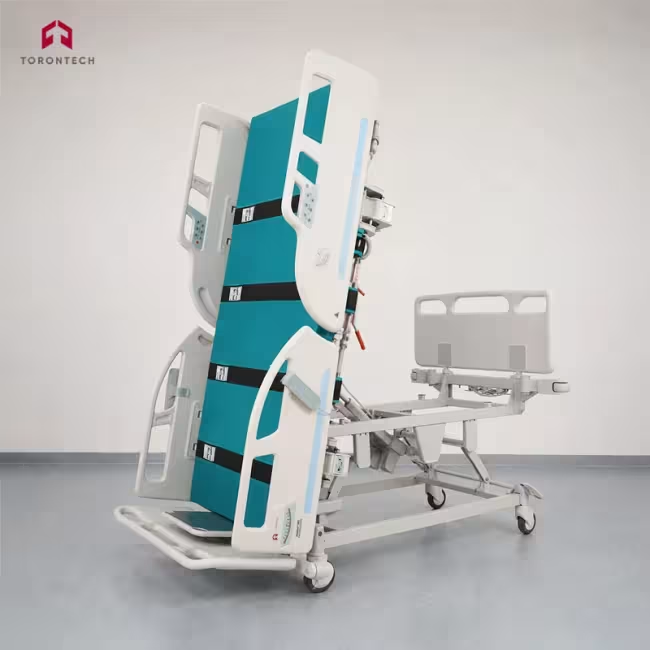
Electric Standing Hospital Bed - ToronCare™ 1055
Electric standing hospital bed ToronCare™ 1055 helps clinical teams move long-term bedridden patients from a supine position to a full standing posture, without a separate tilt table. Intensive care units, high-dependency wards, and rehabilitation departments use the platform to begin early mobilization. Staff can start standing therapy even while a patient remains on monitoring or drainage lines. Neurology and orthopedics teams use the same bed to bridge bed rest and standing therapy. This helps patients recovering from stroke, spinal cord injury, and orthopedic surgery.
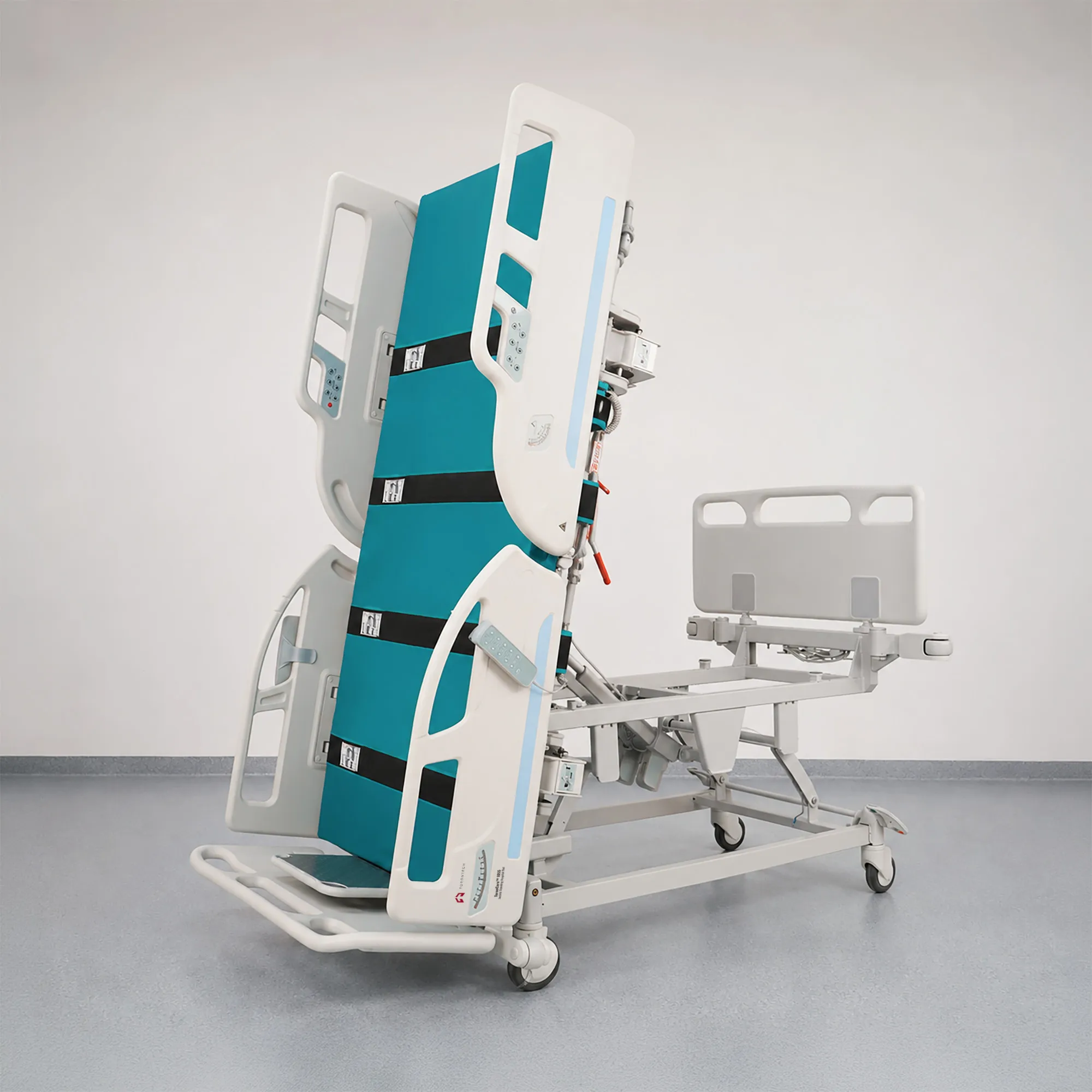
The ToronCare™ 1055 combines a dual-motor upright mechanism with a full set of standard bed functions. These include overall height lifting, Trendelenburg and reverse Trendelenburg positioning, and a one-click chair position. The bed tilts from horizontal to a full 80-degree standing angle. An adjustable backrest and thigh section support the patient through the transition. A footplate and restraint belt hold the patient securely as the angle increases. This lets one bed handle both routine positioning and structured standing therapy.
Extended bed rest carries known risks, including muscle atrophy, pressure injuries, and reduced respiratory function. The electric standing hospital bed addresses these risks by reintroducing gravitational loading in controlled stages. A standard ICU bed offers lifting, tilting, and a chair position. The ToronCare™ 1055 adds the standing function itself on top of those capabilities. This keeps a patient on one bed from initial assessment through active standing and early walking preparation. It also reduces the number of transfers a patient needs during recovery.
Electric Standing Hospital Bed - ToronCare™ 1055 Applications
The ToronCare™ 1055 supports progressive mobilization across care settings where prolonged bed rest is a concern, from acute intensive care through outpatient rehabilitation.
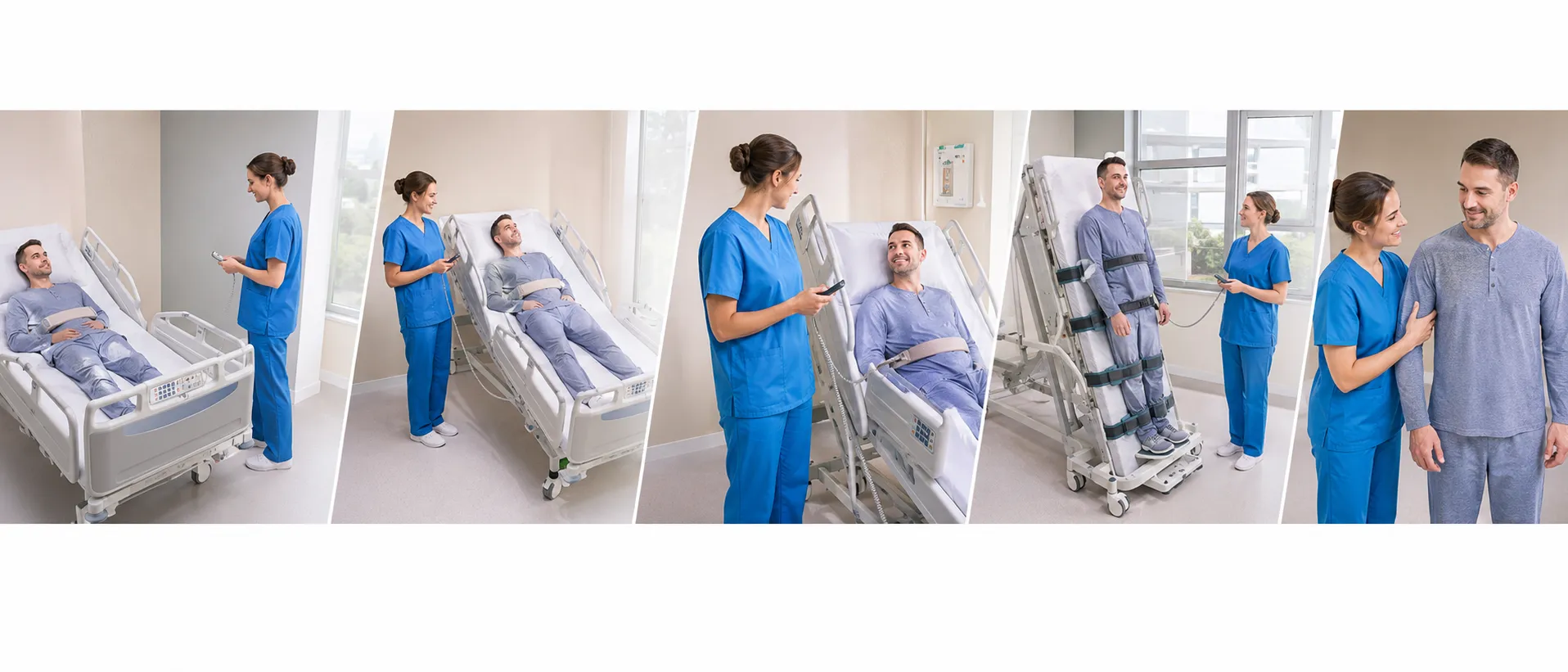
- Intensive Care and High-Dependency Units: supports early mobilization of ventilated or monitored patients through gradual, controlled verticalization without a manual transfer out of bed
- Neurology and Disorders of Consciousness Care: assists rehabilitation of stroke, traumatic brain injury, and vegetative or minimally conscious state patients, where verticalization is associated with improved arousal and cognitive recovery
- Orthopedics and Sports Injury Rehabilitation: helps patients regain standing tolerance and lower-limb weight-bearing after major orthopedic surgery or trauma
- Cardiopulmonary Rehabilitation: trains the circulatory system's response to upright posture and supports respiratory function during recovery from cardiac or pulmonary illness
- Spinal Cord Injury and Neurological Disease Rehabilitation: provides structured, progressive standing training for patients working to rebuild balance and lower-limb loading
- Long-Term and Serious Illness Care: reduces the complications of prolonged immobility for patients confined to bed for extended periods
- Burn Recovery and Extended Immobility Care: supports gradual reintroduction to upright posture for patients recovering from burns or a lengthy hospital stay
Standards
The ToronCare™ 1055 electric standing hospital bed is designed and built around recognized international engineering practices for electric hospital beds, covering areas such as side rail safety, emergency CPR release, and electrical control safety. Specific standard numbers were not listed in the supplier documentation for this model, so a detailed compliance list should be confirmed directly with Torontech before it is used in a specification-driven procurement decision.
Electric Standing Hospital Bed - ToronCare™ 1055 Key Features
The ToronCare™ 1055 pairs its standing function with a full set of safety and workflow features built for intensive care and rehabilitation nursing.
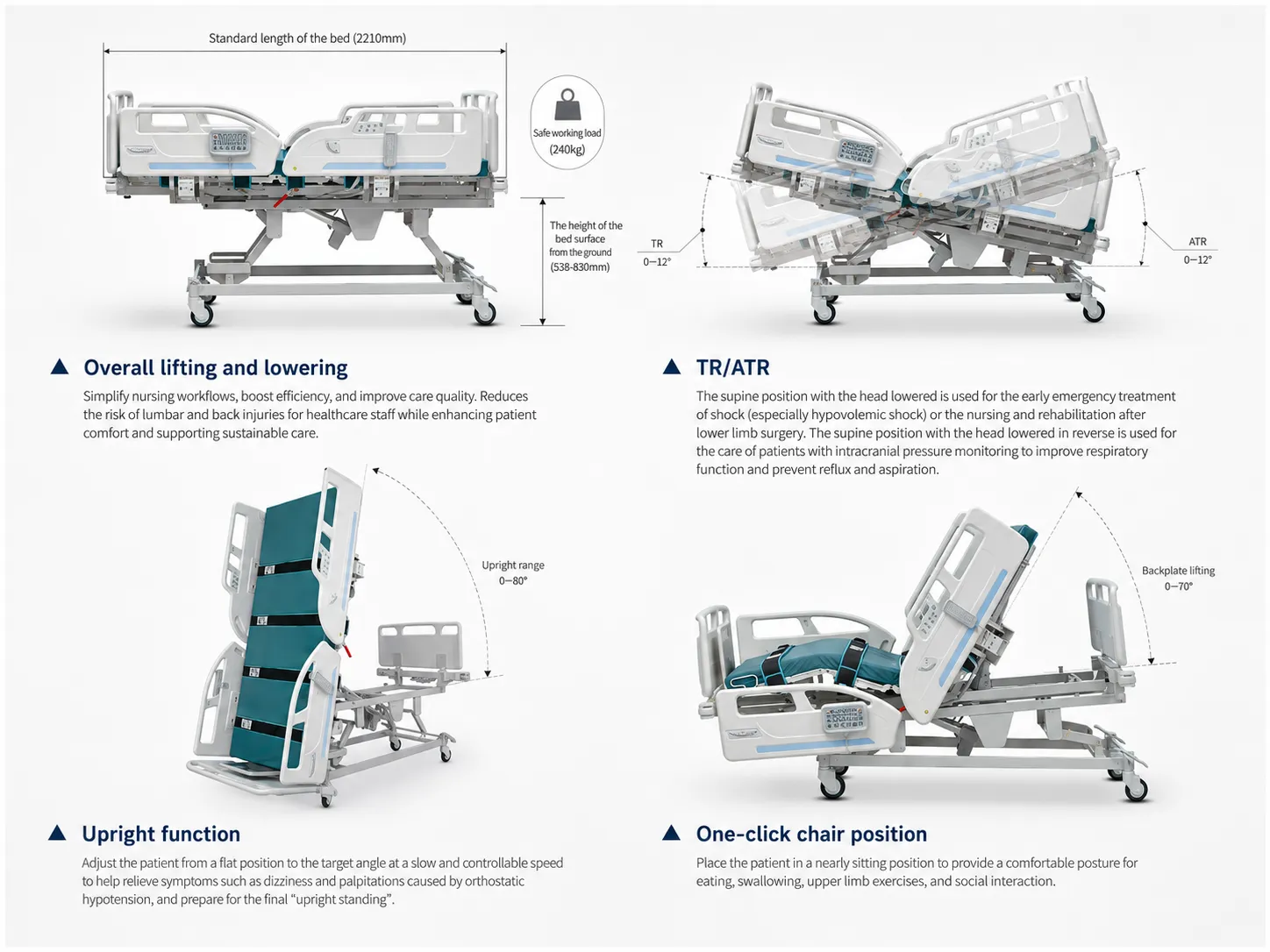
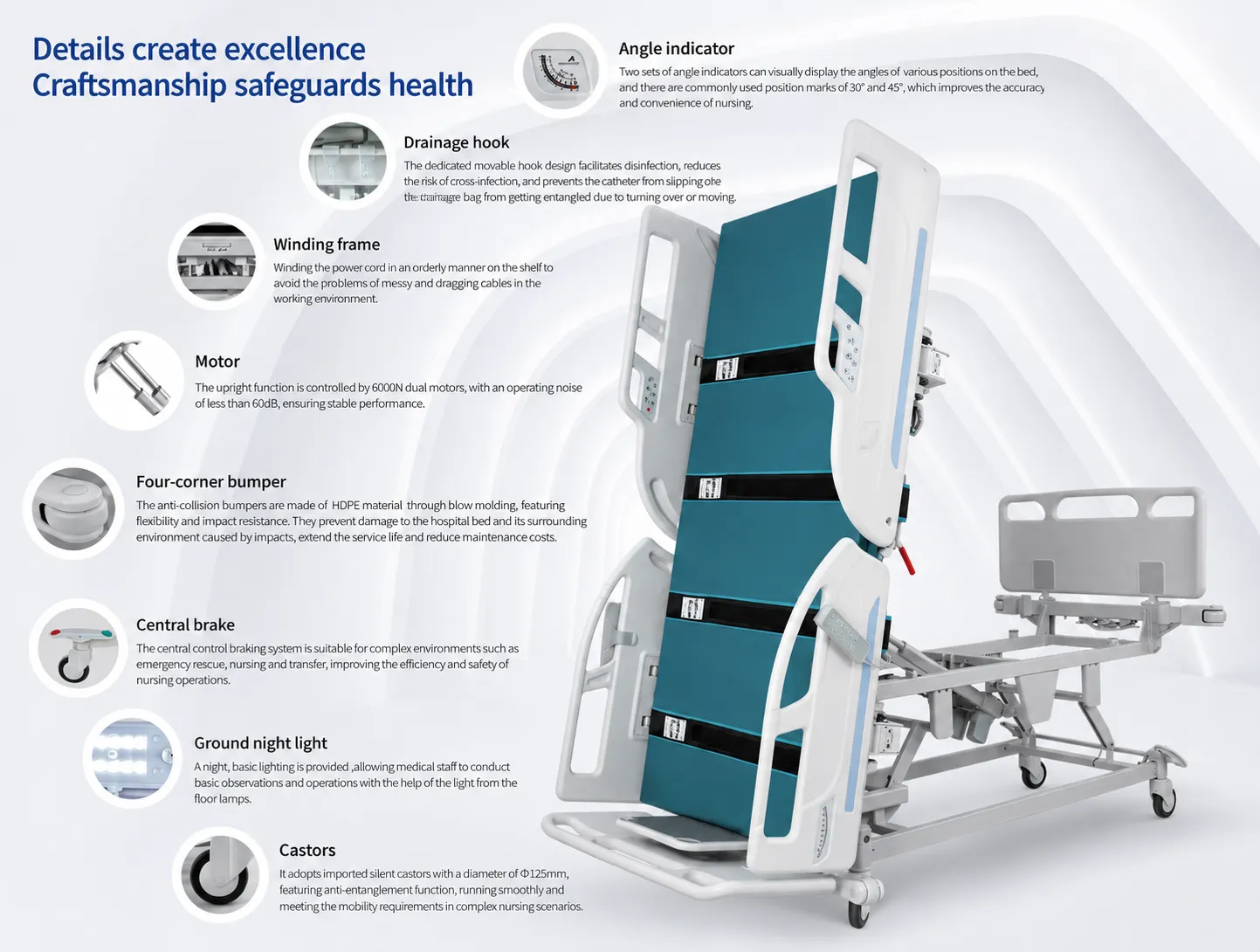
- Full-Body Standing Function: dual 6,000 N motors move the bed from horizontal to an 80-degree standing angle at an operating noise below 60 decibels, keeping sessions quiet for shared care spaces
- One-Click Chair Position: raises the patient to a near-sitting posture for eating, swallowing therapy, upper-limb exercise, and social interaction without a separate repositioning step
- Overall Bed Lift: adjusts the mattress platform from 530 mm to 830 mm, reducing the lumbar strain nursing staff face during transfers and care tasks
- Trendelenburg and Reverse Trendelenburg Positioning: supports early shock management and post-lower-limb-surgery care in the head-down position, and helps manage intracranial pressure and respiratory function in the head-up position
- Adjustable Backrest: raises the back section through a 0 to 70-degree range to support breathing, feeding, and general comfort
- Dual Angle Indicators: mark the commonly used 30-degree and 45-degree reference points on the side rail for accurate, repeatable positioning
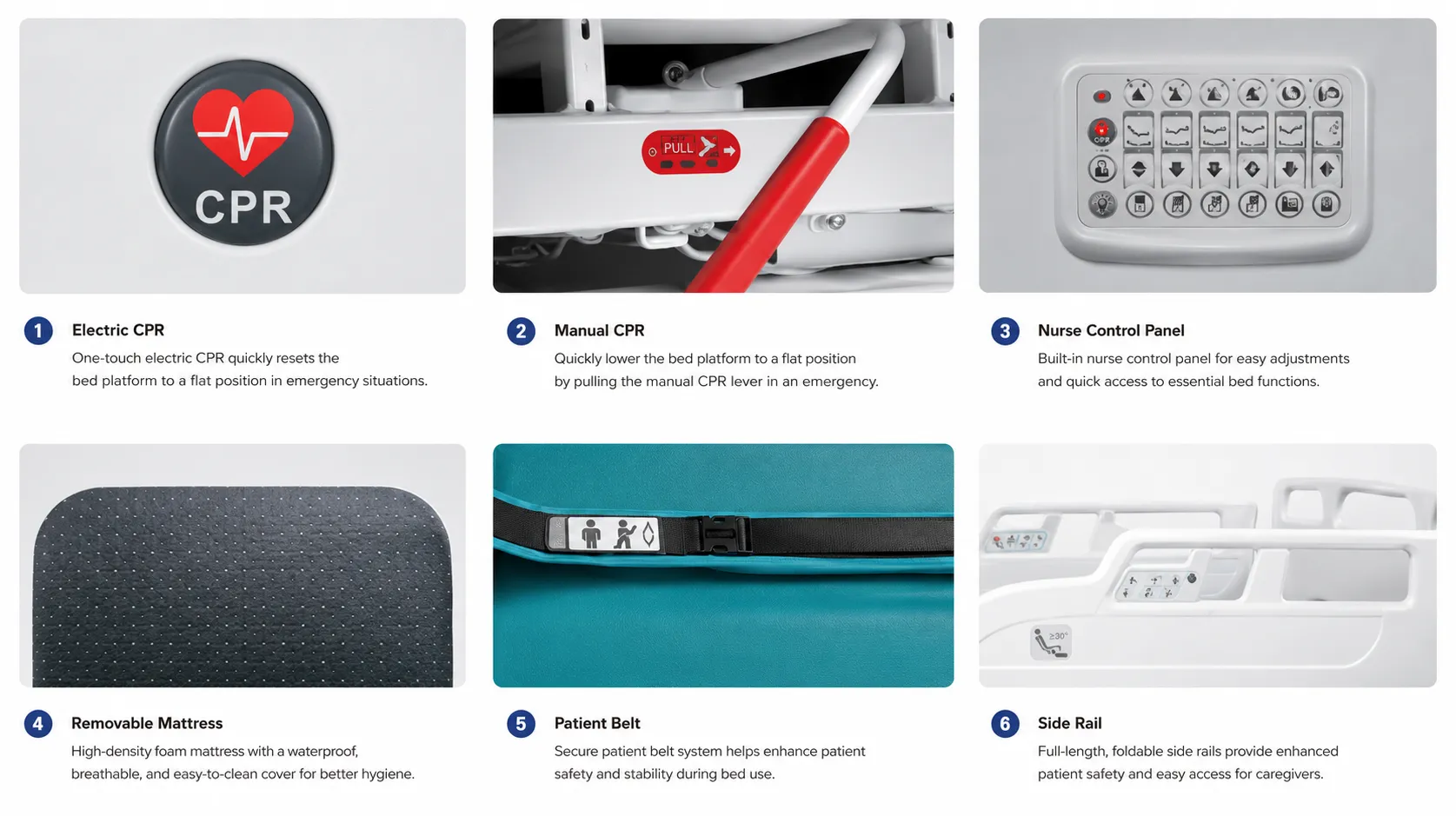
- Electric CPR Release: a single held button returns the bed to horizontal and its lowest height, freeing staff to focus on resuscitation during an emergency
- Manual CPR Backup: a red release wrench on either side of the bed flattens the backrest immediately if power is unavailable
- Full-Function Controller: waterproof and disinfectant-resistant housing with individually locked functions, reducing the chance of a patient or family member triggering an unintended movement
- Reinforced Foot Support Plate: a steel-and-EVA structure gives the patient a stable surface to bear weight against as the bed approaches the standing angle
- Padded Restraint Belt: double-layer PET fabric with an EVA core and inner and outer snap-fit closures, rated to 155 kg, keeps the patient secure during elevation
- Fully Enclosed Side Rails: designed to align with recognized European medical device safety practices, with controls positioned for easy access by patients and staff
- HDPE Corner Bumpers: blow-molded, impact-resistant bumpers at all four corners protect the bed frame and surrounding equipment from collision damage
- Central Brake and Steering System: a single central control brakes and steers the bed, simplifying transfers through corridors and crowded care areas
- Floor-Level Night Light: provides basic illumination for nighttime observation without switching on full room lighting
- Silent Anti-Entanglement Castors: 125 mm castors roll smoothly across mixed flooring while resisting cable and cord entanglement
- Movable Drainage Hook: a detachable hook design reduces cross-infection risk and keeps catheter lines from tangling during repositioning
- Integrated Cord Management: a shelf-mounted wrap keeps the power cord organized and out of the walking path
Theory and Method
Prolonged bed rest reduces the body's tolerance for an upright posture. When a patient who has been lying flat moves quickly to standing, blood pools in the veins of the legs and abdomen. Venous return to the heart drops as a result. Blood pressure can then fall faster than the baroreflex can compensate, a response known as orthostatic hypotension. Verticalization therapy raises the patient through a series of controlled angles instead of a single abrupt change. This gives the cardiovascular system time to adapt.
The ToronCare™ 1055 applies this principle through a dual-motor drive system that moves the bed surface from horizontal to a full 80-degree standing angle. The motors run at a steady, operator-controlled speed. Nursing staff can pause the bed at any intermediate angle and monitor the patient's heart rate and blood pressure. Staff can hold that position until the patient stabilizes before continuing. The angle indicator marks the commonly used 30-degree and 45-degree reference points. This gives staff a consistent visual reference for repeatable sessions.
Gradual weight-bearing through the legs and feet supplies mechanical loading that the skeletal and muscular systems lose during bed rest. This loading helps slow the muscle atrophy and bone density loss linked to immobility. The foot support plate gives the patient a stable surface to bear weight against near the standing angle. The restraint belt and side rails keep the patient secure throughout. Clinical research on tilt-table verticalization links this staged loading to improved alertness and faster functional recovery in patients with severe brain injury.
Electric Standing Hospital Bed - ToronCare™ 1055 Technical Specifications
| Parameter | Specification |
|---|---|
| Overall Dimensions | 2,210 mm (L) x 1,055 mm (W) x 530-830 mm (H) (±10 mm) |
| Bed Surface Height Range | 530 mm to 830 mm |
| Full-Body Standing (Upright) Angle | 0° to 80° |
| Backrest (Back Board) Angle | 0° to 70° |
| Upright Drive System | Dual motors, 6,000 N combined thrust |
| Operating Noise | Less than 60 dB |
| Restraint Belt Load Rating | 155 kg |
| Angle Indicator | 30° and 45° reference marks |
| Castor Diameter | 125 mm, silent, anti-entanglement |
| Side Rail Type | Fully enclosed |
| CPR Function | Electric (button-activated) and manual (wrench-activated), both sides |
| Controller Rating | Waterproof, splash-proof, disinfectant-resistant |