
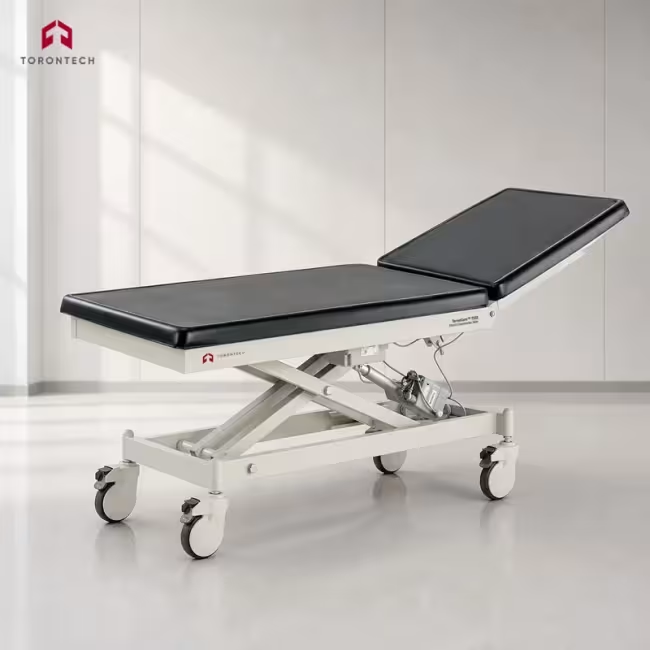
Electric Examination Table - ToronCare™ 1132
The ToronCare™ 1132 electric examination table is available in two configurations: foot-pedal control and handheld controller. Both versions use a single linear motor to drive height adjustment across a 545 to 775 mm range, and both share the same gas-spring backrest, 200 kg safe working load, and battery-backed control box.
The foot-pedal version keeps both hands free during patient transfers or exams that require continuous physical contact. The handheld controller version gives clinicians a portable push-button remote that can be used from any position around the table — a practical choice when standing directly over the foot pedal is awkward or when the clinician is seated during the exam. The gas-spring backrest adjusts from 0 to 45 degrees upward and 0 to 50 degrees downward in both configurations.
The ToronCare™ 1132 suits general practice rooms that need reliable electric height adjustment without the cost or complexity of a fully motorized multi-function platform.
Electric Examination Table - ToronCare™ 1132 Applications
The ToronCare™ 1132 suits general clinical settings where routine height and backrest adjustment cover most exam needs.
- General Practice and Outpatient Exams: foot-pedal height adjustment accommodates patients and clinicians of different heights without manual cranking
- Physical Assessment and Minor Procedures: gas-spring backrest adjustment supports both semi-reclined and prone-leaning positions for a range of routine exams
- Multi-Provider Clinic Rooms: quick pedal-controlled height changes reduce setup time between patients seen by different practitioners
- Space-Conscious Exam Rooms: a simpler mechanical layout suits clinics that do not require lateral translation or Trendelenburg tilt
- Mobile Clinic Use: individually braked castors support repositioning the table within a room or between spaces
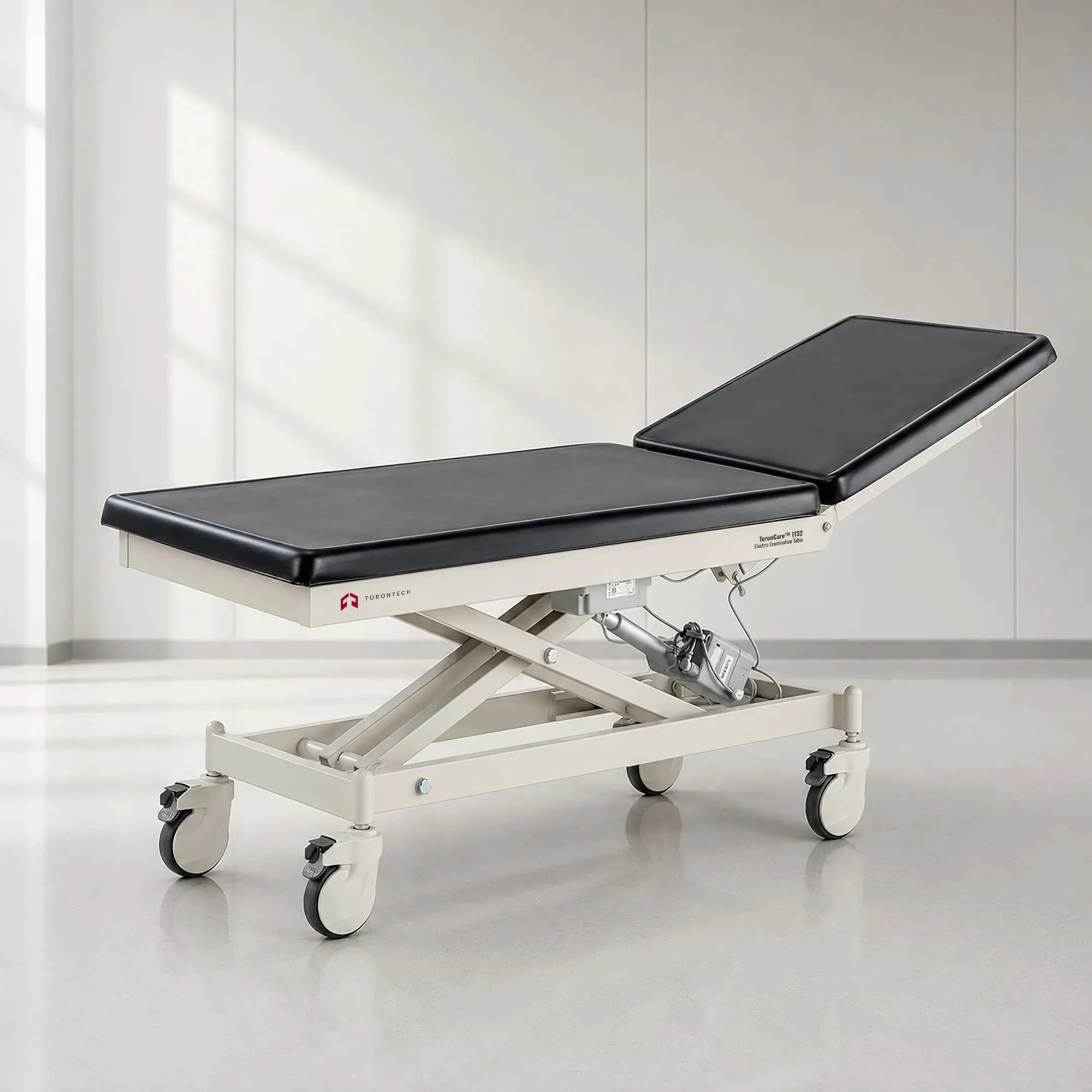
Electric Examination Table - ToronCare™ 1132 Key Features
The ToronCare™ 1132 pairs electric height adjustment with a gas-spring backrest for straightforward, everyday exam table use.
- Foot-Pedal Height Adjustment (545-775 mm): a single linear motor raises and lowers the table at the pedal, keeping both hands free during positioning
- Gas-Spring Backrest (0-45° Up, 0-50° Down): moves smoothly in both directions without waiting on a motor, supporting a range of exam positions
- Individually Braked Castors (125 mm): each of the four castors locks separately for stable positioning at the bedside
- Battery-Backed Control Box: keeps the height adjustment function powered between charges
- Foam Mattress: provides a supportive, comfortable surface for routine exams and minor procedures
- Two Control Configurations — Foot Pedal or Handheld Controller (545–775 mm): a single linear motor raises and lowers the table via foot pedal (hands-free operation) or handheld push-button remote (portable control from any position around the table)
Theory and Method
Height adjustment runs through a single linear motor connected to the table's scissor-lift base. The motor converts an electrical signal into direct push-and-pull force along a fixed axis. This force drives the scissor mechanism open or closed to raise or lower the mattress platform. Foot-pedal control lets staff adjust height while both hands stay on the patient. This matters most during a transfer or an exam that needs continuous physical contact.
The handheld controller version replaces the foot pedal with a wired push-button handset. The handset sends the same electrical signal to the linear motor, so the height adjustment mechanism works identically. The practical difference is ergonomic: a clinician seated during an exam can hold the controller and adjust height without reaching with a foot. Both control types connect to the same battery-backed control box.
The backrest works on a different principle. A gas spring stores compressed gas in a sealed cylinder, and releasing a locking valve lets the piston move while the compressed gas resists sudden motion. This gives the backrest smooth, controlled movement in both directions without an electric motor. The 0 to 45-degree upward range and 0 to 50-degree downward range let staff angle the backrest above or below the main platform level to suit the position an exam requires.
Combining an electric height mechanism with a gas-spring backrest reflects a deliberate mechanical tradeoff. Height adjustment happens often during a clinic day and benefits from consistent, repeatable motor control. Backrest angle changes happen within a single exam and benefit from the instant, hand-driven response a gas spring provides. This split keeps the table responsive where speed matters most, without the cost of motorizing every function.
Electric Examination Table - ToronCare™ 1132 Technical Specifications
| Parameter | Specification |
|---|---|
| External Dimensions | 1,940 mm (L) x 630 mm (W) |
| Mattress Platform Dimensions | 1,940 mm (L) x 630 mm (W) |
| Mattress Platform Ground Clearance | 545 mm to 775 mm |
| Backrest (Upward) | 0° to 45° (±5°) |
| Backrest Downward | 0° to 50° (±5°) |
| Castor Diameter | 125 mm |
| Safe Working Load | 200 kg |
| Configuration Item | Foot Pedal Version | Handheld Controller Version |
|---|---|---|
| Control Box | 1 pc | 1 pc |
| Linear Motor | 1 pc | 1 pc |
| Foot Pedal | 1 set | — |
| Handheld Controller | — | 1 set |
| Battery | 1 pc | 1 pc |
| Backrest Gas Spring | 1 set | 1 set |
| Individual Brake Castor | 4 pcs | 4 pcs |
| Foam Mattress | 1 set | 1 set |