
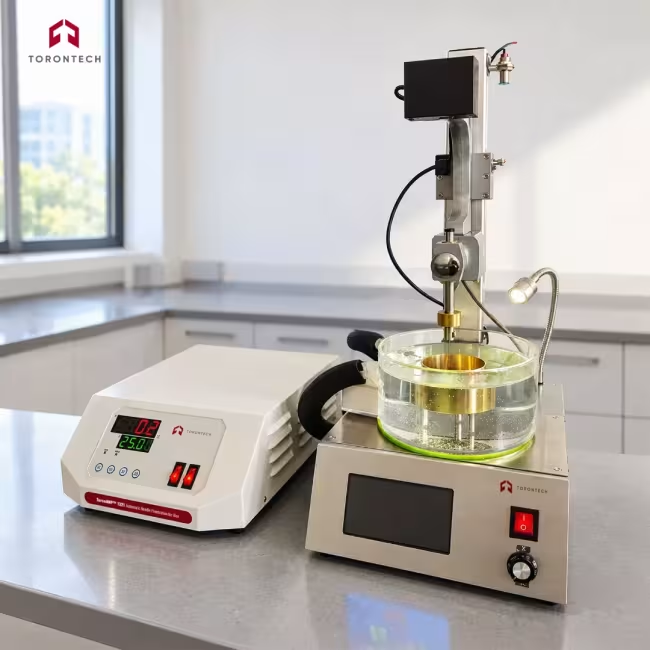
Automatic Needle Penetration for Wax
Automatic Needle Penetration for Wax - ToronANP™ 1321
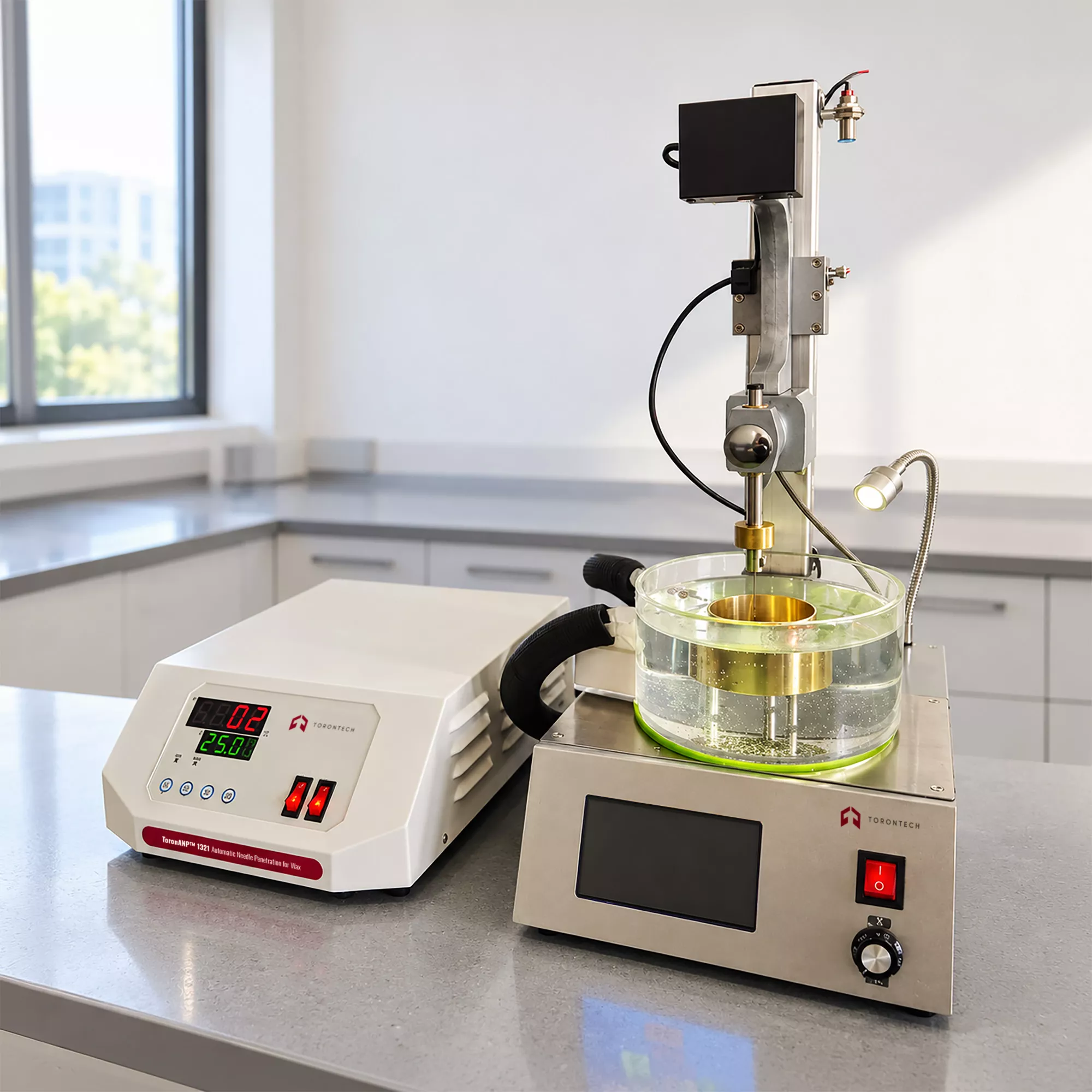
The ToronANP™ 1321 automatic wax penetrometer measures the needle penetration of petroleum waxes for refineries, wax blenders, and quality-control labs. It follows ASTM D1321, which estimates wax consistency from how deep a standard needle sinks into a conditioned sample. A laser sensor finds the sample surface without contact, so nobody sets the needle tip by eye. The instrument then releases the needle, times the drop, and reports the result. Labs get repeatable hardness data with less operator influence.
The integrated design combines laser detection, an electric lifting system, an LCD controller, and a thermostatic water bath in one compact setup. Operators set the test time and bath temperature on the display, and the controller averages repeated readings. The lifting system adjusts speed electronically and locks at any height. The digital water bath controls sample temperature between 23 °C and 35 °C with 0.05 °C accuracy. These functions shorten each test cycle and keep conditions stable.
Wax producers use penetration values to grade paraffin and microcrystalline waxes, while formulators rely on them to hit hardness targets. Cosmetic, packaging, candle, and food-coating manufacturers all specify wax by penetration. The ToronANP™ 1321 gives these teams a direct, method-based number for checking incoming material and finished batches. Contact Torontech for configuration details and a quotation.
Applications
Needle penetration data shows how a wax will behave during processing and in the finished product. The ToronANP™ 1321 supports hardness testing wherever petroleum waxes are produced, blended, or specified.
- Petroleum Wax Refining and Grading: verifies the hardness of paraffin, microcrystalline, and slack waxes for product grading and certificates of analysis
- Cosmetics and Pharmaceuticals: controls wax hardness in lipsticks, balms, creams, and ointments, where consistency affects structure, stability, and application feel
- Paper and Packaging Coatings: confirms coating waxes have the right hardness for scuff resistance and to prevent blocking during storage and transport
- Food Coatings: checks the consistency of waxes applied to cheese, fruit, and other food products so the protective layer stays intact
- Candle Manufacturing: matches wax hardness to candle type, mold release behavior, and burn performance
- Inks, Polishes, and Adhesives: sets wax hardness during formulation to control rub resistance, gloss, and flow
- Research and Product Development: characterizes new wax blends and additives before scale-up
Standards
The ToronANP™ 1321 is designed to align with the ASTM test method for needle penetration of petroleum waxes. The method applies to waxes with a penetration of 250 or less, so labs should confirm their samples fall within that scope.
- ASTM D1321 - Standard Test Method for Needle Penetration of Petroleum Waxes
Key Features
The ToronANP™ 1321 automates the steps that most affect penetration accuracy: surface location, needle release, timing, and temperature control.
- Laser Non-Contact Surface Detection: locates the wax surface automatically and removes the manual needle-tip adjustment that introduces operator error
- Integrated Test Platform: combines laser detection, electric lifting, LCD control, and a thermostatic water bath in one coordinated instrument
- Programmable LCD Controller: lets operators set test time and temperature, then runs the measurement, calculates the average, and stores results
- Electric Lifting System with Adjustable Speed: moves the needle assembly into position at an electronically controlled speed
- Low-Voltage DC Locking Device: holds the moving assembly securely for safe, dependable operation
- Self-Locking Support: stops and holds firmly at any position along its travel
- Manual Release Mechanism: gives operators a backup way to release the needle when needed
- Digital Thermostatic Water Bath: provides adjustable temperature with both heating and cooling, in a transparent acrylic tank for clear sample viewing
- Cold Light Source and Magnifier: lights the test area without warming the sample and makes the needle position easy to see
- Leveling Screws and Spirit Level: allow quick, precise leveling so the needle drops vertically into the sample
Theory and Method
Needle penetration is an empirical hardness test for semisolid and solid materials. ASTM D1321 places a standard needle, carrying a total load of 100 g, on the surface of a temperature-conditioned wax sample. The instrument releases the needle for 5 seconds, and the needle sinks under its own weight. Softer wax offers less resistance, so the needle travels deeper. The penetration value equals that depth in tenths of a millimeter.
Wax hardness changes sharply with temperature, so the method depends on careful sample conditioning. The operator melts the wax, casts it into a container, cools it under controlled conditions, and then holds it in a water bath at the test temperature. Labs commonly report results at 25 °C. The ToronANP™ 1321 bath holds the set point within 0.05 °C, which limits drift between readings. The controller then averages penetrations taken at separate points on the surface.
Manual penetrometers require the operator to lower the needle until its tip just touches the wax, often judged with a light and mirror. Small errors at this step shift the zero point and the final reading. The ToronANP™ 1321 replaces visual setting with laser non-contact detection, which locates the surface before release. A timer with an error of 0.02 s or less controls the drop, and the system records the needle travel as the penetration value.
Technical Specifications
| Parameter | ToronANP™ 1321 |
|---|---|
| Measuring Range | 0 to 600 penetration units (0.1 mm) |
| Needle Release Stroke | Over 60 mm |
| Timing Range | 1 to 90 s, adjustable |
| Timing Error | ≤ 0.02 s |
| Stability (Δu) | ≤ 0.2 |
| Temperature Control Range | 23 to 35 °C |
| Temperature Accuracy | 0.05 °C |
| Surface Detection | Laser, non-contact |
| Display | LCD with test time and temperature settings, averaging, and result storage |
| Water Bath | Digital thermostatic bath, acrylic tank, heating and cooling |
| Main Unit Dimensions (L × W × H) | 340 × 260 × 660 mm |
| Water Bath Dimensions (L × W × H) | 230 × 300 × 200 mm |
| Applicable Standard | ASTM D1321 |