
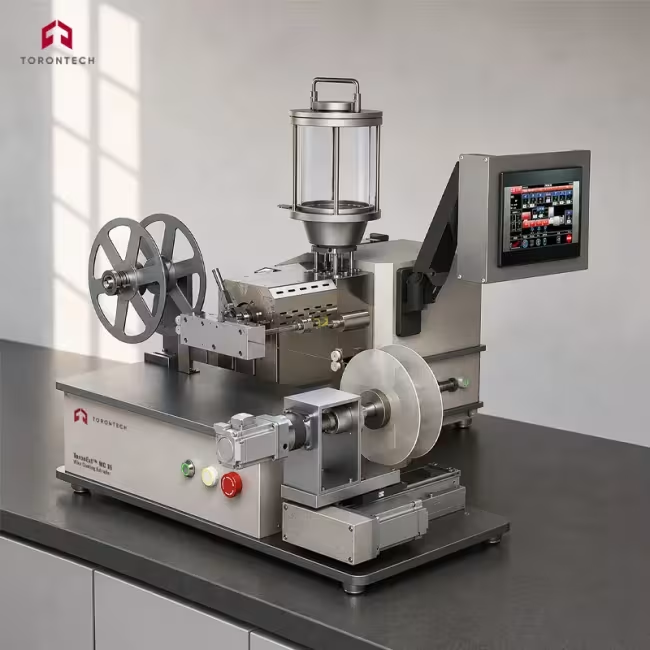
Wire Coating Extruder - ToronExt™ WC 16
The ToronExt™ WC 16 wire coating extruder applies a thermoplastic layer to a continuous core as it passes through a crosshead die. A 16 mm screw feeds the die, and the take-off draws coated product at 3 to 15 m/min. The design targets continuous carbon fiber with thermoplastic resin, where the resin must penetrate the tow rather than sit on its surface. Coated output serves fiber-reinforced 3D printing filament, reinforced cable, and composite core development.
Impregnation separates this machine from a simple sheathing extruder. Melt pressure inside the die forces resin between individual filaments, wetting the fiber bundle through its cross section. Poor penetration leaves dry fiber at the core, and a printed or loaded part then fails at that interface long before the fiber reaches its own strength. Close die tolerances and steady temperature keep the coating complete, with no starved sections or missed coverage.
Two compact units make up the line: the extruder and die at 65 kg, and a separate haul-off and winder at 33 kg. Both run on single-phase 220 V, so installation needs no three-phase service. Bench space of roughly 1.5 m accommodates the pair. Laboratories developing composite feedstock can therefore run trials without committing floor space to a production line.
Wire Coating Extruder - ToronExt™ WC 16 Applications
The ToronExt™ WC 16 suits laboratories and development groups that need to combine a continuous core with a thermoplastic sheath at controlled speed and temperature.
- Continuous Fiber Reinforced Filament: coats carbon fiber tow with thermoplastic resin to produce feedstock for reinforced additive manufacturing
- Fiber Impregnation Research: evaluates how resin chemistry, temperature, and line speed affect wet-out through the fiber bundle
- Composite Core Development: builds thermoplastic-matrix rods and cores for structural and semi-structural components
- Reinforced Cable and Strength Members: applies polymer over fiber or wire cores used as tension members in cable assemblies
- Polymer Overjacketing Trials: adds a secondary layer over an existing coated core to test adhesion and layer compatibility
- Resin and Fiber Compatibility Screening: compares matrix candidates against a given reinforcement before committing to a larger trial
- Coating Uniformity Development: tunes die conditions to achieve concentric, defect-free coverage on small-diameter cores
- Specimen Preparation for Composite Testing: produces coated strand for tensile, interfacial shear, and thermal analysis
- University and Institute Research: demonstrates crosshead coating, melt impregnation, and draw mechanics on a bench-scale unit
- Small-Batch Specialty Feedstock: supplies short runs of coated filament or core that no commercial supplier offers off the shelf
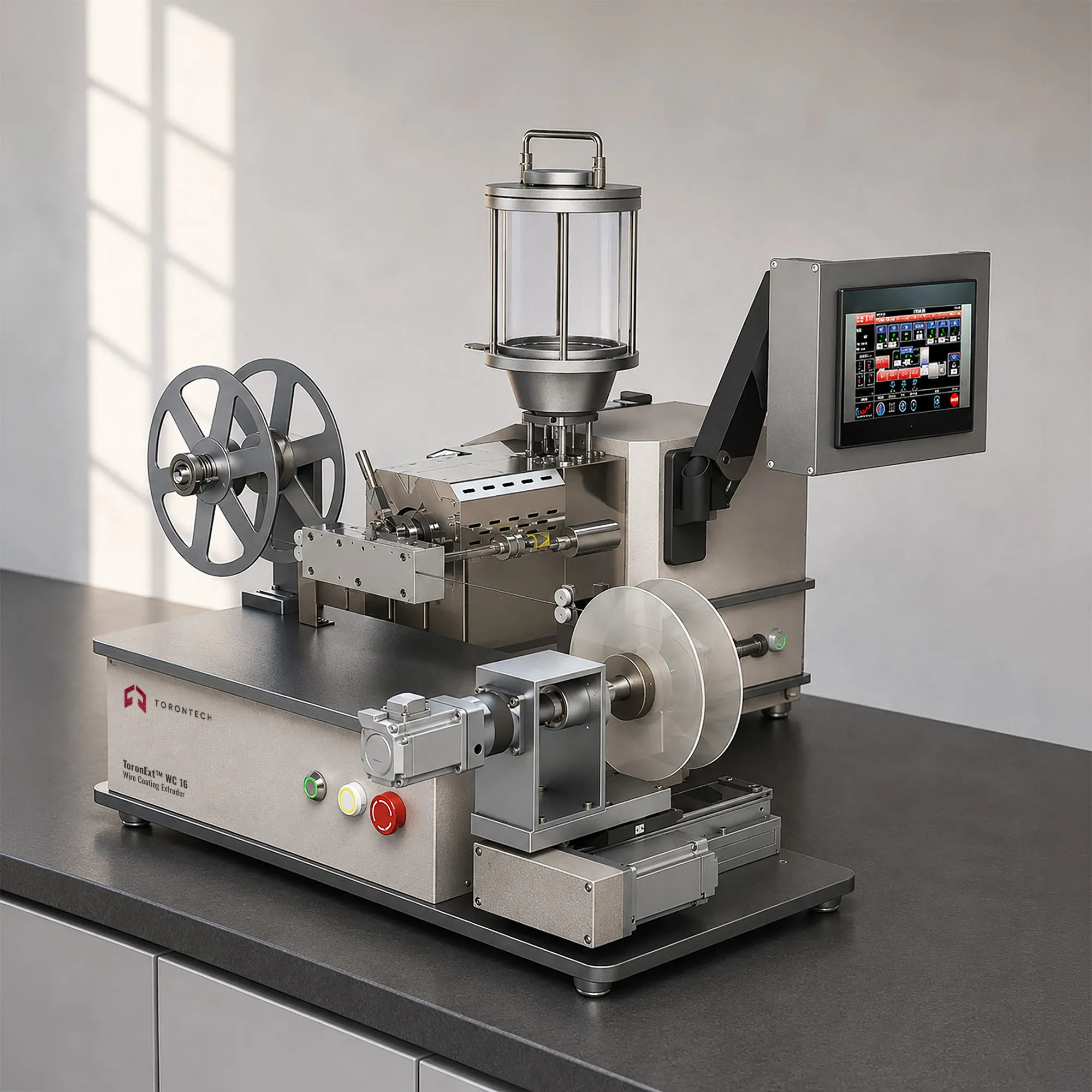
Wire Coating Extruder - ToronExt™ WC 16 Key Features
The ToronExt™ WC 16 pairs a compact coating extruder with a matched haul-off and winder, built around a die that puts resin through the fiber rather than around it.
- Purpose-Built Crosshead Coating Die: distributes melt evenly around the core for concentric coverage without starved sections or missed coating
- Deep Fiber Impregnation: drives resin between individual filaments so the matrix bonds through the tow rather than skinning its outer surface
- Tight Die Sealing: holds melt pressure at the tooling, which is what forces resin into the bundle instead of letting it bypass the fiber
- Precise Multi-Zone Temperature Control: holds three heated zones to 380 °C, covering commodity through higher-temperature engineering resins
- 0.1 to 150 rpm Screw Speed: gives fine control over resin throughput, which sets coating thickness at a given line speed
- Short 14:1 Screw: limits residence time and thermal history, protecting heat-sensitive polymers during the melt stage
- 3 to 15 m/min Continuous Line Speed: covers slow, high-impregnation passes through faster coating runs on the same machine
- Integrated Haul-Off and Winder: draws and spools coated product under steady tension so diameter stays consistent along the length
- Single-Phase 220 V Operation: installs on standard laboratory power, with no three-phase supply required for either unit
- Compact Two-Unit Layout: extruder at 65 kg and take-off at 33 kg, light enough to reposition and small enough for a laboratory bench
- Multi-Material Compatibility: handles a range of resin and reinforcement combinations for exploratory development work
Theory and Method
Crosshead coating turns the melt stream ninety degrees. The extruder delivers resin along its own axis, and the die redirects that flow around a core that passes through the tooling on a perpendicular path. Melt meets the core inside the die, wraps it, and exits as a single coated strand. Concentricity depends on how evenly the melt distributes around the annulus, which is why die design and thermal uniformity matter more here than screw geometry.
Wetting a fiber tow is a pressure and time problem. Resin has to travel between thousands of filaments against capillary resistance, and viscosity works against it the whole way. Higher die temperature lowers viscosity and helps penetration, while slower line speed gives the melt more residence time inside the tooling. Running too hot degrades the polymer, so the operating window sits between those limits and shifts with each resin and fiber combination.
The 14:1 screw reflects what this extruder actually has to do. Compounding happens upstream, so the screw only needs to melt and pump a steady, pressure-stable stream into the crosshead. A short barrel reduces residence time, which protects heat-sensitive resins that would degrade in a long compounding screw. Coating thickness then follows the ratio between resin throughput and line speed, so holding both steady is what holds diameter steady.
Wire Coating Extruder - ToronExt™ WC 16 Technical Specifications
| Parameter | Specification |
|---|---|
| Screw Diameter | 16 mm |
| Screw L/D Ratio | 14:1 |
| Screw Speed Range | 0.1 to 150 rpm |
| Temperature Range | Zones 1, 2, 3: up to 380 °C |
| Continuous Coating Speed | 3 to 15 m/min |
| Main Unit Power Supply | AC 220 V ±10 %, 50/60 Hz, 1,600 W (110V is also available) |
| Haul-Off and Winder Power Supply | AC 220 V ±10 %, 50/60 Hz, 800 W (110V is also available) |
| Main Unit Dimensions (L × W × H) | 650 × 360 × 720 mm |
| Main Unit Weight | 65 kg |
| Haul-Off and Winder Dimensions | 860 × 380 × 500 mm |
| Haul-Off and Winder Weight | 33 kg |
| Target Materials | Continuous carbon fiber with thermoplastic resin |
| Typical Output Products | Reinforced 3D printing filament, reinforced cable, composite core |