
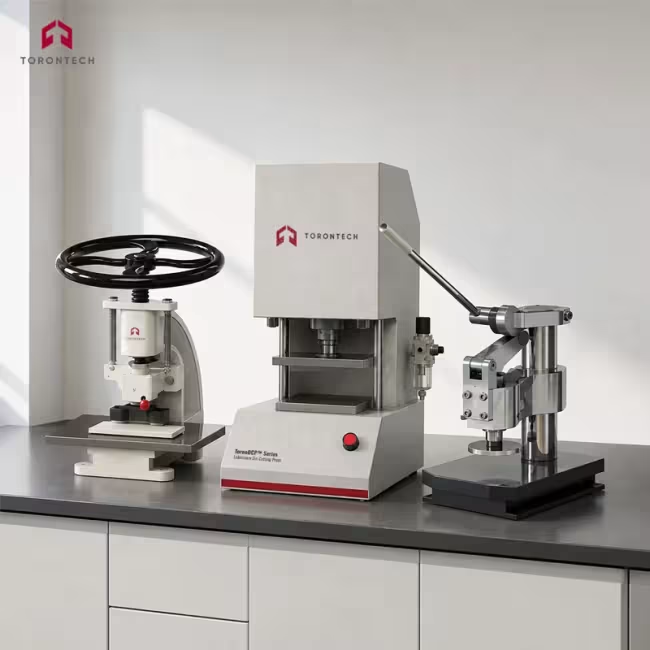
Laboratory Die Cutting Press
Laboratory Die Cutting Press - ToronDCP™ Series
ToronDCP™ Series laboratory die cutting press stamps test specimens from rubber, plastic, film, leather, and similar sheet materials. Three configurations cover the range: a lever press for occasional work, a pneumatic press for routine volume, and a rotary table press for larger sheets. Cutting force runs from 1.8 tons on the lever model to 5 tons on the pneumatic. Each accepts standard cutting dies, so specimen geometry follows whatever the test method requires.
Specimen quality decides test validity long before the sample reaches a tensile machine. A clean die cut leaves parallel edges and no nicks, while a ragged edge seeds a tear that makes the specimen fail early and low. Sharp dies, a flat cutting pad, and consistent force are what keep results repeatable across a batch. The press supplies the force and alignment; the die supplies the shape.
Choosing between the three comes down to volume and sheet size. The lever model cuts with hand force through a 390 mm arm, which suits a few specimens at a time. The pneumatic model runs on a 0.4 MPa air supply with adjustable 20 to 60 mm stroke, cutting thicker stock and higher counts without operator fatigue. The rotary table model offers the largest work surface, 320 by 228 mm, for specimens taken from wide sheet.
Laboratory Die Cutting Press - ToronDCP™ Series Applications
The ToronDCP™ Series prepares specimens for any laboratory that tests sheet materials, from incoming inspection through formulation development.
- Tensile Specimen Preparation: cuts dumbbell and dogbone outlines from rubber and plastic sheet for tensile testing on a universal testing machine
- Rubber Compound Testing: produces test pieces from cured sheet for tensile, tear, hardness, and aging evaluation
- Plastic Film and Sheet Testing: cuts strip and dumbbell specimens from thin film without stretching or curling the edges
- Leather and Textile Testing: prepares specimens from leather, coated fabric, and technical textiles for strength and durability work
- Tear Resistance Specimens: cuts trouser, angle, and crescent shapes where notch geometry has to be exact
- Incoming Material Inspection: turns supplier sheet into test pieces quickly so quality laboratories can verify lots on arrival
- Formulation Development: supplies repeatable specimens from experimental compounds, so results reflect the formulation rather than the cutting
- Gasket and Seal Prototyping: punches discs, rings, and profiles from elastomer sheet for fit and function trials
- Foam and Composite Sheet Work: cuts soft and layered materials that a saw or knife would compress or delaminate
- University and Institute Laboratories: gives teaching labs a safe, repeatable way to prepare specimens across many material types
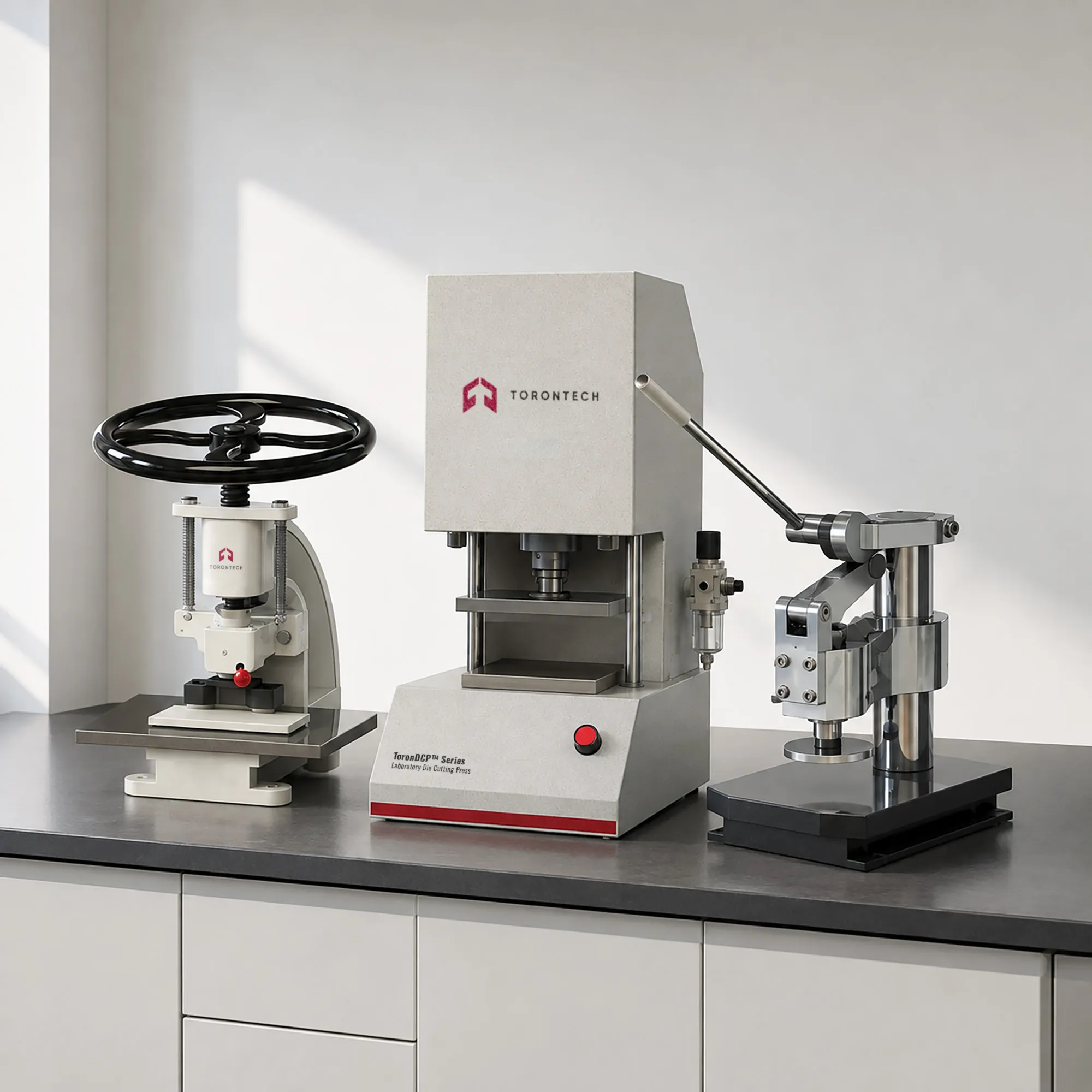
Laboratory Die Cutting Press - ToronDCP™ Series Key Features
The ToronDCP™ Series offers three drive configurations on a common principle, letting a laboratory match cutting force and throughput to the work it actually does.
- Three Configurations in One Series: lever, pneumatic, and rotary table models share tooling compatibility while covering different volume and sheet size needs
- 1.8 to 5 Ton Cutting Force: spans thin film through thick cured rubber sheet, so one series covers most laboratory materials
- Adjustable Pneumatic Stroke: 20 to 60 mm travel lets the operator set penetration depth to the material, protecting both die edge and cutting pad
- Standard Die Compatibility: accepts common cutting dies, so specimen geometry follows the test method rather than the machine
- Large Rotary Work Table: 320 by 228 mm surface on the rotary model handles specimens positioned across wide sheet
- Repeatable Pneumatic Stroke: delivers identical force on every cycle, removing operator variation from a batch of specimens
- Replaceable Nylon Cutting Board: gives the die a forgiving backing that preserves edge sharpness and can be rotated or swapped as it wears
- Low Air Pressure Requirement: 0.4 MPa runs from standard laboratory shop air with no dedicated compressor
- Compact Bench Footprint: the lever model occupies 210 by 370 mm, fitting alongside existing sample preparation equipment
- Rigid Frame Construction: holds die and platen parallel under load, which is what keeps specimen edges square rather than tapered
Theory and Method
Die cutting drives a sharpened steel rule through the material against a firm backing. The die edge concentrates the load onto a narrow line, raising local stress past the material's shear strength while the surrounding sheet stays undeformed. Force requirement scales with cutting perimeter, material thickness, and toughness. A long dumbbell outline therefore needs more tonnage than a small disc cut from the same stock.
The backing surface matters as much as the die. A nylon cutting board gives the edge something to bite into without dulling against steel, and it supports the material right up to the cut line so nothing stretches away from the blade. Worn pads develop grooves that let material sag, producing tapered edges and inconsistent widths. Rotating or replacing the pad restores a flat reference and extends die life at the same time.
How the force arrives changes the cut. Lever action gives the operator direct feel, useful on thin film where too much travel drives the die into the pad. Pneumatic action delivers the same force on every stroke regardless of operator, which is what makes a batch of fifty specimens match. Stroke adjustment sets how far the die descends, so the operator can dial in full penetration without hammering the cutting board.
Laboratory Die Cutting Press - ToronDCP™ Series Technical Specifications
| Parameter | Lever Type | Pneumatic Type | Rotary Table Type |
|---|---|---|---|
| Cutting Force | 1.8 tons | 3 tons or 5 tons | Not specified |
| Stroke | Approx. 18 mm | 20 to 60 mm | 25 mm maximum |
| Lever Arm Length | 390 mm | Not applicable | Not applicable |
| Platen Diameter | 110 mm | 200 mm | Not specified |
| Worktable Dimensions | 150 × 200 mm | 260 × 230 mm | 320 × 228 mm |
| Overall Dimensions | 210 × 370 × 360 mm | 380 × 260 × 590 mm | 520 × 450 × 520 mm |
| Net Weight | 70 kg | 110 kg | 98 kg |
| Air Pressure | Not applicable | 0.4 MPa | Not specified |
| Cutting Pad | Nylon board, 82 × 155 mm (standard) | ||
| Compatible Materials | Rubber, plastic, film, leather, and similar sheet materials | ||