
Laboratory Cast Film Extrusion System
Laboratory Cast Film Extrusion System - ToronCFL™ 20
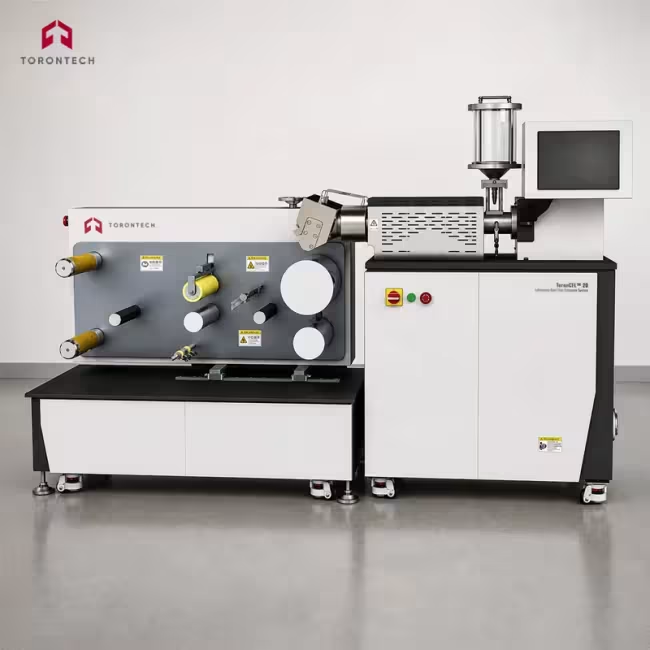
ToronCFL™ 20 Laboratory Cast Film Extrusion System produces flat film samples from 0.02 to 0.1 mm thick using laboratory quantities of resin. A precision single-screw extruder, cast die, casting station, haul-off, edge trimmer, thickness gauge, and winder run as one synchronized sequence. PE, PP, TPU, PVDF, and PC all process on the same machine. Film developers get representative samples without booking time on a production line.
Film thickness depends on how steadily melt leaves the die and how evenly the roll takes it away. Independent servo drives on the extruder, haul-off, and winder lock those speeds together across a wide adjustment range. The web then forms without the stretch marks or chatter that mismatched drives produce. Multi-zone temperature control holds the melt within ±1 °C, which keeps viscosity, and therefore gauge, consistent across a run.
Winding gets the same attention as forming. An automatic web guide corrects lateral drift as the film builds on the core, so the roll comes off flat, tight, and square at the edges. Samples stay free of wrinkles and offset, which matters when the next step is tensile, barrier, or optical testing on cut specimens. The line occupies about 2.65 m of bench length, so it fits a development laboratory rather than a pilot hall.
Laboratory Cast Film Extrusion System - ToronCFL™ 20 Applications
The ToronCFL™ 20 serves laboratories that develop film formulations, prepare film specimens for testing, or tune process parameters before scaling to production width.
- Film Formulation Development: screens resin grades, additives, and blends at gram-to-kilogram scale before committing to a production trial
- Film Specimen Preparation: produces flat, uniform samples for tensile, tear, haze, barrier, and seal-strength testing
- Packaging Film Research: evaluates PE and PP structures for stiffness, clarity, and sealing performance in flexible packaging development
- Technical and Functional Films: casts PVDF and PC for dielectric, optical, and high-temperature applications
- TPU and Elastomeric Film Work: handles soft, tacky polymers that need close draw and winding control to stay flat
- Process Parameter Optimization: maps the relationship between screw speed, roll speed, die temperature, and finished gauge for later scale-up
- Additive and Masterbatch Evaluation: shows how pigments, slip agents, antiblock, and fillers behave once drawn into thin film
- Recycled Resin Assessment: casts film from reclaimed material to measure gel count, clarity loss, and mechanical degradation
- University and Institute Research: demonstrates die flow, melt draw, neck-in, and quench effects on a bench-sized line students can operate
- Quality Control Reference Samples: creates film under documented conditions for comparison against incoming supplier material
Laboratory Cast Film Extrusion System - ToronCFL™ 20 Key Features
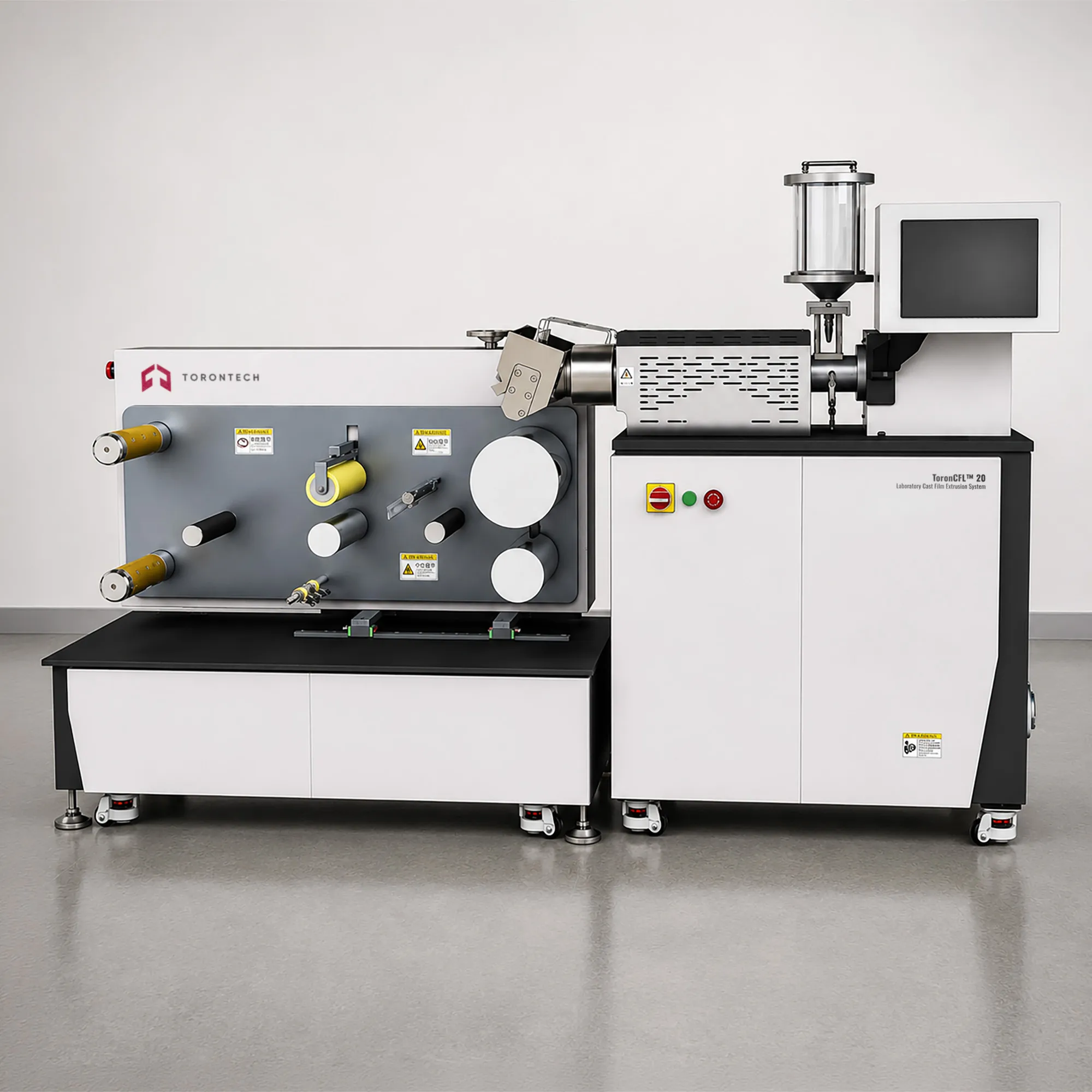
The ToronCFL™ 20 covers extrusion, casting, drawing, trimming, measurement, and winding in one bench-mounted line, with the drive and thermal control a film development laboratory expects.
- Complete Cast Film Line in One System: extruder, cast die, casting station, haul-off, edge trimmer, thickness gauge, winder, and controls arrive matched and commissioned together
- Independent Servo Drive on Every Station: extrusion, haul-off, and winding speeds stay synchronized across a wide range, so the web forms without stretching or judder
- ±1 °C Temperature Control Accuracy: holds melt viscosity steady, which is what keeps film gauge consistent from the start of a run to the end
- Multi-Zone Independent Heating: suits both high-temperature and heat-sensitive polymers on the same machine without recommissioning
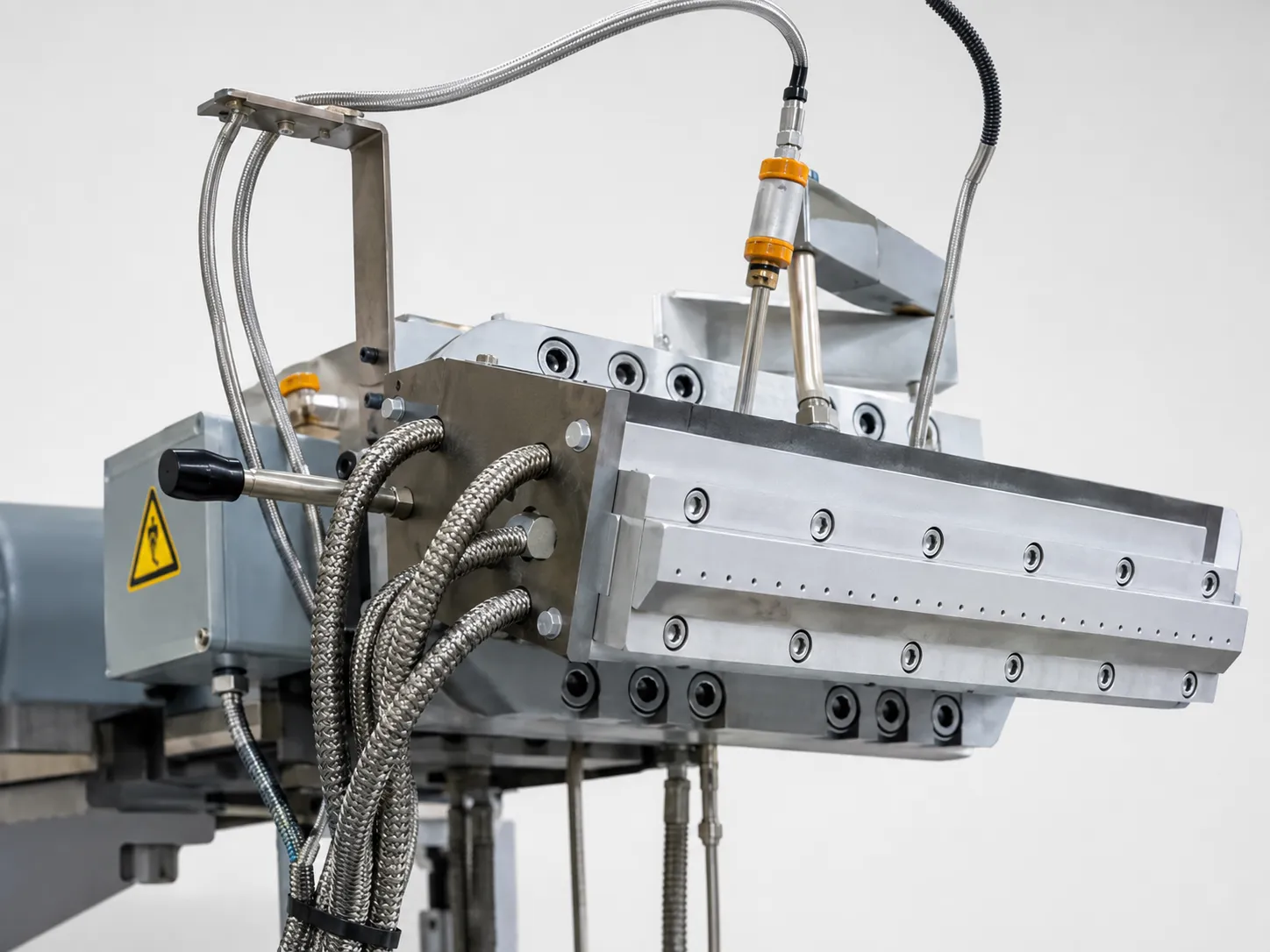
- 200 mm Cast Die: spreads melt into a uniform ribbon wide enough to cut standard test specimens from the finished film
- 0.02 to 0.1 mm Gauge Range: covers thin packaging film through heavier technical film with one die and roll set
- Automatic Web Guiding on the Winder: corrects lateral drift so rolls wind flat, tight, and square at the edges
- Inline Edge Trimming: removes the thickened edge beads that neck-in creates, leaving usable film across the full wound width
- Inline Thickness Measurement: reports gauge as the film runs, so operators see the effect of a process change immediately
- 20 mm Screw with 28:1 L/D: gives the melt enough mixing length to homogenize pigments, additives, and blends before the die
- 0 to 120 rpm Screw Speed: lets operators trade residence time against output for shear-sensitive and heat-sensitive resins
- Broad Material Compatibility: runs PE, PP, TPU, PVDF, and PC, covering commodity through technical film development
- Bench-Scale Footprint: fits a 2.65 m bench run, keeping film development inside the laboratory instead of the pilot hall
Theory and Method
Cast film forming starts at the die. Melt from the 20 mm extruder enters a wide manifold that spreads a round flow into a 200 mm ribbon, and the land at the die lip meters it to a uniform exit velocity across the width. Uneven flow at this stage shows up as gauge bands that no downstream adjustment removes. Die temperature control therefore carries as much weight as the mechanical gap setting.
The web thins between the die lip and the casting roll. Roll surface speed exceeds melt exit velocity, and that ratio, the draw-down ratio, sets final thickness for a given output. Surface tension and melt elasticity pull the edges inward at the same time, an effect called neck-in. Finished width therefore falls short of die width, and the edges run thicker than the center. The edge trimmer removes those beads so the wound roll carries usable gauge across its full width.
Contact with the casting roll freezes the structure. Rapid cooling from the melt state limits crystal growth, which is why cast film comes out clearer and more uniform than film cooled slowly in air. Roll temperature and contact length govern how much crystallinity develops, and that in turn drives stiffness, haze, and sealing behavior. The inline thickness gauge closes the loop, showing whether a change in screw speed, roll speed, or zone temperature moved gauge in the intended direction.
Laboratory Cast Film Extrusion System - ToronCFL™ 20 Technical Specifications
| Parameter | Specification |
|---|---|
| Applicable Materials | PE, PP, TPU, PVDF, PC |
| Screw Diameter | 20 mm |
| Screw L/D Ratio | 28:1 |
| Screw Speed Range | 0 to 120 rpm |
| Die Width | 200 mm |
| Film Width | 0 to 80 mm (material dependent) |
| Film Thickness | 0.02 to 0.1 mm |
| Temperature Range | Room temperature to 350 °C (customizable) |
| Temperature Control Accuracy | ±1 °C |
| Roller Width | 200 mm |
| Line Modules | Single-screw extruder, cast die, casting system, haul-off, edge trimming, thickness measurement, winding, control system |
| Operating Voltage | 3-phase, 380 VAC ±10 % |
| Rated Power | Approx. 12 kW |
| Overall Dimensions (L × W × H) | 2,650 × 950 × 1,460 mm |
| Weight | 600 kg |