
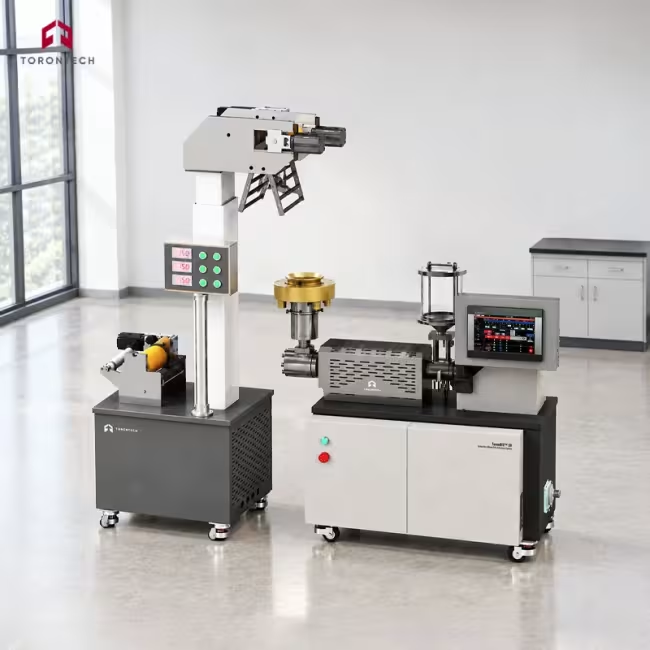
Laboratory Blown Film Extrusion System
Laboratory Blown Film Extrusion System - ToronBFE™ 20
The ToronBFE™ 20 Laboratory Blown Film Extrusion System extrudes, inflates, cools, and winds tubular film using laboratory quantities of resin. A 20 mm servo-driven extruder feeds a 30 mm annular die at roughly 5 kg/h, producing film up to 120 mm lay-flat width. Five heated zones cover the barrel and the die head to 380 °C. Everything runs from a PLC with a 10-inch color touchscreen.
The line answers a specific question: will this material blow into film at all? Laboratories use it to check blown film feasibility for new polymers and degradable grades, to inspect gels and unmelted particles in the bubble, and to judge how well pigments, masterbatch, and additives disperse. A thin, backlit film wall exposes contamination that pellet inspection misses. Results come from a few kilograms of material rather than a production trial.
Servo drives handle screw speed, haul-off, and winding, so the bubble stays stable at the low outputs a laboratory runs. The air ring and the 0 to 5 bar inflation supply set blow-up ratio, while haul-off speed to 18 m/min sets draw-down. Both act on gauge independently, which is what lets an operator separate the two effects. Multi-layer co-extrusion configurations are available when a program calls for structured film.
Laboratory Blown Film Extrusion System - ToronBFE™ 20 Applications
The ToronBFE™ 20 serves laboratories that need to know how a material behaves as film, whether the goal is a new formulation or an incoming-material check.
- Blown Film Feasibility Testing: establishes whether a polymer or blend can form a stable bubble before anyone books production time
- Gel and Unmelt Inspection: stretches contamination into visible defects that pellet or plaque inspection would not reveal
- Pigment and Masterbatch Dispersion: shows how evenly colorants and carriers distribute once the melt is drawn into a thin wall
- Biodegradable and Compostable Film Development: evaluates PLA, PBAT, and starch-based grades that behave differently from commodity resins in the bubble
- Film Formulation Development: screens resins, additives, and blends at kilogram scale before scaling to a wider die
- Additive Performance Screening: measures how slip, antiblock, and processing aids affect bubble stability and film appearance
- Recycled Resin Assessment: quantifies gel count, clarity loss, and bubble instability introduced by reclaimed material
- Test Specimen Preparation: produces film for tensile, dart impact, tear, haze, and seal testing on cut specimens
- Process Parameter Optimization: maps blow-up ratio, draw-down ratio, frost line height, and temperature against finished film properties
- University and Institute Research: demonstrates bubble mechanics, biaxial orientation, and frost line behavior on a bench-scale line students can run
- Incoming Material Quality Control: compares supplier lots under documented conditions using the film itself as the indicator
Laboratory Blown Film Extrusion System - ToronBFE™ 20 Key Features
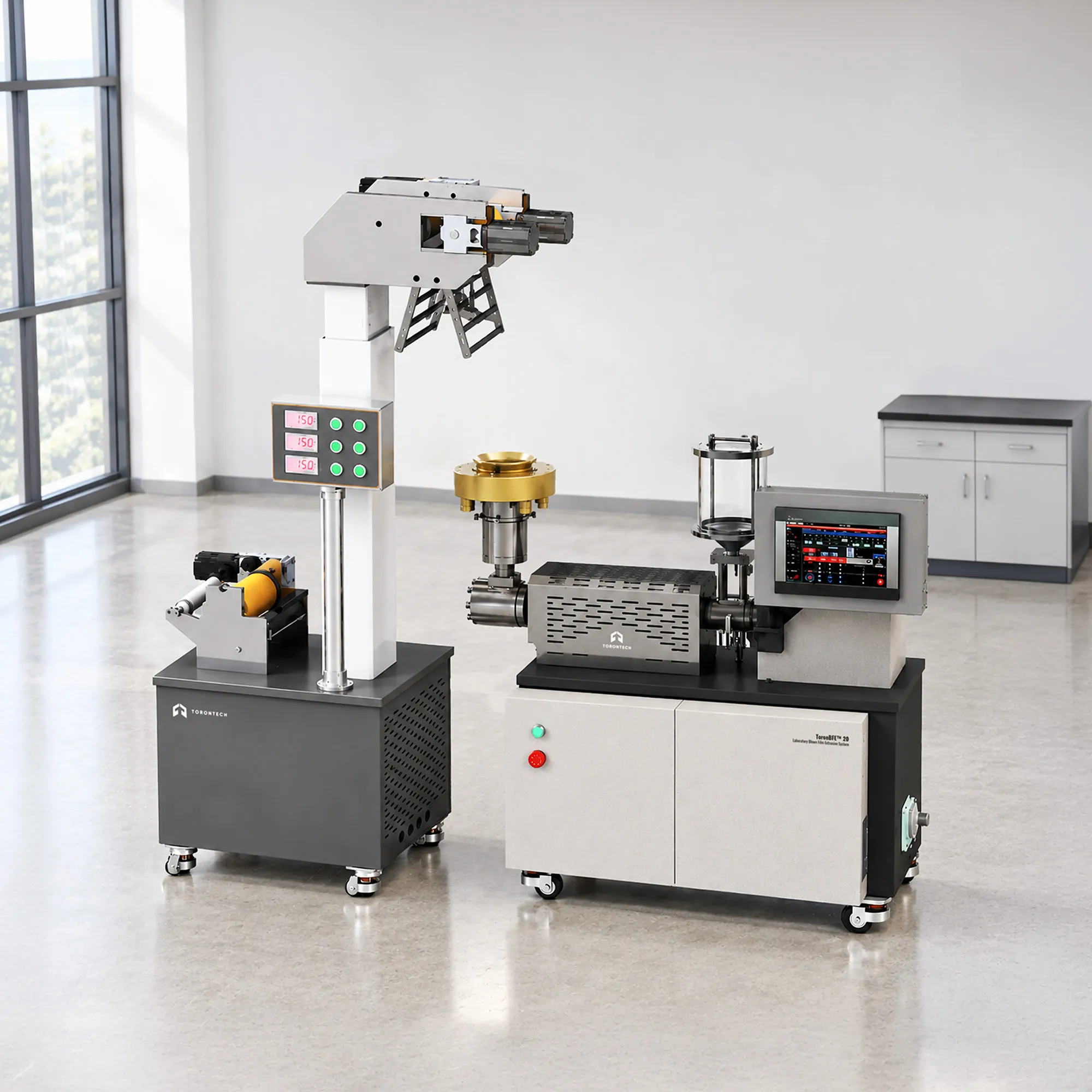
The ToronBFE™ 20 puts extruder, die, air ring, tower, haul-off, and winder on one laboratory-scale frame, with servo control on every motion that affects film gauge.
- Full Blown Film Line at Laboratory Scale: extruder, annular die, air ring, collapsing frame, haul-off, and winder arrive matched and commissioned as one system
- Servo-Driven Screw, Haul-Off, and Winder: holds bubble geometry steady at the low outputs laboratory work demands, where inverter drives tend to wander
- Five-Zone Temperature Control to 380 °C: three barrel zones plus two film-blowing zones cover commodity resins through higher-temperature engineering polymers
- PLC with 10-Inch Color Touchscreen: puts every process parameter on one interface and makes run conditions repeatable between operators
- 20 mm Screw with 28:1 L/D and 2.3:1 Compression: gives the melt enough mixing length to homogenize additives before the die
- Nitrided Alloy Steel Screw: resists abrasion from filled and pigmented compounds, extending service life between rebuilds
- Ø30 mm Annular Die: sizes the bubble for laboratory material budgets while still producing usable specimen width
- Adjustable Blow-Up and Draw-Down: independent control of 0 to 5 bar inflation air and 0 to 18 m/min take-up lets operators separate transverse from machine-direction orientation
- Air Ring Cooling with Dedicated Blower: sets frost line height so crystallization and film properties stay under operator control
- Pneumatic Expanding Winding Shaft: grips standard 50 to 52 mm cores directly, so finished rolls transfer to testing without rewinding
- Rubber and Steel Haul-Off Nip: collapses the bubble cleanly and holds tension without marking soft or tacky films
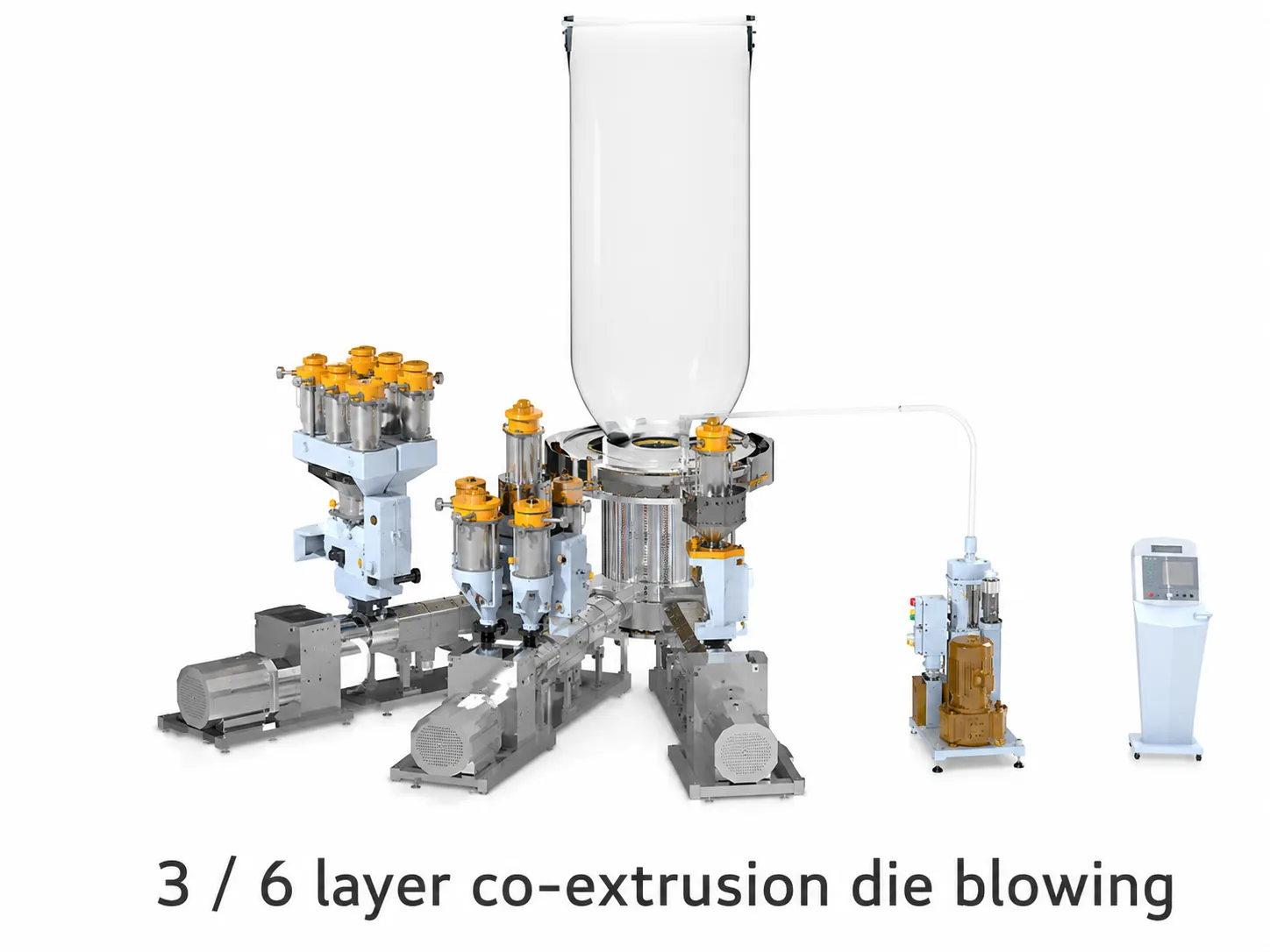
- Multi-Layer Co-Extrusion Configurations: three-layer and multi-layer co-blowing arrangements are available for structured film development
- Low Material Consumption: runs meaningful trials on a few kilograms, which matters when the resin is experimental or expensive
Theory and Method
Blown film extrusion turns a melt tube into a thin film by stretching it in two directions at once. Melt leaves the annular die as a thick tube, compressed air inflates it from inside, and the haul-off pulls it upward. The ratio of bubble diameter to die diameter is the blow-up ratio, which sets transverse orientation. Haul-off speed relative to melt exit velocity is the draw-down ratio, which sets machine-direction orientation.
Cooling decides where the stretching stops. The air ring blows over the bubble surface and removes heat until the polymer crystallizes, and the height where that happens is the frost line. Below it the melt still deforms, above it the geometry is fixed. Raising output or lowering air flow pushes the frost line higher, giving the melt more time to stretch and generally producing hazier film with different tear behavior.
Blowing the melt into a thin wall is also what makes the line a diagnostic tool. Stretching in two directions pulls any gel, unmelted particle, or poorly dispersed pigment into a visible defect. Held up to light, a thin film wall shows contamination that would stay hidden inside a pellet or a molded bar. Operators read the bubble itself as the test result, which is why this configuration sits in quality laboratories as often as in film development groups.
Laboratory Blown Film Extrusion System - ToronBFE™ 20 Technical Specifications
Extruder Unit
| Parameter | Specification |
|---|---|
| Screw Diameter | 20 mm |
| Screw L/D Ratio | 28:1 |
| Screw Compression Ratio | 2.3:1 |
| Screw Material | Nitrided high-strength alloy steel |
| Screw Speed Range | 0.1 to 120 rpm (servo motor regulation) |
| Transmission System | 1:16 planetary gear reducer with timing belt |
| Main Motor Power | 1.5 kW |
| Output | Approx. 5 kg/h |
| Temperature Range | Room temperature to 380 °C |
| Barrel Heating Power | Zones 1, 2, 3: 3,000 W total |
| Film Blowing Zone Heating Power | Zones 4, 5: 2,500 W total |
| Barrel Cooling | Ball-bearing plug-in cooling fan |
| Control System | PLC with 10-inch color touchscreen HMI |
| Power Supply | 3-phase, AC 380 V ±10 %, 50/60 Hz, 5.5 kW |
| Dimensions (W × D × H) | Approx. 2,150 × 660 × 2,060 mm |
| Weight | Approx. 580 kg |
Blown Film Take-Off and Winding
| Parameter | Specification |
|---|---|
| Die Diameter | Ø30 mm |
| Inflation Air | Compressed air, 0 to 5 bar |
| Cooling Air | Blower, 30 L/min |
| Haul-Off Rolls | Ø100 × 350 mm (one rubber, one steel) |
| Winding Roll | Ø150 × 350 mm (rubber) |
| Winding Air Shaft | Ø50 × 350 mm (expands Ø49 to 53 mm, suits core ID Ø50 to 52 mm) |
| Guide Roll | Ø38 × 350 mm (stainless steel) |
| Haul-Off and Winding Speed | 0 to 18 m/min |
| Maximum Film Lay-Flat Width | 120 mm |
| Haul-Off Motor | 200 W servo |
| Winding Motor | 200 W servo |
| Blower Motor | 250 W |
| Auxiliary Power Supply | AC 220 V ±10 %, 50/60 Hz, 650 W (110V is also available) |