
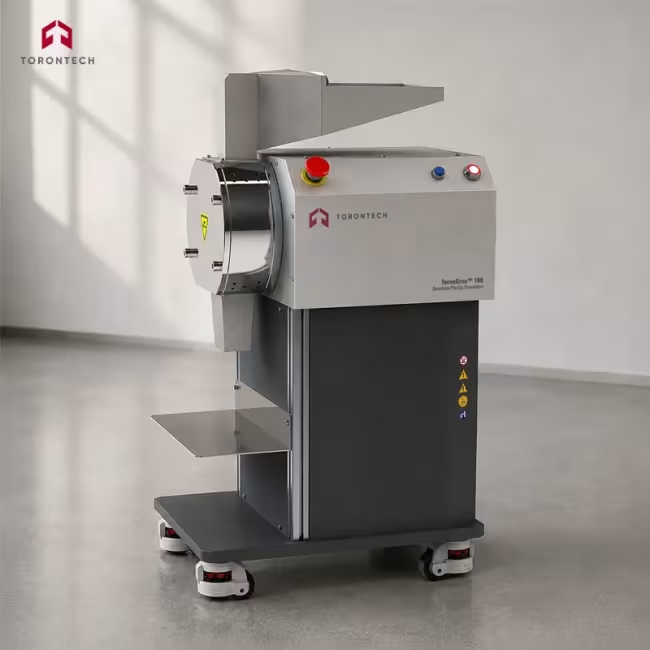
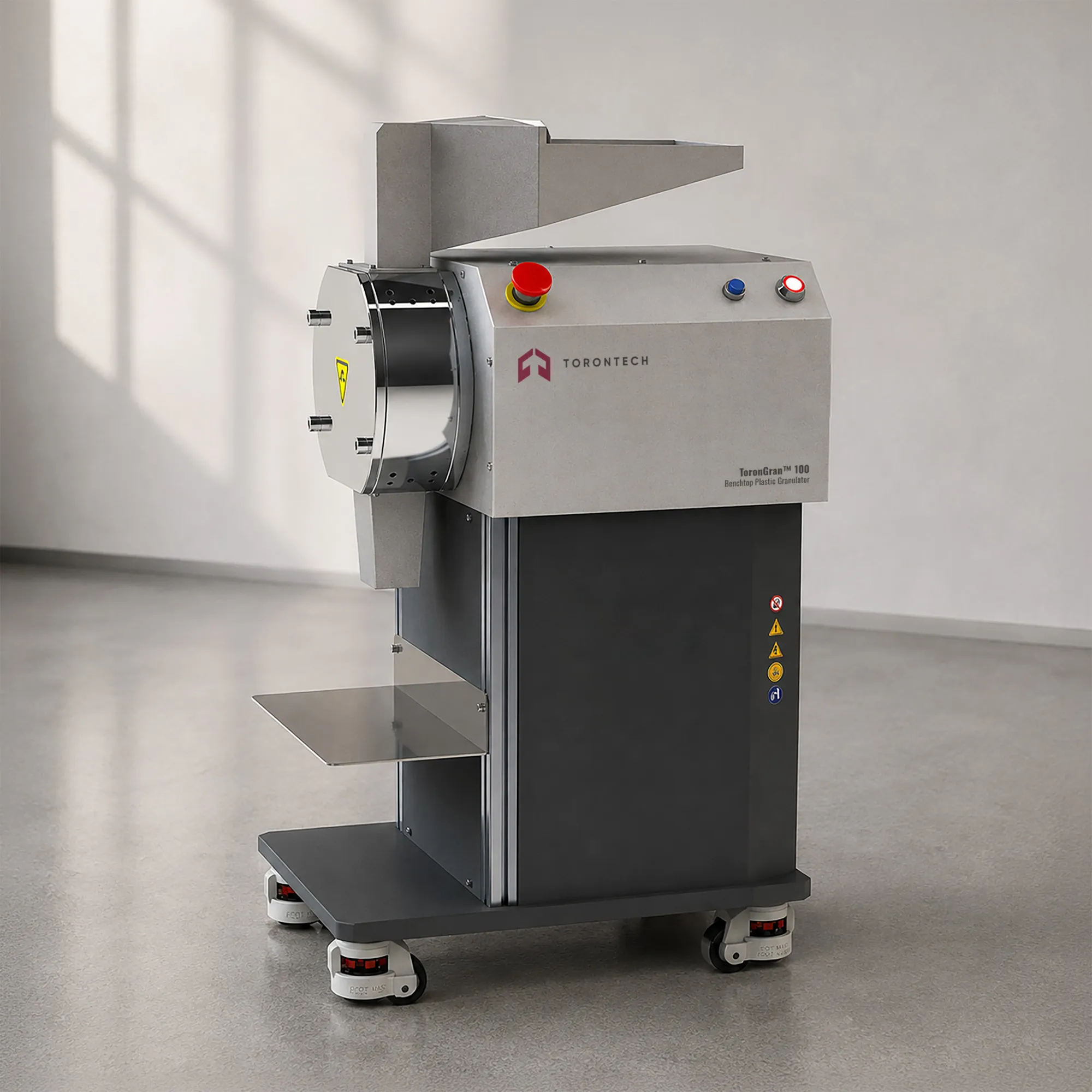
Benchtop Plastic Granulator
Benchtop Plastic Granulator - ToronGran™ 100
ToronGran™ 100 benchtop plastic granulator reduces sprue, runners, and molding scrap back to usable regrind at 15 to 30 kg/h. A 160 mm cutting chamber handles both rigid and flexible plastics, and interchangeable screens from 6 to 10 mm set the output particle size. A 2.2 kW drive supplies the torque, while caster wheels let one person move the unit between machines. Laboratories recover expensive experimental material instead of discarding it.
Material cost drives the case for a small granulator. Development compounds, colored trials, and engineering resins can run into hundreds of dollars per kilogram, and every purge, sprue, and reject part represents that cost sitting in a scrap bin. Reground in-house, the same material returns to the hopper for a repeat trial or a filler experiment. Batch sizes stay small enough that a single formulation does not get contaminated by the previous one.
The chamber holds flat alloy steel blades running against fixed bed knives. Screens drop in below the rotor, so changing particle size takes a screen swap rather than a rebuild. A holding hopper ships with the machine, feeding material at a controlled rate instead of all at once. The frame stands 860 mm tall on casters, which puts the feed opening at working height beside a press or extruder.
Benchtop Plastic Granulator - ToronGran™ 100 Applications
The ToronGran™ 100 suits any laboratory or small production cell that generates plastic scrap worth recovering rather than discarding.
- Injection Molding Scrap Recovery: regrinds sprue, runners, and short shots beside the press so material returns to the hopper the same day
- Laboratory Material Recycling: recovers costly experimental and engineering resins that would otherwise be written off as waste
- Extrusion Purge and Startup Scrap: reduces purge lumps and off-spec extrudate from development runs into feedable regrind
- Test Specimen Reprocessing: converts used tensile bars, plaques, and molded specimens back to granulate for repeat testing
- Recycled Content Studies: prepares controlled regrind fractions so researchers can measure how repeated processing affects properties
- Feedstock Preparation for Compounding: sizes material to a consistent particle range before it enters a lab extruder or mixer
- Color and Formulation Trials: clears small batches quickly between shade changes without tying up a production granulator
- Film and Sheet Offcut Reduction: handles flexible trim and edge waste that a rigid-only crusher would struggle to grip
- University and Institute Laboratories: gives teaching and research labs a safe, movable size reduction unit for polymer coursework
- Prototype and Short-Run Production: keeps material costs down where every kilogram of specialty resin counts
Standards
Published documentation for this granulator does not reference a governing test standard, which is expected for a size reduction machine rather than a measurement instrument. Equipment of this class is specified by chamber diameter, throughput, screen aperture, and drive power instead of by a coded test method. Regrind produced here normally feeds a compounding or molding step, and any ISO or ASTM method applies to the material property being measured rather than to the granulator itself. Torontech can advise on screen selection and blade configuration to suit the particle size a downstream process requires.
Benchtop Plastic Granulator - ToronGran™ 100 Key Features
The ToronGran™ 100 puts a full cutting chamber, screen classification, and a mobile frame into a footprint that fits beside laboratory equipment.
- Selectable 6 to 10 mm Screens: sets output particle size to match the downstream extruder, mixer, or molding machine without changing the machine
- 160 mm Cutting Chamber: sized for laboratory volumes while still accepting molded parts and sprue without pre-cutting
- Alloy Steel Flat Blades: hold an edge through abrasive and filled compounds, and can be resharpened rather than replaced
- Handles Rigid and Flexible Plastics: cuts both hard molded parts and soft trim, where many small granulators manage only one
- 2.2 kW Single-Phase Drive: delivers cutting torque from standard laboratory power with no three-phase supply required
- Inverter Speed Control: matches rotor speed to the material, reducing heat buildup on softer or heat-sensitive polymers
- Included Holding Hopper: meters material into the chamber at a steady rate, which protects the cut quality and the motor
- Caster-Mounted Frame: rolls between the press, extruder, and bench as work moves, without needing a forklift or fixed installation
- 95 kg Compact Build: occupies 380 by 500 mm of floor space, small enough to sit beside a laboratory molding machine
- Quick Chamber Access: opens for cleaning between material and color changes, which matters when cross-contamination would ruin a trial
Theory and Method
Granulation cuts rather than crushes. Rotating blades pass close to fixed bed knives, and the shearing action between them slices material the way scissor blades cross. Clearance between the two sets determines cut quality, typically a fraction of a millimeter, and it has to stay consistent around the rotor. Too wide a gap lets material fold and tear instead of shearing, producing fines and heat rather than clean flake.
The screen decides when material leaves. Particles circulate in the chamber until they are small enough to pass the screen aperture, so a 6 mm screen holds material longer and returns finer regrind than a 10 mm screen. Residence time and particle size therefore move together, and so does energy input. Choosing the largest screen that still feeds the downstream machine keeps heat and fines to a minimum.
Heat is the enemy in polymer size reduction. Cutting converts most of the drive energy into heat, and a plastic that softens near the blade smears instead of cutting, glazing the screen and jamming the chamber. Flexible materials aggravate this because they deform ahead of the edge rather than fracturing. Sharp blades, correct clearance, and steady feeding keep the cut clean, which is why feed rate matters as much as motor size.
Benchtop Plastic Granulator - ToronGran™ 100 Technical Specifications
| Parameter | Specification |
|---|---|
| Cutting Chamber | Ø160 mm, 70 mm depth |
| Throughput Capacity | 15 to 30 kg/h |
| Blade Material | Alloy steel |
| Blade Type | Flat blade |
| Screen Aperture | 6 to 10 mm (selectable) |
| Main Motor Power | 2.2 kW |
| Voltage | AC 220 V ±10 %, 50/60 Hz, single-phase (110V is also available) |
| Speed Control | Inverter drive |
| Overall Dimensions (W × D × H) | 380 × 500 × 860 mm |
| Net Weight | 95 kg |
| Mobility | Caster-mounted frame |
| Compatible Materials | Rigid and flexible plastics, including sprue and runner scrap |
Configuration
| Item | Quantity | Description |
|---|---|---|
| Granulator Unit | 1 | Cutting chamber, rotor, screen, and drive on a caster-mounted frame |
| Holding Hopper | 1 | Feed hopper for controlled material delivery into the chamber |