
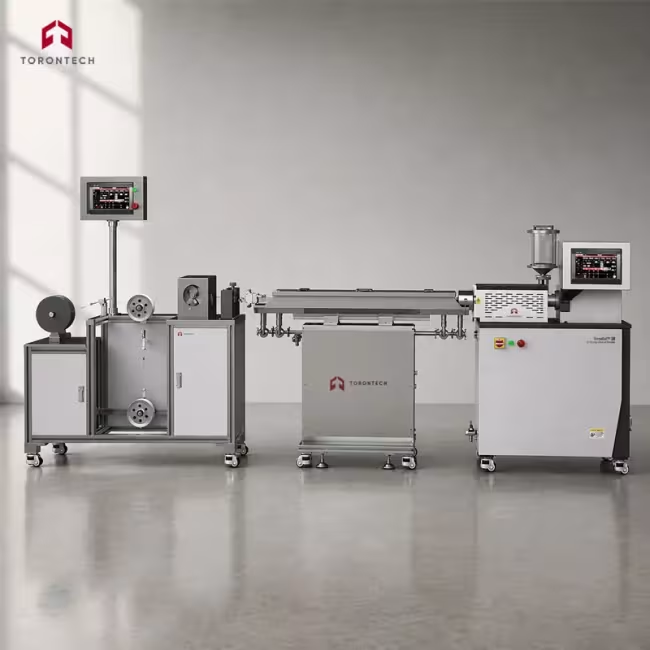
3D Printing Filament Extruder
3D Printing Filament Extruder - ToronExt™ 3D
ToronExt™ 3D 3D printing filament extruder produces spool-ready 1.75 mm filament from raw resin in a single bench-mounted line. A precision single-screw extruder, filament die, cooling tank, haul-off, diameter gauge, winder, and control system work as one sequence. Output runs at roughly 3 kg/h, which suits formulation trials and small production batches alike. Research groups and materials companies use it to turn their own compounds into printable stock.
Filament quality comes down to diameter consistency, and the line holds 1.75 mm to within ±0.02 mm. An inline gauge reads the strand as it leaves the water bath. The measurement feeds back to the servo haul-off, which adjusts pull speed to correct drift before the strand reaches the spool. Neat, tension-controlled winding keeps the finished coil free of the overlaps that jam a printer feed.
Material range covers PLA, ABS, PETG, TPU, PC, and PA, along with glass-fiber and carbon-fiber reinforced grades. Barrel zones and the die head reach 380 °C, so higher-temperature engineering resins stay inside the operating window. PLC control on a Siemens or Delta platform holds each zone and keeps run conditions repeatable. Dies, temperature control, and the feeding system can be specified to match a particular process.
3D Printing Filament Extruder - ToronExt™ 3D Applications
The ToronExt™ 3D serves laboratories and businesses that want control over the filament they print with, whether the goal is a new material or a proprietary formulation.
- Polymer Research and Development: converts experimental compounds into printable filament so researchers can evaluate printability alongside bulk material properties
- Custom Filament Formulation: produces small lots of pigmented, filled, or additive-modified filament for products that no commercial supplier offers
- Fiber-Reinforced Filament Production: extrudes glass-fiber and carbon-fiber compounds for stiffer, dimensionally stable printed parts
- PLA and PETG Filament Manufacturing: handles the commodity print resins that make up most desktop and educational printing volume
- Engineering Resin Filament: processes PC, PA, and TPU for functional prototypes that demand toughness, heat resistance, or flexibility
- Recycled Feedstock Trials: reprocesses reclaimed resin or failed prints into filament so laboratories can measure the effect of regrind content
- Biomedical and Specialty Polymers: prepares filament from small quantities of high-value or custom-synthesized material
- University Teaching and Research Labs: demonstrates the full extrusion, quench, gauge, and wind sequence on equipment students can run directly
- Quality Control of Print Materials: produces reference filament under documented conditions for comparison against incoming supplier lots
- Small-Batch Commercial Production: supports niche filament brands and in-house supply for print farms that need specific colors or grades
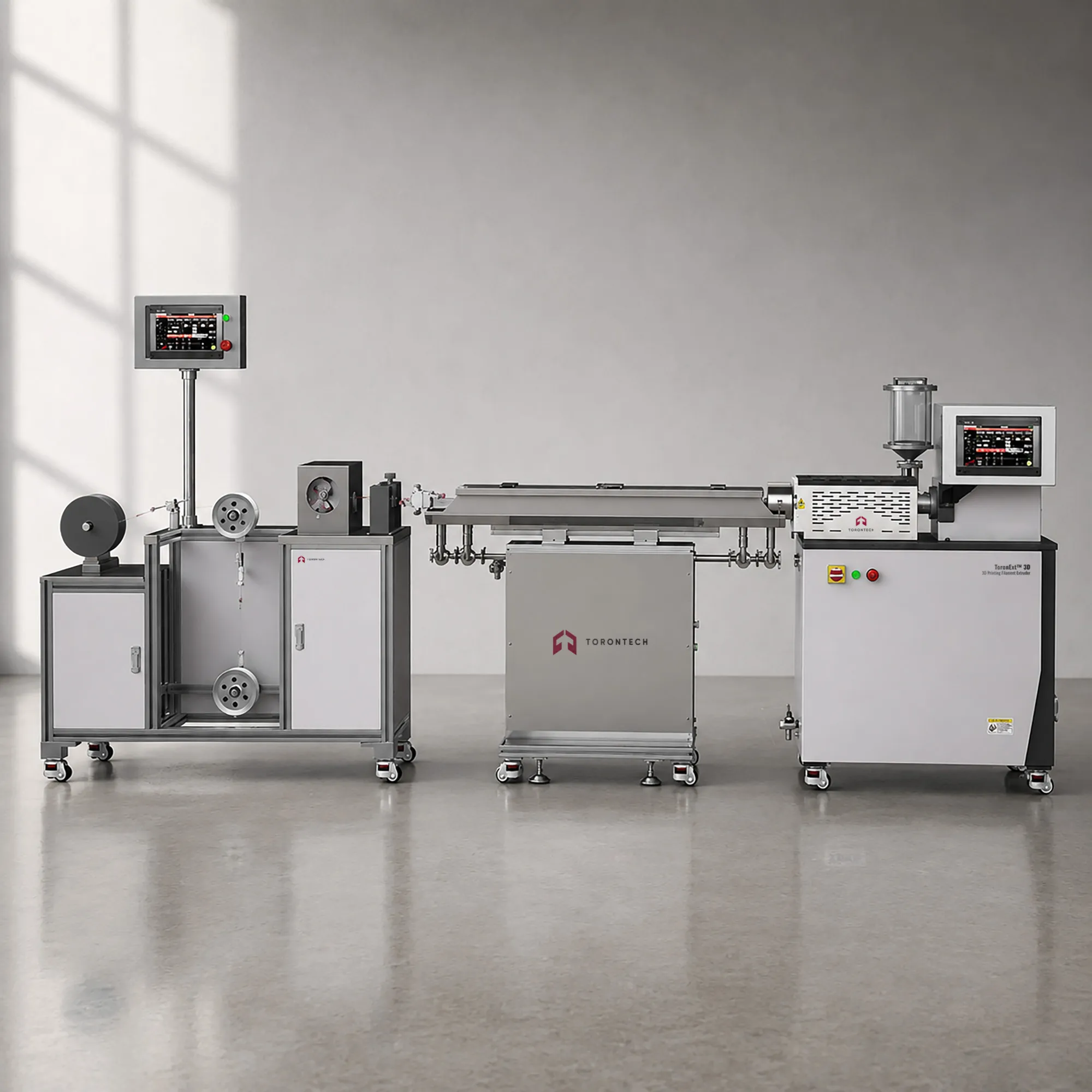
3D Printing Filament Extruder - ToronExt™ 3D Key Features
The ToronExt™ 3D covers extrusion, cooling, measurement, and winding in one integrated line, with the process control a development laboratory expects.
- Complete Filament Line in One System: extruder, die, cooling tank, haul-off, diameter gauge, winder, and controls arrive matched and commissioned as a single line
- ±0.02 mm Diameter Tolerance: holds 1.75 mm filament inside the window that desktop and industrial printers expect for consistent flow
- Inline Diameter Gauge with Closed-Loop Haul-Off: corrects drift automatically instead of leaving diameter to operator judgment
- 20 mm Screw with 28:1 L/D: gives the melt enough mixing length to disperse pigments, fillers, and reinforcing fiber evenly
- Nitrided Alloy Steel Screw and Barrel: withstands abrasion from glass-fiber and carbon-fiber compounds for a longer service life
- 380 °C Thermal Range: covers commodity resins through PC, PA, and other higher-temperature engineering polymers on the same machine
- Precise Multi-Zone Temperature Control: holds each barrel zone and the die head at setpoint so viscosity stays predictable across a run
- PLC Control on Siemens or Delta Hardware: provides familiar, serviceable automation with repeatable recipe handling
- Melt Pressure Monitoring to 70 MPa: turns die pressure into a recordable process signal that flags viscosity shifts and screen loading early
- 0 to 100 rpm Screw Speed: lets operators trade residence time against throughput for shear-sensitive or heat-sensitive materials
- Tension-Controlled Neat Winding: lays the filament in even courses so the spool unwinds cleanly on the printer
- Configurable Die and Feeding System: adapts to alternative filament diameters and feed requirements without replacing the base machine
- Mobile Modular Layout: each station sits on its own castor-mounted frame, so the line can be repositioned or extended as work changes
Theory and Method
Filament extrusion starts with the same drag-flow mechanics as any single-screw process. The 28:1 screw conveys, melts, and pumps resin, and the metering section pressurizes the melt against the die. What happens after the die decides the diameter. Molten polymer swells as it leaves the capillary, since chains stretched inside the die relax once the constraint disappears. Melt draw then pulls the extrudate back down to target.
Haul-off speed sets the draw ratio. Pulling faster than the melt exits thins the strand, and the relationship between line speed and diameter gives the control system its correction lever. The water bath freezes that geometry, so quench distance and water temperature both influence where the strand stops changing size. Too fast a quench locks in stress and leaves brittle filament, while too slow a quench lets the strand sag and go oval before it sets.
Closed-loop control ties those variables together. The diameter gauge samples the cooled strand continuously, compares it to the 1.75 mm setpoint, and trims haul-off speed in proportion to the error. Melt pressure readings up to 70 MPa show whether the die delivers steady volumetric flow, since pressure drift at fixed screw speed points to a viscosity change or a partly blocked die. Stable pressure plus stable draw gives a spool that a printer can feed without retuning flow compensation.
3D Printing Filament Extruder - ToronExt™ 3D Technical Specifications
| Parameter | Specification |
|---|---|
| Screw Diameter | 20 mm |
| Screw L/D Ratio | 28:1 (standard) |
| Screw Material | Nitrided high-strength alloy steel |
| Screw Speed Range | 0 to 100 rpm |
| Temperature Range | Zones 1/2/3: ambient to 380 °C; die head: 380 °C |
| Melt Pressure Range | 0 to 70 MPa |
| Control Mode | PLC control (Siemens or Delta) |
| Filament Diameter | 1.75 ± 0.02 mm |
| Output (approx.) | 3 kg/h |
| Compatible Materials | PLA, ABS, PETG, TPU, PC, PA, plus glass-fiber and carbon-fiber reinforced grades |
| Line Modules | Single-screw extruder, filament die, cooling tank, haul-off, diameter gauge, winder, control system |
| Main Power Supply / Total Power | Three-phase five-wire, AC 380 V ±10 %, 50/60 Hz, 6 kW |
| Main Machine Dimensions (W × D × H, approx.) | 1,050 × 570 × 1,390 mm |
| Weight (approx.) | 300 kg |