
Smarter Surface Activation for Stronger Adhesion
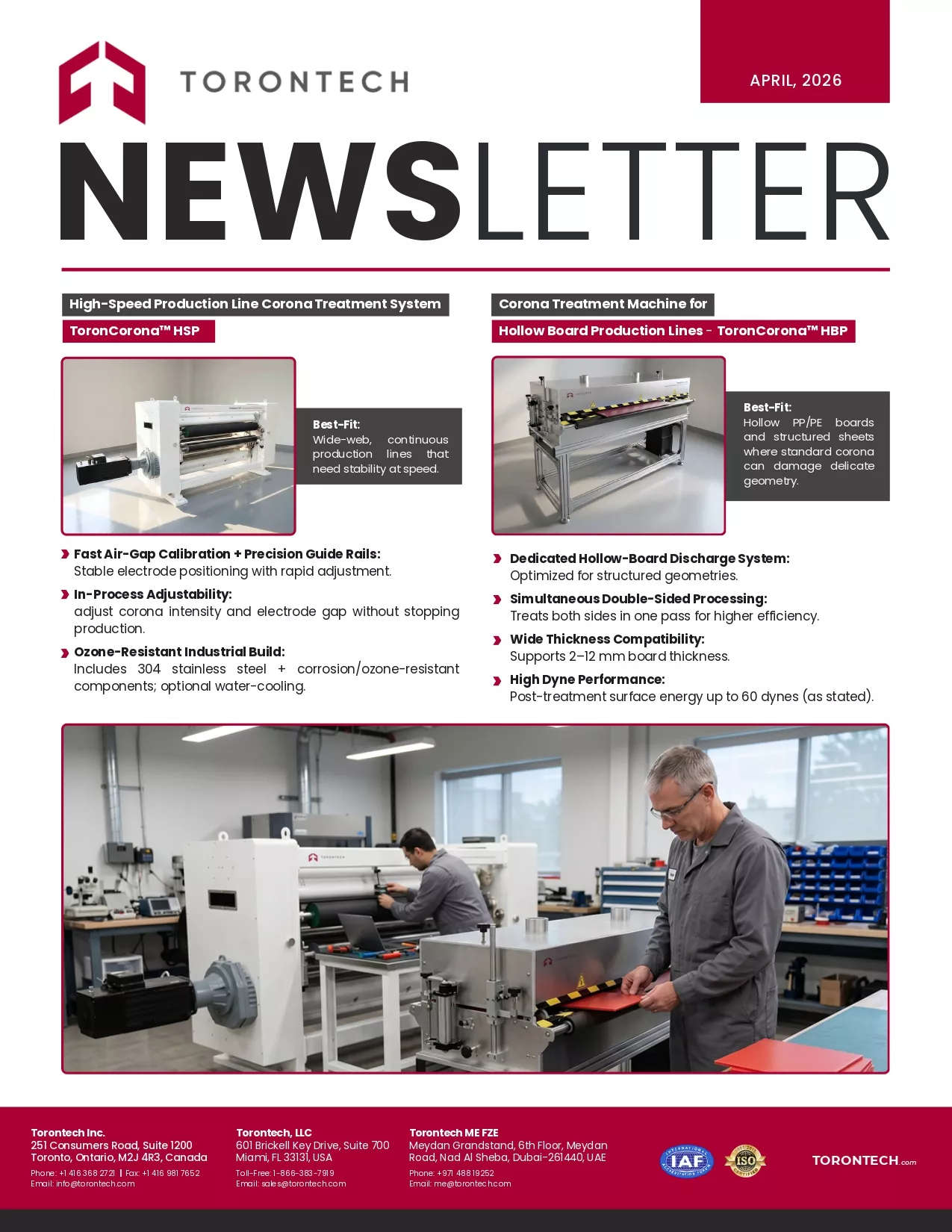
Low surface energy can prevent inks, coatings, and adhesives from wetting PE, PP, and other polymer surfaces evenly. The resulting defects may appear later as ink smearing, inconsistent coating coverage, weak lamination bonds, or early delamination. Torontech’s April newsletter examines how controlled corona discharge and plasma treatment modify surface conditions before printing, coating, bonding, or assembly, helping laboratories and production teams improve wettability without changing the material’s bulk properties.
The featured lineup covers compact laboratory evaluation, continuous high-speed web processing, double-sided treatment for hollow boards, localized plasma activation, roll-to-roll vacuum processing, and vacuum plasma cleaning for precision components. These configurations allow engineers to match treatment width, power, electrode gap, process gas, line speed, and chamber environment to the material and production stage. The result is a more repeatable approach to preparing films, foils, structured sheets, electronics, medical components, and other engineered surfaces for adhesion.
Keep surface preparation aligned with changing materials, geometries, and production speeds. Subscribe to the Torontech Newsletter for focused guidance on corona treatment, plasma cleaning, wettability evaluation, process selection, and equipment configuration for R&D, quality, engineering, and manufacturing teams.