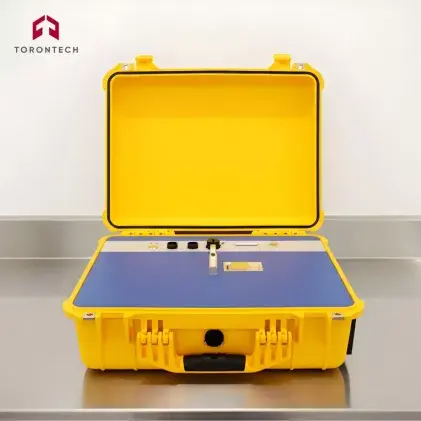
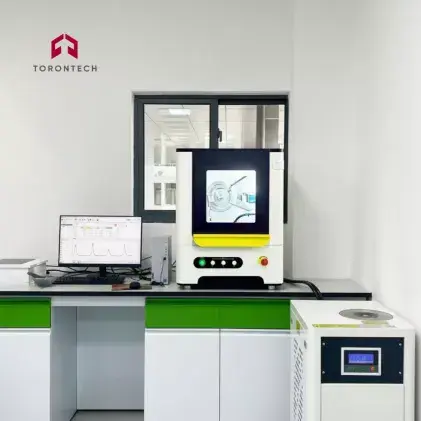
The SHINE and FRINGE Families of XRD Analyzers – X-ray Diffractometers, revolutionizing material analysis. The SHINE Family presents a portable solution integrating XRD and XRF technologies for comprehensive composition and structure data, with effortless one-key operation and automatic detection. Waterproof and compact, it's perfect for both lab and field research.
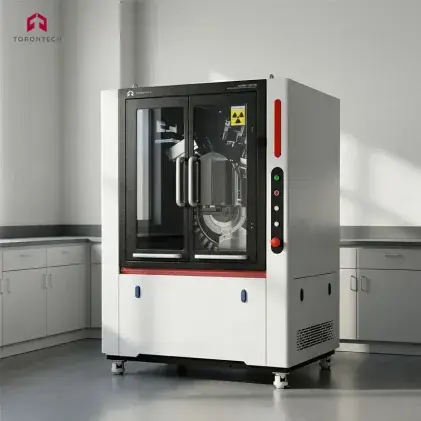
Meanwhile, the FRINGE Family offers benchtop precision with advanced features like Sora slits and digital multi-channel analysis for efficient polymer crystallinity assessment. Simplified operation, excellent resolution, and reliable results define both families' commitment to superior material analysis.
Compare XRD Analyzers and X-ray Diffractometers
Side-by-side overview of Torontech XRD analyzer families for portable field work and benchtop lab precision.
XRD Analyzer Families
| Feature | Portable XRD Analyzer (SHINE Family) | Benchtop XRD Analyzer (FRINGE Family) |
|---|---|---|
| Primary purpose | Portable material analysis combining composition and structure insights using XRD + XRF | Benchtop XRD for precise diffraction measurements and crystallinity assessment workflows |
| Best for | Field inspection, on-site research, and mobile labs needing fast identification and screening | Laboratories needing stable setup, high resolution, and repeatable analysis |
| Form factor | Portable, compact, field-ready | Benchtop system for lab environments |
| Key differentiator | Integrated XRD and XRF for broader material insight in one portable platform | Precision benchtop performance with advanced features for efficient crystallinity analysis |
| Typical use cases | Rapid screening, identification, and characterization in lab-to-field workflows | Polymer crystallinity assessment, materials R&D, and quality control (application dependent) |
| Ease of operation | One-key operation and automatic detection designed to reduce setup effort | Simplified operation with features designed to improve efficiency and usability |
| Environmental readiness | Waterproof design supports harsher environments and field conditions | Designed for controlled lab use and stable measurement conditions |
| How to choose | Choose SHINE when portability and combined XRD/XRF insight are critical for your workflow | Choose FRINGE when you need benchtop precision, resolution, and repeatable lab analysis |
| Selection tip | If you need answers on-site and want both composition and structure data, start here | If your analysis is routine, method-driven, or needs higher resolution, choose this option |
Quick selection guide: choose SHINE for portable XRD + XRF screening in field environments, and choose FRINGE for benchtop precision and crystallinity-focused lab workflows.
X-ray diffractometers serve laboratories that need to identify crystalline phases and study material structure across research, quality control, and production.
Materials Research and Development
Identify unknown phases, study crystal structure, and characterize new materials, catalysts, and thin films.
Pharmaceutical Analysis
Identify polymorphs and confirm crystalline form, which affects the stability and performance of drug products.
Mining, Cement, and Geology
Analyze ores, minerals, and cement phases to support process control and product quality.
Metals, Forensics, and Failure Analysis
Determine phase composition, residual stress, and crystallinity in metals and recovered materials.
1. Phase Identification
The diffractometer identifies the crystalline phases in a sample by matching its diffraction pattern against reference databases.
2. Precise Goniometer Geometry
A high-resolution goniometer moves the source and detector through measured angles, which delivers accurate peak positions for reliable analysis.
3. Quantitative and Structural Analysis
Beyond identification, the system supports quantitative phase analysis, crystallite size, and strain measurement.
4. Flexible Sample Handling
Sample stages accept powders, solids, and thin films to cover a wide range of materials.
5. Stable X-ray Source
A controlled X-ray tube and detector provide consistent intensity for repeatable patterns over long runs.
6. Analysis Software
Integrated software collects the diffraction pattern, performs phase matching, and exports results for reporting.
X-ray diffraction (XRD) identifies the crystalline structure of a material, which reveals what phases or compounds it contains. Because every crystalline substance has a unique atomic arrangement, XRD acts like a fingerprint reader for solids.
Bragg's Law and Diffraction
The analyzer directs a beam of X-rays at the sample. The atoms in a crystal are arranged in regular planes, and these planes reflect the X-rays. When the path difference between rays reflected from adjacent planes equals a whole number of wavelengths, the rays reinforce and produce a strong diffracted beam. This condition is described by Bragg's law, where n times the wavelength equals 2d times the sine of theta, and d is the spacing between crystal planes.
From Diffraction Pattern to Identity
The instrument measures the angles and intensities of the diffracted beams to build a diffraction pattern. Each crystalline phase produces a characteristic set of peaks, so comparing the pattern against reference databases identifies the phases present and can reveal crystallite size and strain. This makes XRD a core tool for material identification and quality control.