

Magnetron Sputtering System
Magnetron Sputtering System ToronSP-400 is a box-type Physical Vapor Deposition (PVD) system designed with prismatic or cylindrical vacuum chambers. It features 1 to 4 DC/RF sputtering sources, allowing the deposition of multi-layered thin films using up to four different materials.
The ToronVak Sputter System can be customized to meet user requirements, enabling the production of multilayered nanoscale metallic, oxide, carbide, or nitride films. Compatible materials include Ni, Fe, Au, Zr, Ti, Si, SiO₂, ZnO, TiO₂, Si₃N₄, SiC, and more.
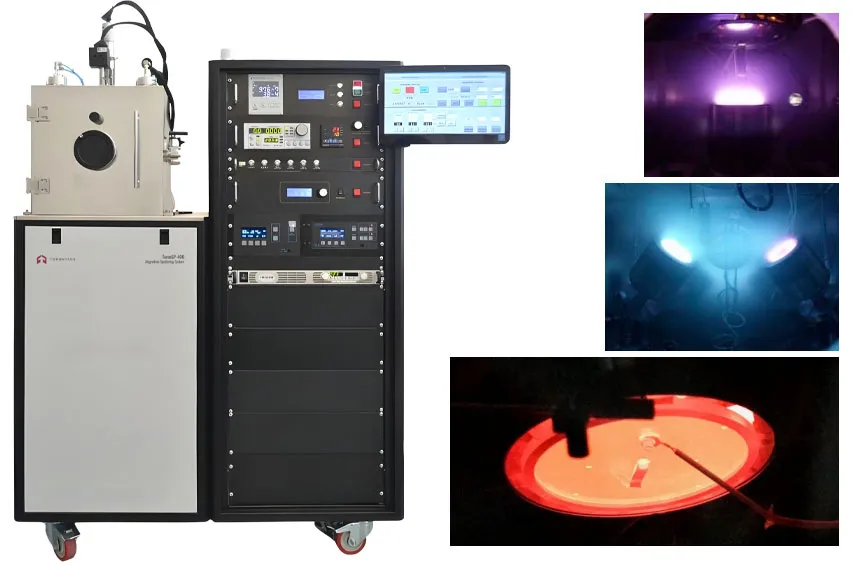
Semiconductor & Microelectronics - Deposition of multilayer thin films for integrated circuits, sensors, and optoelectronic devices, supporting high precision and uniformity at the nanoscale.
Materials Science & Nanotechnology - Development of advanced coatings such as metallic, oxide, carbide, and nitride films for research, prototyping, and functional material innovation.
Optics & Photonics - Fabrication of anti-reflective, conductive, and dielectric coatings on optical components, lasers, and photonic devices for improved performance.
Energy & Renewable Technologies - Production of thin-film coatings for solar cells, fuel cells, and energy storage devices, improving efficiency and durability.
Aerospace & Automotive Engineering - Application of wear-resistant, corrosion-resistant, and thermal barrier coatings to important components for improved reliability under extreme conditions.
Surface Engineering & Coating Services - Precision deposition of tailored thin films on various substrates for industrial applications, prototyping, and specialized contract coating projects.
Research & Development - Versatile platform for universities, laboratories, and corporate R&D centers to explore new materials, deposition techniques, and multilayer coating processes.
- Fully Automated Touchscreen Control – Real-time LCD display for seamless operation
- High-Quality Vacuum Chamber – Prismatic or cylindrical SS304 chamber with electro-polished surfaces; available in 30, 40, 50, and 60 cm sizes
- Enhanced Visibility & Access – Front viewing window and rotatable shutter
- Versatile Connectivity – Standard 1", QF, CF, and ISO ports
- Optimized Internal Systems – Built-in lighting and baking system (up to 120°C)
- Power Supply Options – RF: 13.6 MHz, 300-1200 W | DC: 0-1000 V, 2000 W
- High Vacuum Performance – Base pressure: 10⁻⁸ Torr | Achieves 2x10⁻⁶ Torr in 20 minutes
- Advanced Pumping System – Turbomolecular + mechanical pump; cryo and dry pump available
- Wide-Range Vacuum Control – 1000 - 10⁻⁹ Torr precision monitoring
- Customizable Sample Processing – PID-controlled heating (50-700°C) and adjustable sample rotation (2-30 rpm)
- Plasma Cleaning Unit – RF plasma cleaning via RF biasing
- Efficient Cooling System – Automatic start-stop, closed-loop water cooling
- Precision Coating Control – Dual-channel thickness rate measurement (0,1Å/s) with 1-4 QCMs
- Flexible Sputtering Options – 1-4 DC/RF magnetron sputter sources (1”, 2”, 3”, 4”)
- Gas Flow Management – Mass flow meter-controlled inputs (Ar, N₂, O₂, He, CH₄, H₂) with 3-channel real-time control
- Pressure Regulation – Throttle, vent, and isolation valves for precise pressure adjustment (1 - 100 mTorr)
- Optimized Experiment Cycle – 1.5-hour cycle time
- Vacuum Retention – Stays under vacuum with isolation valve when not in use
- Smart PC Control – LabVIEW-based automation for multi-layer coatings
- Additional Precision Monitoring – Capacitance manometer for accurate plasma pressure measurement
- Compact & Mobile Design – 75x120 cm footprint with lockable wheels, fits through standard doors
- Reliable Build – One-year warranty covering design, materials, and craftsmanship
A magnetron sputtering system deposits thin films of metal or other materials onto a substrate. It is a core tool for coatings used in electronics, optics, tooling, and research, where film thickness and purity must be tightly controlled.
Sputtering in a Plasma
The process takes place in a vacuum chamber filled with a small amount of inert gas, usually argon. A high voltage applied to the target, the source material, ionizes the gas into a plasma. The positively charged argon ions accelerate into the target and knock atoms loose from its surface, a process called sputtering. These atoms travel across the chamber and condense on the substrate to form a film.
The Role of the Magnetron
Magnets placed behind the target create a magnetic field that traps electrons close to the target surface. This concentrates the plasma where it is needed, which raises the sputtering rate and lets the system deposit films faster and at lower pressure. The result is a dense, uniform coating with good adhesion, deposited under controlled, repeatable conditions.


