A Practical Guide to Pulsed Laser Deposition
Why do some labs nail perfect thin films while others settle for patchy results?
In the high-stakes business of making new materials, getting those skinny layers to stick is the whole ballgame. We’re calling it: this pulsed laser deposition technique is the heavyweight champ for moving tricky recipes from a puck to a plate without a hitch .
Here is the straight talk on getting those flawless, top-tier layers in this practical guide to pulsed laser deposition.
Key Takeaways
- The Recipe Champion: We consider the pulsed laser deposition method the absolute best technique for copying a complex target material onto a new surface without losing the original mix.
- How the Magic Happens: The pulsed laser deposition process relies on a high-energy beam blasting a target inside a pure vacuum to create a fast-moving cloud of material.
- The Perfect Fits: It is the ultimate choice for cooking up high-heat superconductors, body-friendly medical coatings, and tiny microchip parts.
- The Main Catch: While it is a superstar for R&D labs, you'll find both advantages of pulsed laser deposition and certain limitations when you need to cover massive production areas.
- The Scale-Up Solution: When it is time to move from a tiny test square to a thousand parts, we always recommend swapping out the PLD setup for a high-capacity sputter coater.
What is Pulsed Laser Deposition?
If you are new to the high-end business of sticking thin bits of material onto surfaces, you might be scratching your head and asking: what is pulsed laser deposition?
At its heart, the pulsed laser deposition technique is a super flexible member of the Physical Vapor Deposition (PVD) family. It uses intense, lightning-fast zaps from a high-energy beam to melt, poof into gas, and electrify material off a target's face. This blasted-off stuff creates a glowing, high-speed cloud that zooms away from the target and ends up landing on a surface to grow into a skinny layer.
From where we’re sitting, the real magic of the pulsed laser deposition method is how clean and tidy it is. Because everything happens inside a heavy-duty vacuum tank, you get insanely pure and managed layers that are a total nightmare to get right if you were just using plain old heat.
The Pulsed Laser Deposition Process Explained
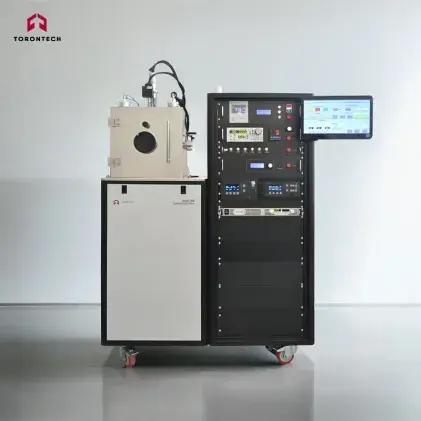
To really get why this tech is so cool, we have to pull apart the actual pulsed laser deposition process. To make this concrete, let's track a specific batch of stuff, say, a puck of YBCO (that famous high-heat superconductor), through the four big moments inside a serious piece of hardware like our PLD Pulsed Laser Deposition System - PLD-T:
Beam and Target Face-Off
A beastly, fast-pulsing beam (usually an excimer type) is aimed through a glass porthole at the solid chunk of YBCO. The target soaks up that massive energy hit, causing the surface to get blistering hot in a fraction of a second.
Blasting Off and Cloud Making
That sudden heat makes the YBCO instantly turn into a ghost, spitting out electrons, bits of atoms, and molecules. This creates a super energetic, straight-shooting glowy cloud of material.
Cloud Expansion
That glowy cloud puffs out from the target and heads for the landing pad. This part of the pulsed laser deposition method can be tweaked to perfection by fiddling with the gas pressure inside the tank.
Growing the Layer
Finally, the blasted-off YBCO bits smack into the landing pad. Those atoms and molecules settle down, huddle together, and grow into a smooth, skinny film.
Key Factors in the Pulsed Laser Deposition Technique
By getting the hang of the pulsed laser deposition technique, people can grow complex crystal structures that are basically perfect. However, we reckon that having a tight grip on a few key knobs and dials is the real "secret sauce" for a win:
- Landing Pad Heat: We see it all the time; the landing pad needs to be pretty toasty to make sure the arriving atoms have enough "get up and go" to find their perfect spot in the crystal grid.
- Vacuum Purity: Having a tank that is sucked totally empty of air is, in our book, a complete deal-breaker if you want to keep your thin film from getting gunked up by outside gases.
- Background Gas Squeeze: Letting in a tiny bit of specific gas, like oxygen when you are making oxides, during the blast helps manage how fast that glowy cloud is moving.
From our perspective, keeping a lid on the pulsed laser deposition process requires gear that is as steady as a rock to keep things from wobbling. That exact need for unwavering stability is why we build the PLD-T with an obsessive focus on precision control.
Pulsed Laser Deposition Applications
Because it can do things other methods cannot touch, plenty of industries lean hard on various pulsed laser deposition applications. In our humble opinion, the most impressive uses are:
High-Heat Superconductors
The pulsed laser deposition technique became a household name (well, in labs anyway) because it was so good at making top-shelf superconducting films.
We think that is what really parked it in the big leagues of high-end research. Think of levitating magnetic trains or zero-resistance electrical grids; those wild ideas rely on films like the ones PLD cooks up.
Medical Coatings
The pulsed laser deposition method is used to put body-friendly layers, like bone-mimicking minerals, onto surgical hardware. For instance, putting a flawless coat of hydroxyapatite onto a titanium hip replacement so the body accepts the metal piece faster. We find this mix of heavy physics and fixing people to be one of the coolest things going.
Microchip Parts
In the world of pulsed laser deposition applications, PLD is the go-to for making complex oxide layers for fancy electronics and tiny sensors. A prime example is slapping down a perfectly mixed layer for a solid-state memory chip, ensuring your smartphone remembers your photos without draining the battery.
Pulsed Laser Deposition Advantages and Disadvantages
Sizing up pulsed laser deposition advantages and disadvantages is a must-do before you decide if it is the right tool for your specific job.
Advantages of Pulsed Laser Deposition
- Exact Ingredient Copying: One of the biggest advantages of pulsed laser deposition is how it copies the exact recipe of a multi-element target onto the film. We think this is its absolute best trait.
- Do-Anything Attitude: This pulsed laser deposition method can lay down a huge list of different materials, even the ones that are a nightmare for other methods.
- Fast Growth: Because that glowy cloud is so punchy, the pulsed laser deposition process lets you grow layers at impressive rates compared to other ways of doing things.
- Research Freedom: We are convinced that being able to swap out target materials in a snap makes the pulsed laser deposition technique a tool that nothing else can beat for R&D labs.
Disadvantages of Pulsed Laser Deposition
- Spitting and Gunk: One of the main disadvantages of pulsed laser deposition is the chance of "spitting," where tiny blobs of melted stuff get stuck on the film. In our eyes, this is still the most annoying part of the whole tech.
- Small Sweet Spot: A common entry in pulsed laser deposition advantages and disadvantages lists is that thickness is usually stuck to small areas because the cloud shoots out like a laser.
- Pricey Entry Fee: We get that needing a heavy-hitting beam means the first bill for setting up the pulsed laser deposition method is going to be a big one.
PLD vs. Sputtering: Which One Wins for Your Lab?
When folks look at ways to make thin films, they usually compare the pulsed laser deposition process to Magnetron Sputtering. For those of you scanning this on a coffee break, here is the fast breakdown of how they stack up against each other:
| Feature | Pulsed Laser Deposition (PLD) | Magnetron Sputtering |
|---|---|---|
| Recipe Copying | Flawless (Copies complex targets perfectly) | Good, but tricky for wild, multi-part mixes |
| Coverage Area | Tiny (Stuck to small sweet spots) | Massive (The gold standard for getting big) |
| Surface Finish | Prone to annoying "spitting" or blobs | Insanely smooth and clean |
| First Bill | Pricey (Those beams cost a pretty penny) | Way friendlier on the budget |
| Best Fit | R&D labs, wild new materials, proof of concept | Factories, pilot runs, making a ton of even parts |
Picture this common scenario: a university team whips up a efficient new battery material using the pulsed laser deposition technique. It performs flawlessly on a one-inch testing square.
Fast forward to a few months later, and that project gets handed over to a commercial manufacturing partner. Now, a factory lead needs to coat a thousand battery cells for a pilot run. That is exactly when the project hits a wall with PLD's small coverage area, and the facility moves the process to a heavy-hitting rig like our Load-Lock Equipped Coating System ToronTS-450.
Sputtering, on the other hand, is what we would call the gold standard for getting big. It gets rid of that "spitting" problem that the pulsed laser deposition method has, giving you layers that are smooth and clean.
Related article: Sputter Coater for SEM: Important Insights You Must Know
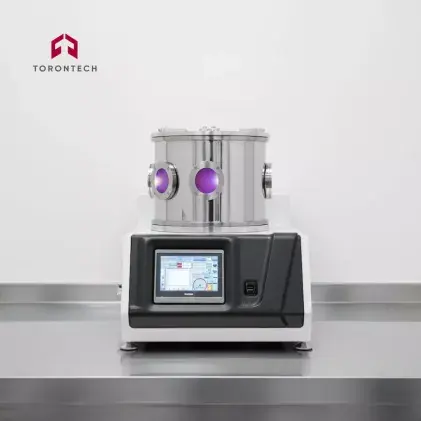
If your crew is just prepping small, simple samples, a compact unit like the Desk Sputter Coater - DSR1 is a total lifesaver. But for labs and factories that care about growing big, keeping things perfectly even, and not spending a fortune on day one, we think stepping up to the Magnetron Sputtering System ToronSP-400 is usually the smarter, more budget-friendly move.
What’s Next for Thin-Film Tech?
As we keep moving, the bar for making thin films is getting higher and higher. Emerging fields like quantum computing materials and various pulsed laser deposition applications need layers that are practically perfect down to the last atom.
We’re seeing a push to scale up the pulsed laser deposition process for industrial use while keeping that atomic-level control. In our view, hooking up smart self-checking systems like RHEED and computer-brained controls to vacuum gear is going to be the next big thing for making sure everything stays top-notch.
Getting Your Lab Up to Speed with Torontech
The right film-making method can make or break your project. While the pulsed laser deposition technique is a star for complex jobs, we know that getting wins takes gear built to last. At Torontech, we focus on cost-effective solutions and innovative technologies that stand up to the tough vacuum life.
Check out our full lineup of Sputter Coaters and Vacuum Coating Systems to bridge the gap between research and production without blowing the budget. Get in touch with Torontech today to chat with our crew.
References:
- Blank, D., Dekkers, M., & Rijnders, G. (2014). Pulsed laser deposition in Twente: from research tool towards industrial deposition. Journal of Physics D: Applied Physics, 47.
- Haider, A., Alawsi, T., Haider, M., Taha, B., & Marhoon, H. (2022). A comprehensive review on pulsed laser deposition technique to effective nanostructure production: trends and challenges. Optical and Quantum Electronics, 54.
- Hubler, G. (1992). Pulsed Laser Deposition. MRS Bulletin, 17, 26-29.
- Lorenz, M. (2019). pulsed laser deposition. Catalysis from A to Z.
- Lorenz, M. (2013). 25 years of pulsed laser deposition. Journal of Physics D: Applied Physics, 47, 030301.
- Ogugua, S., Ntwaeaborwa, O., & Swart, H. (2020). Latest Development on Pulsed Laser Deposited Thin Films for Advanced Luminescence Applications. THE Coatings, 10, 1078.
- Shepelin, N., Tehrani, Z., Ohannessian, N., Schneider, C., Pergolesi, D., & Lippert, T. (2023). A practical guide to pulsed laser deposition. Chemical Society Reviews, 52, 2294 - 2321.
- Yu, J., Han, W., Suleiman, A., Han, S., Miao, N., & Ling, F. (2023). Recent Advances on Pulsed Laser Deposition of Large‐Scale Thin Films. Small Methods, 8.