
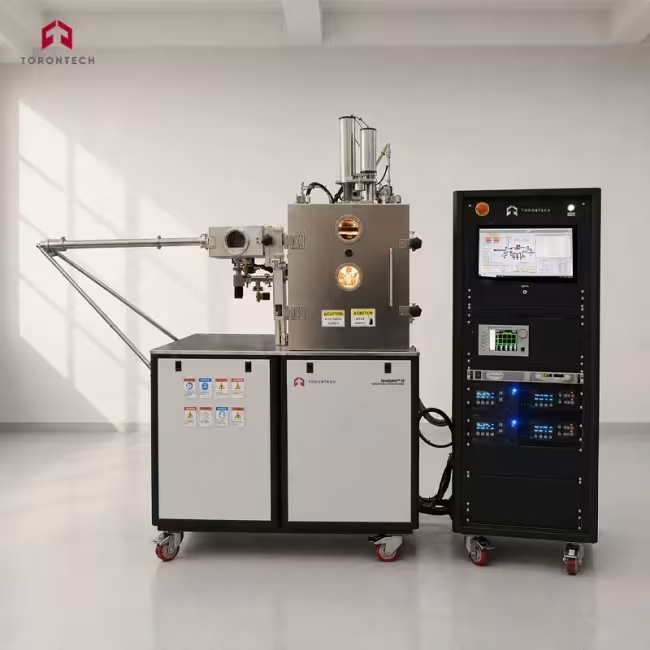
Load-Lock Sputter-Up Deposition System
Load-Lock Sputter-Up Deposition System - ToronSputter™ SU
Load-Lock Magnetron Sputtering System – Sputter-Up
The Load-Lock Sputter-Up Deposition System combines upward-facing magnetron sputtering sources with organic effusion cells in a load-lock chamber for combined inorganic and organic thin film deposition. The sputter-up configuration positions targets below the substrate, which faces downward, enabling confocal deposition geometry and multi-source integration. A dedicated load-lock pump reaches 10⁻⁶ Torr in 10 minutes, keeping the main chamber at 10⁻⁸ Torr base pressure. Load-lock sample exchange via magnetic arm enables 20 to 30 experiments per day.
Organic evaporation uses PID-controlled effusion cells across 50 to 800 °C at ±1 °C for organic semiconductor and OLED material deposition. Inorganic sputtering uses 1 to 6-inch RF and DC guns, depositing conductors and insulators including Au, Al, TiN, and SiO₂ at high rates with recipe control. Digital MFC gas inputs at 0.1 sccm sensitivity enable inert and reactive sputtering. High-power thermal sources at 8V to 500A, 5000W add sequential and co-evaporation capability in the same run.
PID-controlled substrate heating across 50 to 600 °C at ±1 °C, combined with 2 to 30 rpm rotation and DC/RF plasma cleaning, supports deposition onto heated substrates. A dual-channel thickness controller with two QCMs tracks deposition rate and cumulative thickness at 0.1 Å/s. Vacuum control spans 10⁻¹ to 10⁻⁹ Torr with downstream and upstream pressure-fixing capability. Automatic on-off water cooling interlock and a UV-blocking observation window with LabVIEW shutter control manage process safety and deposition timing.
Load-Lock Sputter-Up Deposition System - ToronSputter™ SU Applications
The Load-Lock Sputter-Up Deposition System serves organic and inorganic thin film research requiring combined sputter deposition and organic evaporation in a continuous-vacuum platform. Its confocal sputter-up geometry, organic effusion cells, and load-lock architecture make it suited to multilayer organic-inorganic device fabrication and high-throughput PVD research programs.
- OLED and Organic Light-Emitting Device Fabrication: combined in-situ deposition of organic emitter and transport layers by effusion cell and metal electrode layers by sputtering, without air exposure between steps
- Organic Photovoltaic Cell Research: sputter-up deposition of transparent contact layers and reactive-sputtered oxide films alongside effusion-deposited organic active layers for OPV device prototyping
- Perovskite Solar Cell Development: combined organic hole-transport and metallic contact deposition in a single vacuum environment, reducing defects from atmospheric moisture and oxygen exposure
- Organic Semiconductor and OFET Research: precise effusion-cell deposition of small-molecule organic semiconductors with confocal sputter-up metallization for device contact fabrication
- Optical Thin Film Research: reactive sputter-up deposition of TiO₂, SiO₂, and other optical coatings with downstream pressure control for stoichiometric accuracy
- Hard Coating and Surface Engineering: reactive RF sputtering of TiN, CrN, DLC, and related films from below-mounted upward-facing targets on tooling and mechanical components
- High-Throughput Multi-Material PVD Research: 20 to 30 experiments per day with load-lock sample exchange supporting iterative multilayer organic-inorganic deposition programs
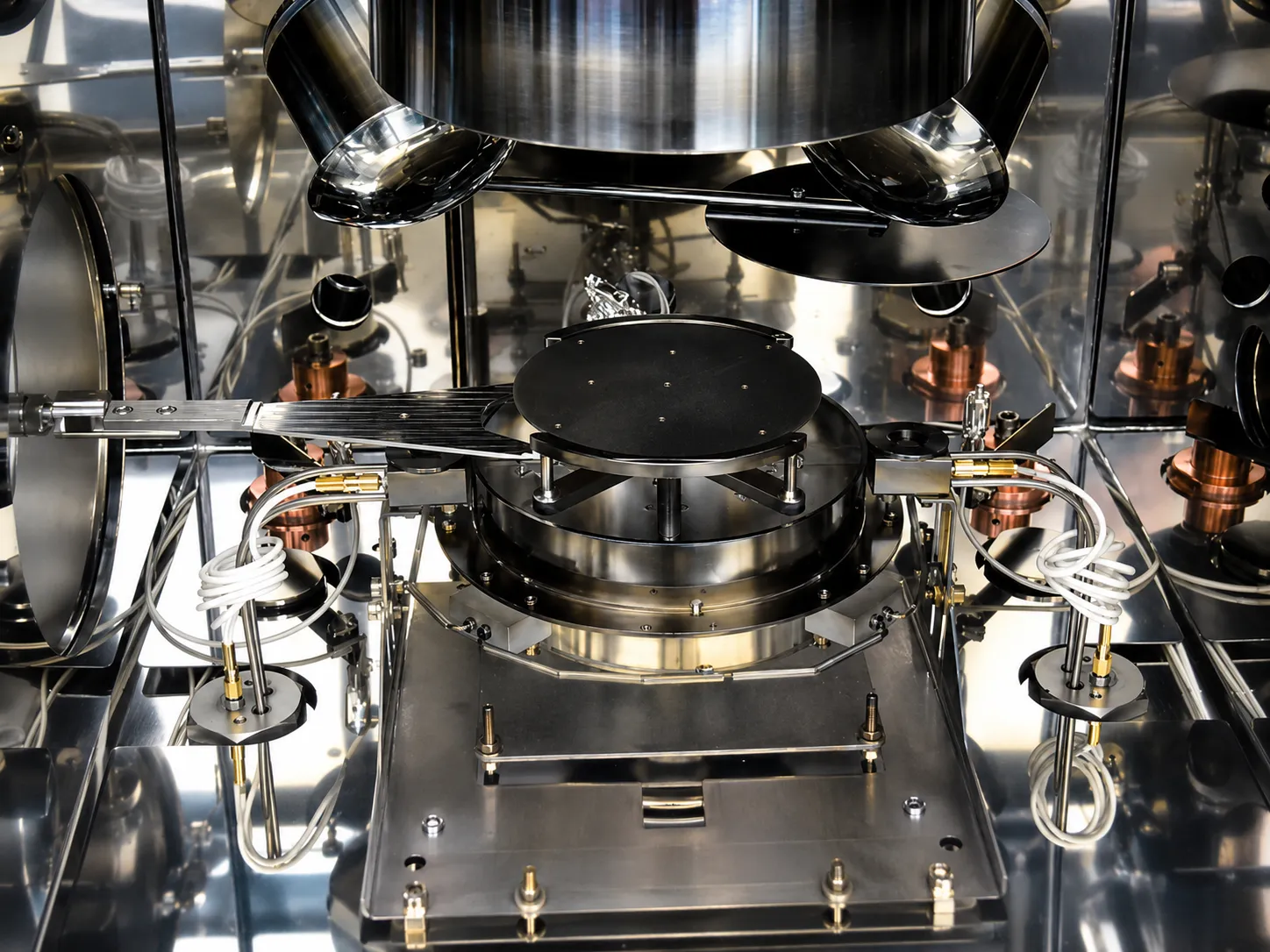
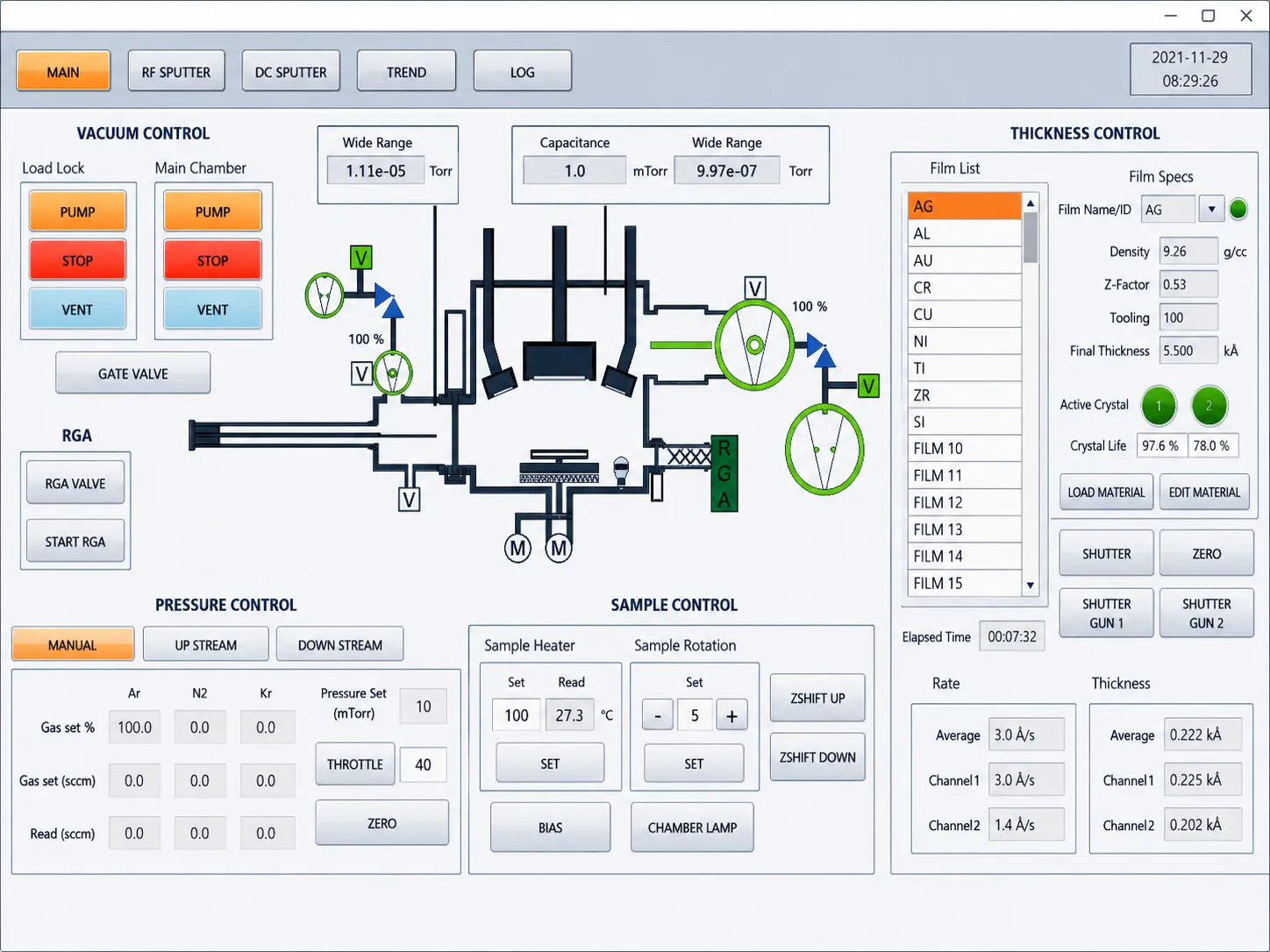
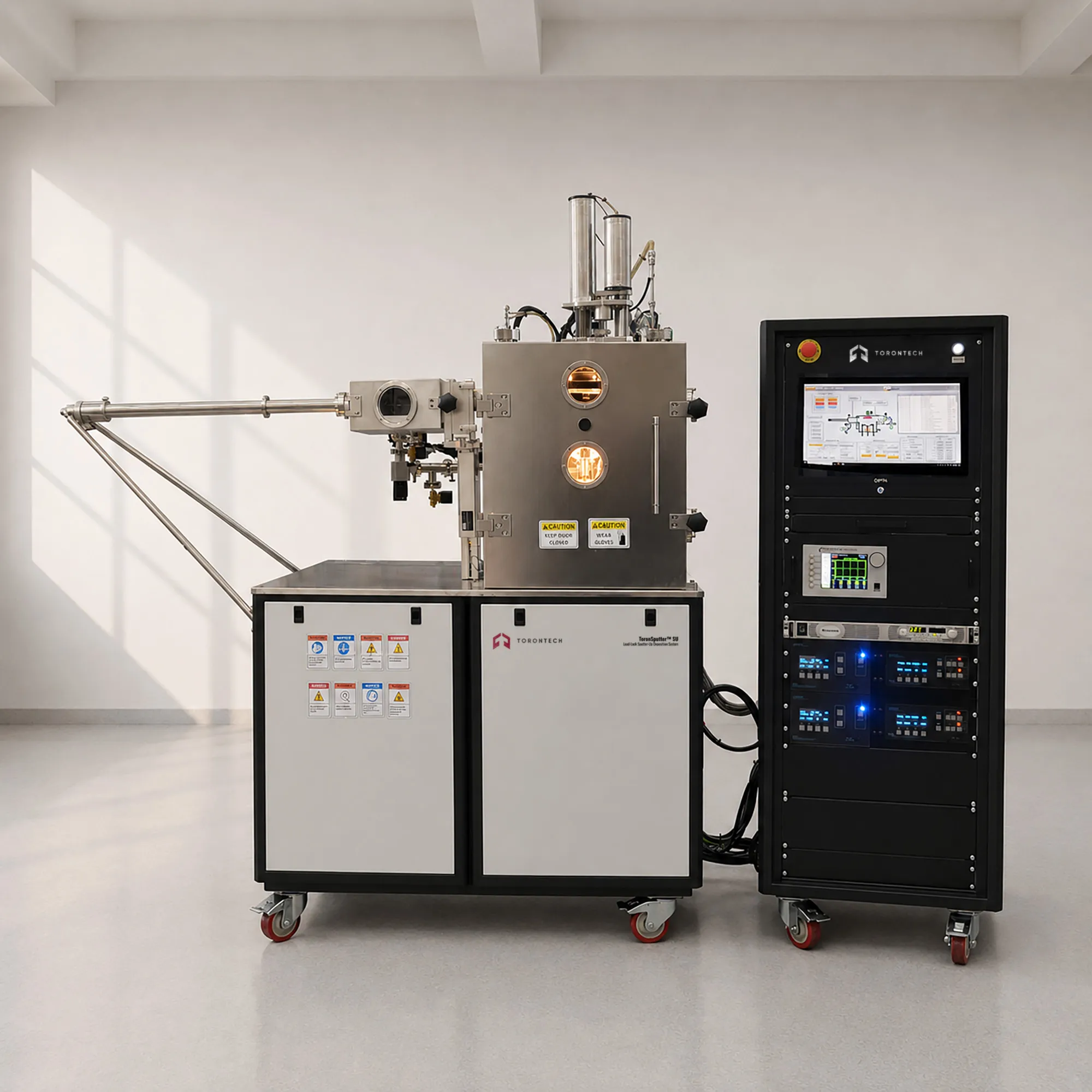
Load-Lock Sputter-Up Deposition System - ToronSputter™ SU Key Features
The Load-Lock Sputter-Up Deposition System integrates confocal sputter-up magnetron guns, Knudsen effusion cells for organics, MFM gas control, and load-lock sample exchange in a high-vacuum platform for combined organic-inorganic thin film research.
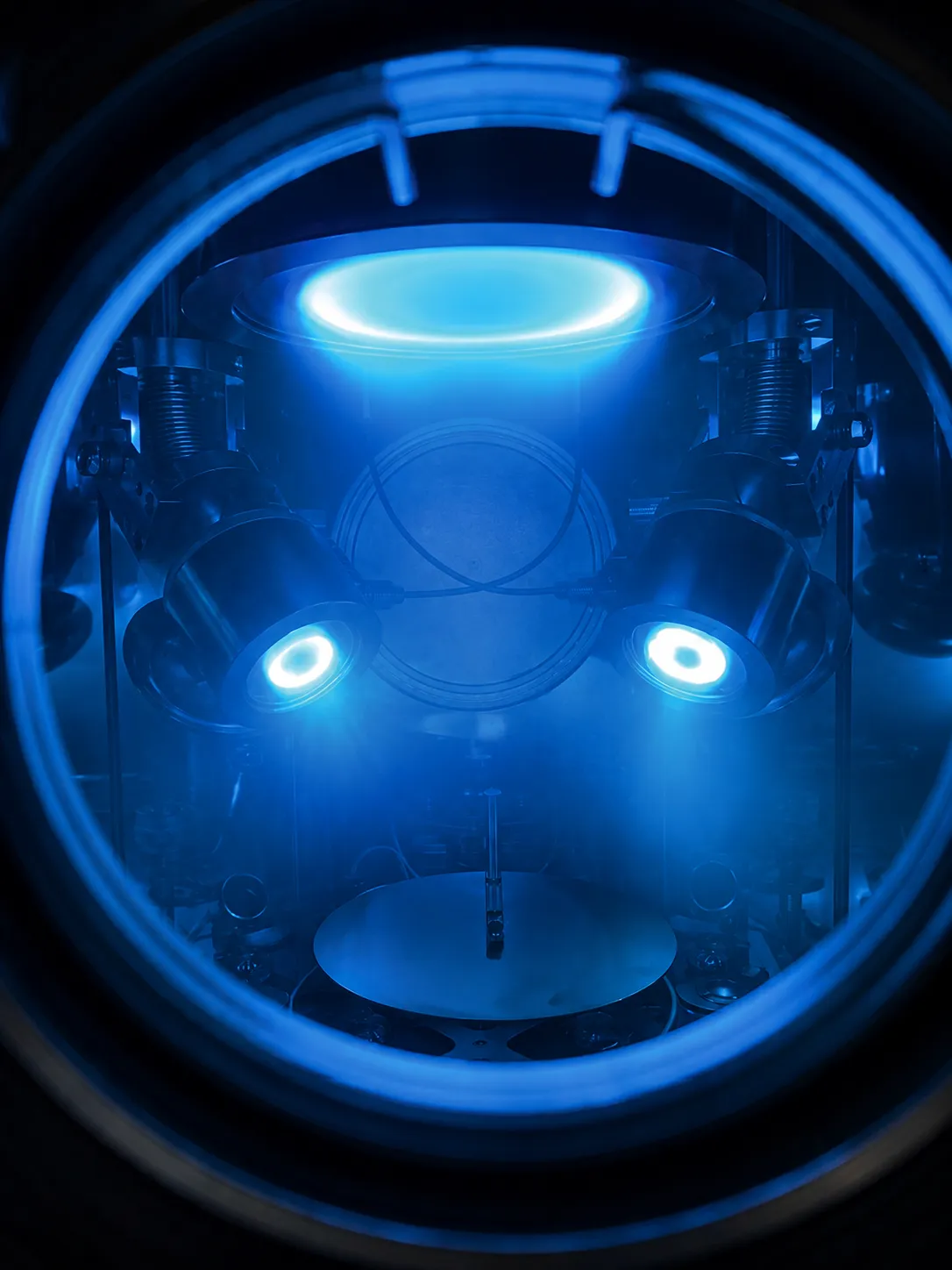
- 50 to 800 °C Effusion Cells for Organic Evaporation (±1 °C PID): Knudsen effusion cells provide precise organic semiconductor, OLED emitter, and hole-transport material deposition alongside sputtering sources in the same chamber, distinguishing this system from sputter-down configurations
- 1 to 6-Inch RF and DC Sputter-Up Guns with Flex-Head Rotation: upward-facing guns with self-axis rotation and compression seals for confocal multi-source deposition geometry on downward-facing substrates
- Confocal Sputter-Up Geometry: multiple gun axes converge at a common substrate center point, improving co-deposition uniformity and enabling multi-material deposition without substrate repositioning
- 10⁻⁸ Torr Main Chamber Base Pressure: turbomolecular and mechanical pump combination with dry pump option maintains the base pressure level needed for high-purity organic and inorganic film deposition
- Dedicated Load-Lock Pump, 10⁻⁶ Torr in 10 Minutes: separate pumping system evacuates the load-lock without disturbing main chamber vacuum; adaptable to e-beam and thermal source platforms
- Magnetic Arm Sample Transfer, 2" to 6" Substrates: magnetic arm loading and unloading for 2" to 6" diameter substrates with easy sample exchange options
- 20 to 30 Experiments Per Day: load-lock architecture enables rapid sample cycling, supporting high-throughput multilayer research and iterative device fabrication programs
- 8V to 500A, 5000W Thermal Sources for Co-Evaporation: high-power sequential and co-evaporation thermal sources with cross-contamination prevention design and easy material replacement
- SS304 Chamber (Prismatic or Cylindrical) with Electro-Polished Surfaces: feather-touch, electro-polished interior with SS304 liner; water-cooled chamber surfaces available when needed
- Standard 1-inch, QF, CF, and ISO Feedthrough Ports: configurable port selection supports upgrades to additional thermal and sputtering sources
- UV-Blocking Observation Window with LabVIEW Shutter Control: rotatable door shutter and LabVIEW-integrated sample shutter for precise deposition timing and thickness control integration
- Throttle, Vent, Isolation, and Gate Valve Configuration: comprehensive valve set manages all pressure transitions; main chamber held continuously under vacuum via isolation valve when idle
- Fully Automatic Computer and Panel Control with LCD Displays: all deposition operations run automatically under computer control, with panel override and real-time LCD process monitoring
- Interlock-Protected Automatic Water Cooling: closed-loop water cooling activates and deactivates automatically, with interlock preventing source operation without active coolant flow
- Wide-Range Vacuum Control (10⁻¹ to 10⁻⁹ Torr) with Pressure Fixing: vacuum measurement and downstream or upstream pressure-fixing capability for precise reactive sputtering process windows
- 50 to 600 °C PID Substrate Heating with ±1 °C Sensitivity: closed-loop substrate temperature for film crystallinity, adhesion, and interface management across a wide range
- 2 to 30 rpm Sample Rotation with DC/RF Plasma Cleaning: PC-controlled substrate rotation for deposition uniformity, plus DC/RF plasma cleaning to remove surface oxides before deposition
- Digital MFC Gas Inputs (Ar, N₂, O₂, He, CH₄) at 0.1 sccm Sensitivity: MFC-controlled mixed gas delivery supports inert and reactive sputtering processes
- 0.1 Å/s Dual-Channel Thickness Monitoring with Two QCMs: simultaneous rate and thickness measurement across organic and inorganic deposition channels
- Load-Lock Adaptable to E-Beam and Thermal Source Systems: load-lock architecture can be configured for platforms combining magnetron sputtering with e-beam and thermal evaporation sources
- Two-Year Warranty for Materials, Design, and Workmanship: comprehensive two-year coverage for system components, design, and manufacturing quality
Theory and Method
Sputter-up magnetron sputtering positions targets below the substrate, which faces downward with its deposition surface presented to the upward-traveling sputtered flux. This substrate-down, source-up geometry enables confocal arrangements where multiple gun axes converge at the substrate center, improving composition uniformity during co-deposition. The downward-facing substrate sits directly above organic effusion cells, allowing sequential or simultaneous organic and inorganic deposition in the same vacuum cycle. Load-lock access keeps the main chamber under vacuum while samples cycle in and out through the antechamber.
Organic material evaporation uses Knudsen effusion cells rather than the high-current boats used for inorganic metals. PID control at ±1 °C across 50 to 800 °C maintains stable molecular flux, since organic materials respond disproportionately to small temperature shifts. QCM thickness monitoring at 0.1 Å/s tracks organic and inorganic film buildup across two channels in real time. Target-sample geometry in the sputter-up configuration places organic and metallic sources on the same side, depositing both on the same substrate face without repositioning.
The main chamber holds 10⁻⁸ Torr base pressure with a turbomolecular and mechanical pump, while a separate load-lock pump reaches 10⁻⁶ Torr in 10 minutes. Throttle, vent, isolation, and gate valves control all vacuum transitions, with the main chamber held continuously under vacuum when the system is idle. Vacuum measurement and control spans 10⁻¹ to 10⁻⁹ Torr, with downstream or upstream pressure-fixing capability. High-power 8V to 500A, 5000W thermal sources supplement sputtering with co-evaporation and sequential deposition capability.
Load-Lock Sputter-Up Deposition System - ToronSputter™ SU Technical Specifications
| Parameter | Specification |
|---|---|
| Deposition Configuration | Sputter-up (substrate-down, sources-up) |
| Organic Evaporation | Knudsen effusion cells; 50 to 800 °C; PID controlled; ±1 °C |
| Main Chamber Base Pressure | 10⁻⁸ Torr |
| Load-Lock Vacuum Level | 10⁻⁶ Torr in 10 minutes |
| Vacuum Control Range | 10⁻¹ to 10⁻⁹ Torr |
| Pump Configuration | Turbomolecular + Mechanical (dry pump optional); dedicated load-lock pump |
| Valve Configuration | Throttle, vent, isolation, and gate valves |
| Chamber Material | SS304 (prismatic or cylindrical); electro-polished; SS304 liner |
| Chamber Surface Cooling | Water-cooled surfaces (when needed) |
| Feedthrough Ports | Standard 1-inch, QF, CF, ISO |
| Observation Window | UV-blocking; rotatable door shutter |
| Sputtering Guns | 1 to 6 inches (upward-facing); RF and DC; flex-head; self-axis rotation; compression seal |
| Thermal Sources | 8V to 500A, 5000W (sequential and co-evaporation) |
| Sample Transfer | Magnetic transfer arm |
| Sample Sizes | 2", 3", 4", 6" |
| Substrate Heating | 50 to 600 °C (PID controlled, ±1 °C) |
| Sample Rotation Speed | 2 to 30 rpm (PC controlled) |
| Plasma Cleaning | DC/RF plasma |
| Gas Inputs | Ar, N₂, O₂, He, CH₄ and others; digital MFC; 0.1 sccm sensitivity |
| Pressure Control Method | Downstream and upstream flow control |
| Thickness Monitoring | Dual-channel; 0.1 Å/s precision; 2 QCMs |
| Cooling System | Automatic closed-loop water cooling (interlock protected) |
| Control System | Fully automatic computer control; panel control; real-time LCD; LabVIEW |
| Experiment Throughput | 20 to 30 experiments per day |
| Warranty | 2 years (materials, design, and workmanship) |