
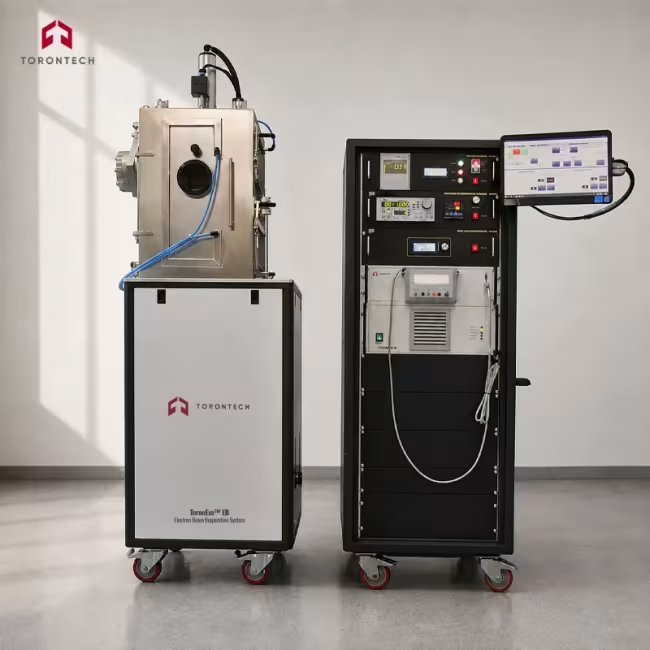
Electron Beam Evaporation System
Electron Beam Evaporation System - ToronEva™ EB
ToronEva™ EB is a high-vacuum electron beam evaporation system for thin film deposition of metals, alloys, and high-melting-point oxides. The e-beam gun operates at 10 kV and up to 600 mA of beam current, enabling deposition of Al, Pt, Ni, TiO₂, SiO₂, and similar materials with recipe-controlled rate adjustment. The SS304 chamber reaches 10⁻⁸ Torr base pressure, meeting purity requirements for demanding research PVD applications. Auxiliary 2500 W thermal sources add co-evaporation and doping capability within the same vacuum cycle.
PID-controlled substrate heating, covering 50 to 700 °C at ±1 °C sensitivity, combined with 2 to 30 rpm rotation, achieves better than 3% film thickness homogeneity across 4-inch substrates. The system accepts 3", 4", and 6" wafers and sample attachments between 1 and 15 cm. A dual-channel thickness controller with two QCMs monitors deposition rate to 0.1 Å/s in real time. Fully automatic computer control with LabVIEW-based software and real-time LCD displays coordinates vacuum sequencing, interlocks, and power delivery.
A digital mass flow meter system manages Ar, N₂, O₂, He, and CH₄ gas inputs at 0.2 sccm sensitivity for reactive evaporation and process gas control. An integrated ICP, CCP, and DC-RF plasma cleaning unit conditions substrate surfaces before deposition, removing contamination at the interface. The electro-polished, water-cooled chamber with UV-blocking observation window supports a 1.5-hour experiment cycle, allowing four to six deposition runs per day. Configurable 1-inch, QF, CF, and ISO ports accommodate additional thermal sources and process feedthroughs as needed.
Electron Beam Evaporation System - ToronEva™ EB Applications
The ToronEva™ EB serves thin film research programs requiring high-purity deposition of refractory metals and complex oxide materials that cannot be processed by resistive evaporation alone. Substrate heating, reactive gas capability, and in-situ plasma cleaning make it a single-platform solution for applications that would otherwise require multiple deposition tools.
- Semiconductor and Microelectronics Research: deposition of gate dielectrics, metal contacts, and passivation layers including TiO₂, SiO₂, Pt, and Ni on wafers up to 6 inches
- Optical Thin Film Research: deposition of high-refractive-index oxide layers and metallic mirrors for photonic devices, optical filters, and anti-reflective coatings
- Academic and University PVD Laboratories: research-grade thin film fabrication for materials science, device physics, and condensed matter studies requiring vacuum below 10⁻⁷ Torr
- MEMS and NEMS Device Fabrication: conformal metallization and functional oxide deposition for sensor, actuator, and resonator prototype development
- Organic Electronics and Photovoltaics: deposition of transparent conductive oxide contacts and metallic electrodes on organic device stacks with precise rate and substrate temperature control
- Hard Coating and Surface Engineering Research: e-beam deposition of wear-resistant oxide, nitride, and metallic films for tribology and materials durability studies
- Reactive Oxide and Nitride Film Research: controlled reactive deposition of TiO₂, SiO₂, Al₂O₃, TiN, and related compound films from metallic sources using process gas introduction
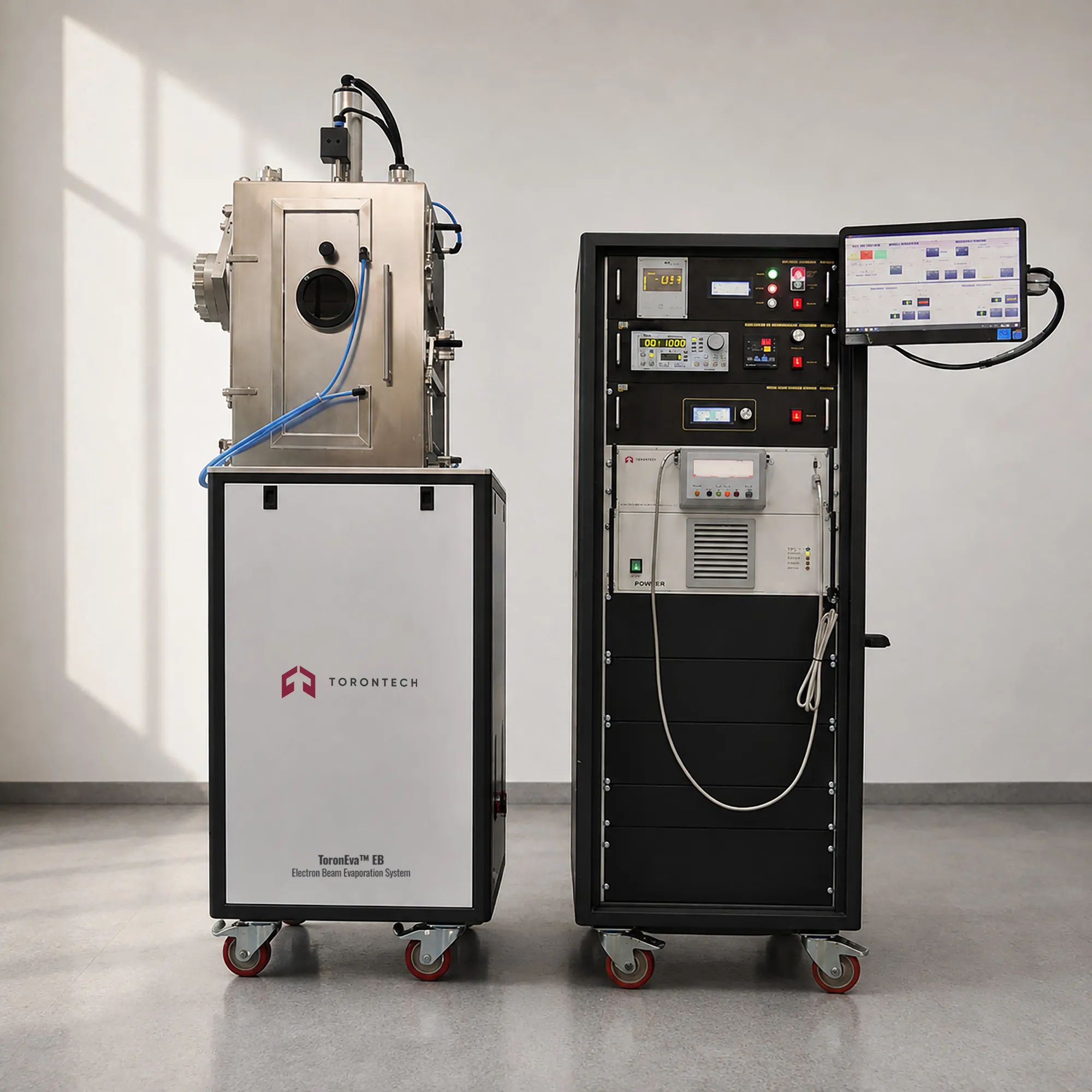
Electron Beam Evaporation System - ToronEva™ EB Key Features
The ToronEva™ EB combines a 10 kV e-beam source with PID substrate heating, multi-channel gas control, in-situ plasma cleaning, and auxiliary thermal sources in a single high-vacuum platform for demanding research PVD applications.
- 10 kV, 600 mA E-Beam Power Supply with Arc Protection: high-voltage supply delivers concentrated beam energy to the target, with active arc protection preventing discharge damage during deposition of insulating or reactive materials
- Electro-Polished SS304 Vacuum Chamber: prismatic or cylindrical chamber with water-cooled, electro-polished surfaces and SS304 liner reduces particulate generation and simplifies post-deposition cleaning
- 10⁻⁸ Torr Base Pressure: turbomolecular and mechanical pump combination (dry pump optional) achieves 10⁻⁸ Torr base and 10⁻⁷ Torr working pressure for a fully loaded system in one hour
- Wide-Range Vacuum Control with Pressure Fix (1000 to 10⁻⁹ Torr): integrated vacuum control and measurement system allows the operator to set and hold a target pressure value throughout the deposition
- 50 to 700 °C PID Substrate Heating: closed-loop temperature control at ±1 °C sensitivity supports substrate temperatures across a wide range, promoting crystallinity and adhesion for oxide and functional films
- 2 to 30 rpm Substrate Rotation with Homogeneity Control: continuously adjustable rotation, controlled via panel or PC, achieves better than 3% film thickness homogeneity across 4-inch samples
- Multi-Format Sample Holder Selection: accepts 3", 4", and 6" wafers and sample attachments between 1 and 15 cm to accommodate a wide range of substrate geometries
- Recipe-Controlled Deposition of Metals and Oxides: pre-set deposition recipes manage e-beam power ramp and rate for Al, Pt, Ni, TiO₂, SiO₂, and other materials at high evaporation rates
- 2500 W Sequential Thermal Sources for Co-Evaporation: auxiliary 8 V to 300 A thermal sources provide co-evaporation and doping capability in the same vacuum cycle, with source design preventing cross-contamination and supporting easy source replacement
- 0.1 Å/s Dual-Channel Thickness Rate Controller with Two QCMs: two independent QCMs monitor deposition rate with 0.1 Å/s precision, with optional ion gun implementation for additional process control
- Digital Mass Flow Meter Gas Control (Ar, N₂, O₂, He, CH₄): panel or PC-operated MFM system manages multiple process gas inputs at 0.2 sccm sensitivity, enabling reactive deposition and controlled gas mixing
- ICP, CCP, and DC-RF Plasma Cleaning Unit: in-situ substrate surface conditioning before deposition removes native oxides and contaminants, improving film adhesion and interface quality
- Configurable Port Selection (1-inch, QF, CF, ISO): standard and high-vacuum port options support custom feedthrough configurations and straightforward installation of additional thermal sources
- UV-Blocking Observation Window with Rotatable Shutter: front-mounted UV-filtering window enables process monitoring while protecting the operator; shutter position integrates with LabVIEW-based thickness control
- Dual-Mode Control (Automatic Computer and Manual Panel): fully automatic computer control with LabVIEW-based software and manual panel operation work independently or together, with real-time LCD status throughout the process
- Interlock-Protected Automatic Water Cooling System: closed-loop cooling with automatic on/off and interlock protection prevents e-beam power delivery without active coolant flow, protecting gun and chamber components
- Throttle, Vent, and Isolation Valve Configuration: isolation valve holds the chamber under vacuum between experiments; throttle valve provides precise working pressure control throughout the deposition
- 1.5-Hour Experiment Cycle with Multi-Run Throughput: designed for consistent daily use with four to six deposition experiments per day achievable in routine operation
- Two-Year Full Warranty: coverage for materials, design, and workmanship provides extended assurance for research facility investment
Theory and Method
Electron beam evaporation directs a focused beam of high-energy electrons onto a source material held in a water-cooled copper crucible, heating the target to its evaporation temperature without heating the crucible. A 10 kV electron gun deflects the beam magnetically, concentrating energy at the target surface with up to 600 mA of beam current. This approach vaporizes refractory materials that resistive heating cannot reach, including high-melting-point metals and complex oxides. Vaporized atoms travel through the vacuum in straight lines and condense on substrates above.
Electron beam evaporation requires deeper vacuum than resistive thermal evaporation because the electron beam can ionize residual gas, causing scattering and beam instability at higher pressures. The turbomolecular and mechanical pump combination drives the SS304 chamber to 10⁻⁸ Torr base pressure, low enough to sustain a well-focused, stable beam. An isolation valve maintains the chamber under vacuum between experiments, eliminating pump-down overhead between successive runs. Throttle and vent valves allow precise pressure adjustment across the 1000 to 10⁻⁹ Torr range.
Reactive evaporation introduces O₂ or N₂ through MFM-controlled gas lines, producing oxide or nitride films from metallic sources without compound targets. The ICP, CCP, and DC-RF plasma cleaning stage removes native oxides from substrate surfaces before deposition, improving nucleation and adhesion. Substrate heating at 50 to 700 °C promotes film crystallinity during growth, particularly relevant for oxide films where crystalline phase determines properties. A dual-channel thickness monitor with two QCMs tracks deposition rate to 0.1 Å/s, providing continuous feedback to e-beam power control.
Electron Beam Evaporation System - ToronEva™ EB Technical Specifications
| Parameter | Specification |
|---|---|
| E-Beam Power Supply | 10 kV, 600 mA |
| Arc Protection | Integrated |
| Auxiliary Thermal Sources Power Supply | 2500 W (8 V – 300 A), sequential |
| Base Pressure | 10⁻⁸ Torr |
| Working Vacuum Level (Pump-Down Time) | 10⁻⁷ Torr in 1 hour (fully loaded system) |
| Vacuum Control Range | 1000 to 10⁻⁹ Torr |
| Pump Configuration | Turbomolecular + Mechanical (dry pump optional) |
| Chamber Material | SS304 (prismatic or cylindrical); electro-polished, water-cooled |
| Chamber Liner | SS304 |
| Observation Window | UV-blocking, front-mounted; rotatable shutter |
| Ports | Standard 1", QF, CF, ISO (configurable) |
| Control System | Fully automatic computer control; manual panel control; LabVIEW-based software |
| Display | Real-time LCD |
| Cooling System | Automatic closed-loop water cooling (interlock protected, automatic on/off) |
| Sample Holder Options | 3", 4", 6" wafers; 1 to 15 cm sample attachments |
| Sample Rotation Speed | 2 to 30 rpm (continuously adjustable; panel or PC) |
| Film Homogeneity | Better than 3% across 4-inch sample |
| Sample Heating Range | 50 to 700 °C (PID controlled, ±1 °C) |
| Thickness Monitoring | Dual-channel; 0.1 Å/s precision; 2 QCMs; ion gun optional |
| Gas Inputs | Ar, N₂, O₂, He, CH₄ and others; digital MFM; 0.2 sccm sensitivity; panel or PC |
| Plasma Cleaning Modes | ICP, CCP, DC-RF (adjustable pressure) |
| Valve Configuration | Throttle, vent, and isolation valves |
| Cycle Time | ~1.5 hours (4 to 6 experiments per day) |
| Warranty | 2 years (materials, design, and workmanship) |