
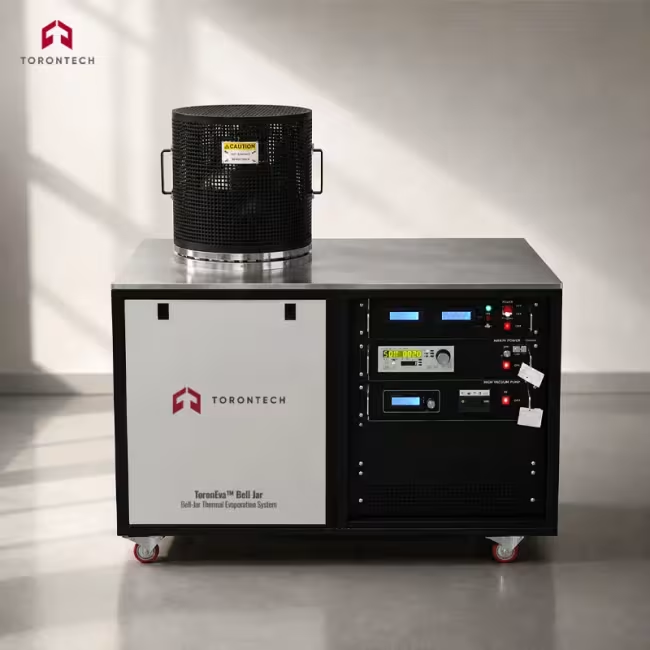
Bell-Jar Thermal Evaporation System
Bell-Jar Thermal Evaporation System - ToronEva™ Bell Jar
ToronEva™ Bell Jar is a fully automated bell-jar thermal evaporation system for thin film deposition in research and development laboratories. Resistive heating in a high-vacuum environment produces metal, oxide, and organic thin films at base pressures reaching 10⁻⁷ Torr. Panel control, quick cycle times, and adjustable source-to-substrate distance simplify operation while conserving evaporation material. The system handles 4-inch wafers, 1×3-inch lamellae, and various substrate sizes, adapting easily to changing deposition requirements.
A turbomolecular and mechanical pump combination, fitted with SS316 flex hose and a dust filter, reaches 10⁻⁶ Torr in under 30 minutes. The vacuum range spans 1000 to 10⁻⁹ Torr with automatic vent, back-fill, and chamber-hold capability. The bell jar is available in Pyrex glass or SS304, and the 75×120 cm footprint with lockable wheels fits through a standard 85 cm doorway. A closed-cycle water cooler with automatic on/off control manages heat load during extended deposition runs.
The ToronEva™ Bell Jar supports sequential and co-evaporation configurations with an optional four-source layout for 4×1 sequential or 2×2 co-evaporation. A servo-controlled shutter serves two thermal sources simultaneously, and a dual-channel thickness monitor with one QCM tracks deposition rate and cumulative film thickness in real time. Proprietary source-chamber geometry prevents cross-contamination between materials, preserving film purity across consecutive runs. Sample rotation at 2 to 30 rpm promotes deposition uniformity across the substrate surface.
Bell-Jar Thermal Evaporation System - ToronEva™ Bell Jar Applications
The ToronEva™ Bell Jar serves thin film deposition requirements across research institutions, university laboratories, and specialized industrial facilities where a laboratory vacuum coater is needed for controlled thin-film work. Its versatile chamber configuration and multiple sample holder options make it suited to a wide range of substrate types and deposition materials.
- Academic and University Research: deposition of metals, oxides, and organic films for fundamental materials science and device physics studies in campus laboratory settings
- Semiconductor Device Fabrication: formation of metal contacts, gate electrodes, and dielectric layers on silicon wafers for transistor and IC prototype development
- Optical Thin Film Research: deposition of reflective and anti-reflective coatings on glass and crystal substrates for photonics and optical component development
- Organic Electronics and OLED Research: controlled deposition of organic and metallic layers for organic photovoltaic cells, OLEDs, and thin-film transistor prototypes
- MEMS and NEMS Fabrication: metallization and functional film deposition for microelectromechanical and nanoelectromechanical device development
- Solar Cell Research: deposition of contact layers and absorber films for laboratory-scale photovoltaic cell prototyping and efficiency studies
- Materials Science and Surface Engineering: thin film characterization studies requiring precise control of film thickness, composition, and deposition rate

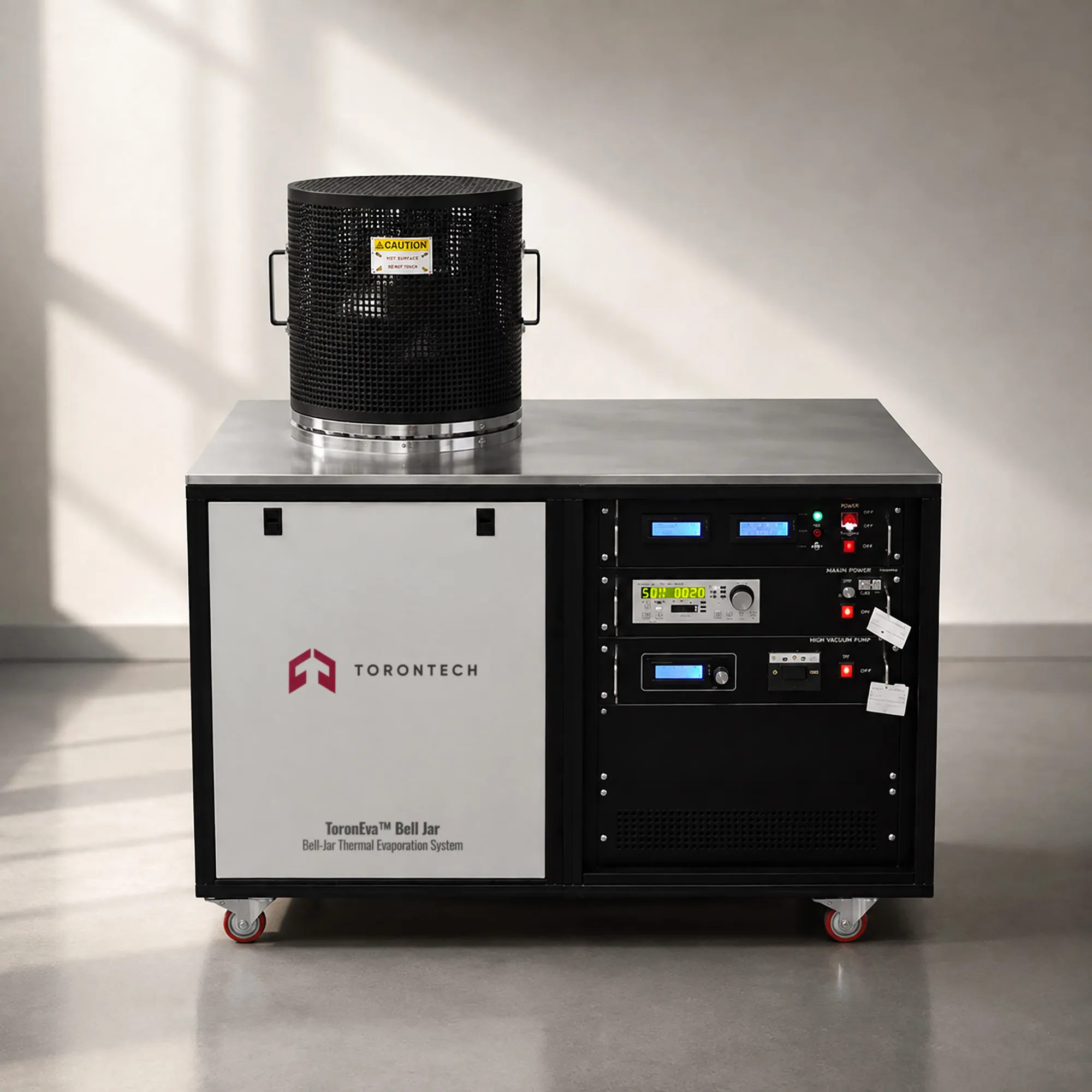
Bell-Jar Thermal Evaporation System - ToronEva™ Bell Jar Key Features
The ToronEva™ Bell Jar combines high-vacuum performance with a feature set oriented toward reproducibility, contamination control, and operational simplicity in research laboratory environments.
- Fully Automated Vacuum Management: panel control with quick cycle times reduces operator steps and preparation time between consecutive deposition runs
- Pyrex Glass or SS304 Bell Jar: operator selects chamber material to match process chemistry, with standard 1-inch ports for flexible feedthrough integration
- Versatile Sample Holder Selection: accommodates 4-inch wafers, 1×3-inch lamellae, and small-to-large samples with straightforward loading
- Adjustable Source-Substrate Distance: optimizes deposition angle and rate distribution by repositioning the source relative to the substrate without chamber modification
- SS304 Internal Protection Jacket: shields the chamber interior from direct evaporant exposure, extending service intervals and simplifying post-deposition cleanup
- 10⁻⁷ Torr Base Pressure with Fast Pump-Down: reaches 10⁻⁶ Torr working pressure in under 30 minutes, reducing cycle time in multi-run sessions
- Turbomolecular and Mechanical Pump Stack: paired pumps with SS316 flex hose and dust filter provide clean, low-contamination vacuum across the full operating range
- Wide-Range Vacuum Control (1000 to 10⁻⁹ Torr): integrated control and measurement system with automatic vent and back-fill eliminates manual valve operation
- Integrated Closed-Cycle Water Cooler: automatic thermal management activates and deactivates cooling as needed, protecting the system during continuous operation
- Optional Four-Source Configuration: supports 4×1 sequential or 2×2 co-evaporation for alloy, compound, or multilayer film deposition in a single pump-down cycle
- Power-Failure Auto Shut-Off with Vacuum Hold: shuts down safely on power loss and maintains chamber vacuum to protect samples and preserve the deposition environment
- 2000 W Thermal Evaporation Power Supply: 10 V to 200 A output range accommodates low-melting organics and high-temperature metals in a single unit
- Cross-Contamination Elimination Design: proprietary source-chamber geometry prevents evaporant cross-contact between sources and chamber walls, preserving material purity
- Dual-Channel Thickness Monitor with QCM: real-time monitoring of deposition rate and cumulative film thickness across two independent sources simultaneously
- 2 to 30 rpm Sample Rotation: adjustable substrate rotation distributes vapor flux uniformly, improving film thickness homogeneity across the substrate area
- Servo-Controlled Dual-Source Shutter: a single shared shutter with servo actuation controls deposition initiation and termination for both thermal sources simultaneously
- One-Touch Vent Control: a single button initiates the automatic vacuum management sequence, simplifying chamber access without stepwise manual procedures
- Operator-Friendly Interface: intuitive control layout with a clear display reduces the learning curve for new users and speeds up daily laboratory operation
- Compact Mobile Platform: 75×120 cm footprint on lockable wheels provides stable positioning while allowing the system to be relocated within the laboratory
- Standard Doorway Clearance: the system passes through a standard 85 cm doorway, removing installation and relocation barriers in buildings with conventional corridor widths
- One-Year Full Warranty: coverage for design, materials, and workmanship gives laboratories confidence in long-term reliability and manufacturer accountability
Theory and Method
Thermal evaporation deposits thin films by heating a source material inside a high-vacuum chamber to its vaporization point. A high-current, low-voltage power supply drives electrical current through a resistive source such as a tungsten boat, coil, or basket. Vaporized atoms travel in straight lines through the vacuum and condense on substrate surfaces positioned above the source. At pressures below 10⁻⁵ Torr, residual gas molecules are too sparse to scatter vapor atoms, producing high-purity films.
The vacuum system determines film quality as much as the source material itself. A turbomolecular pump backed by a mechanical pump evacuates the chamber to base pressures below 10⁻⁷ Torr, reducing residual gas contamination to negligible levels. Automatic vent and back-fill functions let the operator cycle the chamber without manual valve operations, and a hold-vacuum mode maintains the environment between depositions. The 2000 W (10 V to 200 A) power supply accommodates both low-melting organics and high-temperature refractory metals in a single unit.
A dual-channel deposition controller and a quartz crystal microbalance (QCM) monitor film thickness in real time. As film mass accumulates on the oscillating QCM crystal, the resonant frequency shifts in proportion to the deposited thickness, a relationship derived from the Sauerbrey equation. The controller converts that frequency shift to a thickness reading continuously without interrupting deposition. Sample rotation at 2 to 30 rpm distributes vapor flux evenly across the substrate, improving uniformity.
Bell-Jar Thermal Evaporation System - ToronEva™ Bell Jar Technical Specifications
| Parameter | Specification |
|---|---|
| Thermal Evaporation Power Supply | 2000 W (10 V – 200 A) |
| Base Pressure | 10⁻⁷ Torr |
| Working Vacuum Level (Pump-Down Time) | 10⁻⁶ Torr in ≤30 minutes |
| Vacuum Control Range | 1000 to 10⁻⁹ Torr |
| Pump Configuration | Turbomolecular + Mechanical |
| Pump Hose | SS316 flex hose with dust filter |
| Bell-Jar Material | Pyrex glass or SS304 cylinder |
| Bell-Jar Ports | Standard 1-inch |
| Internal Protection Jacket | SS304 cylindrical |
| Sample Holder Options | 4-inch wafer; 1×3-inch lamellae; small and large samples |
| Source-to-Substrate Distance | Adjustable |
| Sample Rotation Speed | 2 to 30 rpm |
| Thickness Monitoring | Dual-channel thickness monitor + one QCM |
| Standard Number of Thermal Sources | 2 |
| Optional Source Configuration | 4 sources (4×1 sequential or 2×2 co-evaporation) |
| Shutter | Servo-controlled, common to two thermal sources |
| Cooling System | Closed-cycle water cooler (automatic on/off) |
| Vacuum Management Functions | Automatic vent, back-fill, and chamber-hold |
| Footprint | 75 × 120 cm |
| Door Clearance | Passes through standard 85 cm doorway |
| Mobility | Lockable wheels |
| Warranty | 1 year (design, materials, and workmanship) |