
Bell-Jar Thermal Evaporation & Sputtering System
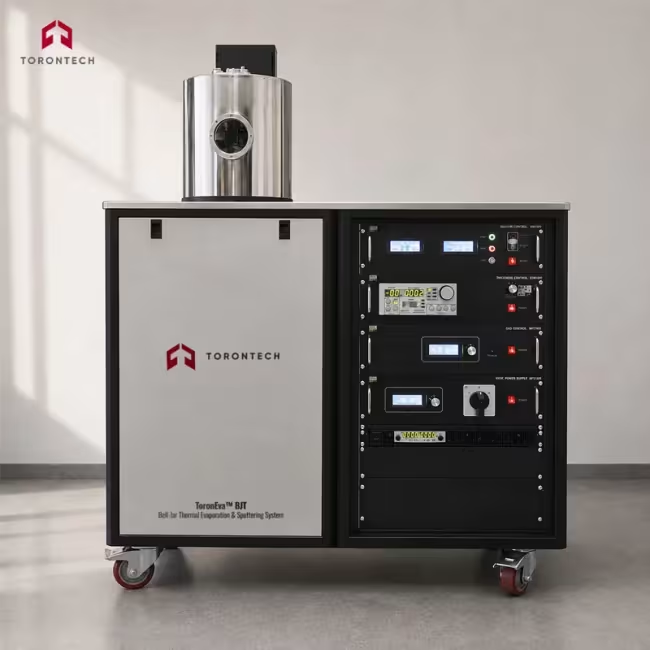
Bell-Jar Thermal Evaporation & Sputtering System - ToronEva™ BJT
ToronEva™ BJT is a fully automated bell-jar thermal evaporation and sputtering system for research-grade PVD thin film deposition. A 2-inch DC sputter gun and two thermal evaporation sources share the same chamber, enabling sequential or combined deposition without venting. DC and RF sputtering options, three-channel MFC gas control, and a 1-hour cycle time support both standard and reactive deposition processes. The system reaches 10⁻⁷ Torr base pressure with 10⁻⁶ Torr working pressure achieved in under 30 minutes.
Sputtering power is selectable as 600 VDC, 3 A DC or 300 W, 13.56 MHz RF, covering both conductive and insulating target materials. A three-channel MFC system controls Ar, N₂, and O₂ inputs at 0.1 sccm sensitivity with real-time digital mixing, supporting inert and reactive gas sputtering. Throttle, vent, and isolation valves allow precise manual pressure setting across the 1 to 100 mTorr sputter working range. Automatic vent and N₂ back-fill simplify chamber cycling between depositions.
The thermal evaporation side uses a 2000 W (8 V to 300 A) power supply and a proprietary box-source design that prevents evaporant cross-contact and chamber contamination. Sample holders accept 2", 3", and 4" wafers, 1×3" lamellae, and small samples via spring clips, covering a wide range of substrate geometries. Source-to-substrate distance is adjustable to optimize deposition rate and uniformity. An optional SS bell jar with hoist expands the system for larger substrates or batch loads.
Bell-Jar Thermal Evaporation & Sputtering System - ToronEva™ BJT Applications
The ToronEva™ BJT addresses the growing need for combined PVD capabilities in research laboratories where multiple deposition methods are required within a single workflow. The system's hybrid thermal evaporation and sputtering configuration reduces equipment floor space and eliminates cross-contamination risks that arise when transferring substrates between separate systems.
- Academic and University Research Laboratories: deposition of metallic, oxide, and compound thin films for materials science and device physics studies requiring both evaporation and sputter-deposited layers within a single vacuum cycle
- Semiconductor Device Prototyping: fabrication of metal contacts, gate oxides, and dielectric layers on silicon wafers using sequential evaporation and reactive sputter deposition without breaking vacuum
- Organic Electronics and OLED Research: thermal evaporation of organic emitter layers combined with sputter-deposited transparent conductive oxide contacts for OLED and organic photovoltaic device development
- Optical Coating Research: deposition of metallic mirrors, anti-reflective stacks, and optical filters using RF sputtering of oxide layers combined with thermal evaporation of metal overlayers
- MEMS and NEMS Fabrication: metallization and functional film deposition combining sputter-deposited adhesion layers with thermally evaporated overlayers for microdevice prototype development
- Solar Cell and Photovoltaic Research: deposition of contact layers, absorber films, and buffer layers through both evaporation and reactive sputtering to prototype thin-film photovoltaic cell structures
- Materials Science and Surface Engineering: investigation of thin film composition and properties across co-deposited or sequentially deposited material systems in a controlled reactive gas environment

Bell-Jar Thermal Evaporation & Sputtering System - ToronEva™ BJT Key Features
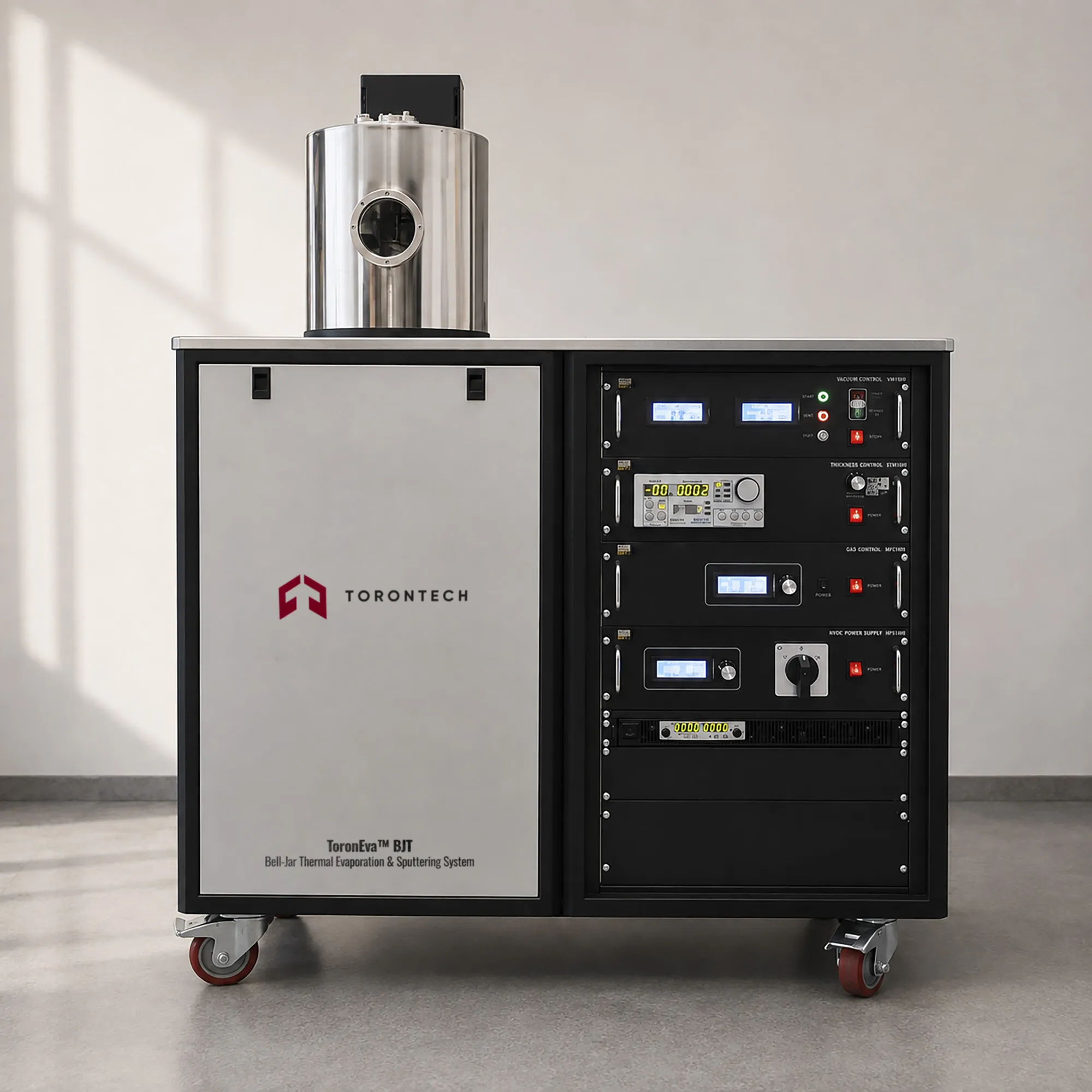
The ToronEva™ BJT integrates thermal evaporation and DC/RF magnetron sputtering into a single bell-jar platform, offering the flexibility of two deposition methods with the convenience of one vacuum system.
- Fully Automated Vacuum Management with 1-Hour Cycle Time: panel-controlled operation completes a full vent-to-deposition cycle in approximately one hour, minimizing downtime between runs
- Pyrex Glass or SS304 Bell Jar: operator selects chamber material to match process chemistry, with standard 1-inch ports on the base plate for flexible feedthrough integration
- Multi-Format Sample Holder Selection: accommodates 2", 3", and 4" wafers, 1×3" lamellae, and small samples held by spring clips, supporting a broad range of substrate geometries
- Adjustable Source-Substrate Distance: optimizes deposition geometry for both evaporation and sputtering processes without chamber modification
- SS304 Internal Protection Jacket: shields the chamber interior from direct evaporant exposure, reducing contamination buildup and extending service intervals
- 10⁻⁷ Torr Base Pressure with Rapid Pump-Down: reaches 10⁻⁶ Torr working pressure in under 30 minutes, enabling fast cycle times for both evaporation and sputtering runs
- Turbomolecular and Mechanical Pump Stack: paired pumps with SS316 flex hose and dust filter provide clean, low-contamination vacuum to UHV levels
- Wide-Range Vacuum Control (1000 to 10⁻⁹ Torr): integrated control and measurement system with automatic vent and N₂ back-fill eliminates manual valve sequencing
- Integrated Closed-Cycle Water Cooler: automatic thermal management activates and deactivates cooling to protect system components during continuous operation
- 2000 W Thermal Evaporation Power Supply: 8 V to 300 A output drives resistive evaporation of metals, organics, and alloys with a wide current range
- Proprietary Box-Source Evaporation Design: two thermal sources with a box enclosure prevent cross-source and chamber contamination, preserving material purity across consecutive depositions
- 2-Inch DC Sputter Gun: positioned on the base plate for direct line-of-sight deposition onto substrates loaded above the source
- DC or RF Sputtering Power Supply: 600 VDC, 3 A switching supply handles conductive targets; the 300 W, 13.56 MHz RF option extends capability to dielectrics and insulators
- Three-Channel MFC Gas Control: real-time digital management of Ar, N₂, and O₂ flows at 0.1 sccm sensitivity enables stable inert and reactive sputtering gas compositions
- Precision Sputter Pressure Control (1 to 100 mTorr): throttle, vent, and isolation valves allow fine manual adjustment of working pressure across the full sputter operating range
- Argon and Reactive Gas Sputtering: oxide and nitride thin films can be deposited directly using N₂ or O₂ reactive gas, eliminating the need for compound targets
- Power-Failure Auto Shut-Off with Vacuum Hold: safe shutdown on power loss and chamber vacuum preservation protects samples and prevents atmospheric exposure
- Servo-Controlled Dual-Source Shutter: one shared servo-actuated shutter manages deposition start and stop timing for both thermal sources simultaneously
- One-Touch Vent Control: a single button initiates automatic vacuum management for chamber access, replacing manual stepwise valve procedures
- Compact Mobile Platform with Intuitive Interface: 75×120 cm footprint on lockable wheels with a clear, operator-friendly control layout for daily laboratory use
- Standard Doorway Clearance: the system passes through a standard 85 cm doorway, removing installation barriers in buildings with conventional corridor widths
- Combined DC-RF Sputtering and Thermal Evaporation Options: thermal evaporation and sputter sources can be operated within the same run, enabling heterogeneous multi-layer film stacks in a single vacuum cycle
- Optional SS Bell Jar with Hoist: stainless steel bell-jar upgrade with integrated hoist mechanism simplifies chamber access for systems handling larger substrate loads
- One-Year Full Warranty: coverage for design, materials, and workmanship provides confidence in long-term system reliability
Theory and Method
The ToronEva™ BJT operates on two complementary PVD mechanisms, thermal evaporation and magnetron sputtering, within a shared bell-jar chamber. Thermal evaporation drives source material from a resistive boat, coil, or basket with the 2000 W power supply until the material vaporizes. Atoms travel in a line-of-sight trajectory through the high vacuum and condense on the substrate above. This mechanism is favored for high-purity metallic and organic films where substrate heating and ion bombardment must be minimized.
Sputtering works by bombarding a solid target with energetic ions from a low-pressure argon plasma. The DC magnetron configuration confines the plasma near the target surface with a magnetic field, increasing sputter yield and deposition rate. Sputtered atoms arrive at the substrate with higher kinetic energy than thermally evaporated atoms, producing denser films with stronger adhesion and better step coverage. The RF supply at 13.56 MHz extends this to insulating targets such as oxides and nitrides, which cannot sustain DC plasma.
Reactive sputtering adds N₂ or O₂ through MFC-controlled gas lines to form nitride or oxide films directly at the substrate, eliminating the need for compound targets. The three-channel MFC system sets each gas flow independently at 0.1 sccm resolution, with throttle valve control maintaining precise working pressure across the 1 to 100 mTorr range. Combining reactive sputter-deposited layers with thermally evaporated metal overlayers builds multi-material structures without breaking vacuum, preserving interface cleanliness. A servo-controlled shutter manages deposition timing across both thermal sources simultaneously.
Bell-Jar Thermal Evaporation & Sputtering System - ToronEva™ BJT Technical Specifications
| Parameter | Specification |
|---|---|
| Thermal Evaporation Power Supply | 2000 W (8 V – 300 A) |
| Sputtering Power Supply | 600 VDC, 3 A (DC) or 300 W, 13.56 MHz (RF) |
| Base Pressure | 10⁻⁷ Torr |
| Working Vacuum Level (Pump-Down Time) | 10⁻⁶ Torr in ≤30 minutes |
| Cycle Time | ~1 hour (vent to deposition) |
| Vacuum Control Range | 1000 to 10⁻⁹ Torr |
| Sputter Working Pressure Range | 1 to 100 mTorr (manual via throttle valve) |
| Pump Configuration | Turbomolecular + Mechanical |
| Pump Hose | SS316 flex hose with dust filter |
| Bell-Jar Material | Pyrex glass or SS304 cylinder |
| Bell-Jar Ports | Standard 1-inch, on base plate |
| Internal Protection Jacket | SS304 cylindrical |
| Sputter Gun | 1 × 2-inch DC sputter gun (base plate mounted) |
| Thermal Evaporation Sources | 2 (proprietary box-source design) |
| Sample Holder Options | 2", 3", 4" wafers; 1×3" lamellae; small sample spring holder |
| Source-to-Substrate Distance | Adjustable |
| Gas Inputs | Ar, N₂, O₂; MFC-controlled, 3-channel, 0.1 sccm sensitivity |
| Gas Control | Real-time digital; independent channel mixing |
| Valve Configuration | Throttle, vent, and isolation valves |
| Sputtering Modes | DC Argon; reactive (N₂ or O₂) |
| Shutter | Servo-controlled, common to two thermal sources |
| Cooling System | Closed-cycle water cooler (automatic on/off) |
| Vacuum Management Functions | Automatic vent; N₂ back-fill |
| Footprint | 75 × 120 cm |
| Door Clearance | Passes through standard 85 cm doorway |
| Mobility | Lockable wheels |
| Optional Configurations | DC-RF combined sputtering; SS bell jar with hoist |
| Warranty | 1 year (design, materials, and workmanship) |