
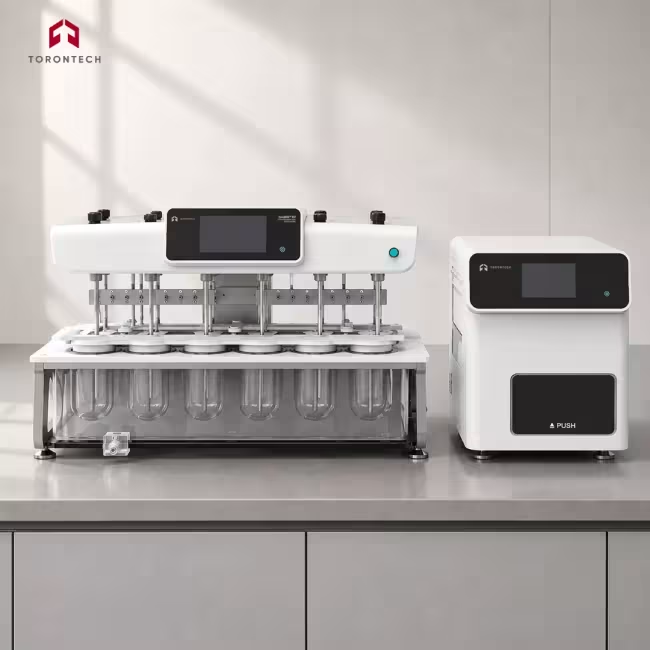
12-Vessel Dissolution Tester with Autosampler
12-Vessel Dissolution Tester with Autosampler
ToronDISS™ A12 Automatic Dissolution system integrates a 12-vessel dissolution tester with a fully automatic sampling module in one workstation for pharmaceutical QC labs, formulation development teams, and contract testing organizations. The platform runs paddle and basket dissolution methods per USP <711>, then withdraws, filters, and dispenses samples into collection vials without operator intervention. Torontech engineered the A12 to eliminate the manual pipetting steps that account for most repeatability errors in traditional dissolution workflows.
Twelve independent test cells run in parallel, letting labs process two full USP six-vessel runs simultaneously or dedicate the platform to a single high-throughput product line. The onboard controller manages media temperature, paddle speed, sampling schedules, and cleaning cycles from a single interface. Data feeds directly to a PC via USB, and stored audit trails support GMP documentation requirements.
Its magnetic pump architecture, dual-layer temperature protection, and modular sampling head make the ToronDISS™ A12 suited to labs running multiple formulations under demanding QC schedules. Fully compliant with international pharmacopoeia dissolution methods, the system delivers the traceability and reproducibility expected in FDA-regulated and EU GMP environments.
12-Vessel Dissolution Tester with Autosampler - ToronDISS™ A12 Applications
The ToronDISS™ A12 supports dissolution testing across pharmaceutical development, quality control, and contract analysis environments.
- Solid Oral Dosage QC: routine batch-release testing of immediate-release, delayed-release, and extended-release tablets and capsules per USP <711> paddle and basket methods
- Formulation Development: comparative dissolution profiling of prototype formulations to guide excipient selection and manufacturing process design
- Bioequivalence Studies: multi-media dissolution profile generation for generic drug submissions requiring f2 similarity factor calculations
- Method Development and Validation: parameter screening across pH, apparatus, and rotation speed combinations to establish discriminating dissolution methods
- Extended-Release Product Testing: automated multi-point sampling over 12 to 24 hour dissolution profiles without operator presence
- Contract Testing Laboratories: high-throughput dissolution analysis with full audit trails for CRO and CDMO client submissions
- Stability Studies: long-term and accelerated stability monitoring of dissolution performance across storage conditions and time points
Standards
The ToronDISS™ A12 is designed to align with internationally recognized pharmacopoeia dissolution methods and holds CE certification for the EU market.
- USP <711> - Dissolution Test for Pharmaceutical Dosage Forms
- Ph.Eur. 2.9.3 - Dissolution Test for Solid Dosage Forms
- EN ISO 12100:2010 - Safety of Machinery: General Principles for Design, Risk Assessment and Risk Reduction
- EN 60204-1:2018 - Safety of Machinery: Electrical Equipment of Machines
- EN 61010-1:2010+A1:2019 - Safety Requirements for Electrical Equipment for Measurement, Control, and Laboratory Use
- EN IEC 61326-1:2021 - Electrical Equipment for Measurement, Control, and Laboratory Use: EMC Requirements
CE certification covers the EU Machinery Directive 2006/42/EC and EMC Directive 2014/30/EU. IQ/OQ qualification documentation is available upon request.
12-Vessel Dissolution Tester with Autosampler - ToronDISS™ A12 Key Features
The ToronDISS™ A12 combines a validated dissolution bath with an integrated autosampler in a single platform, delivering hands-off operation from method start through final vial collection.
- Twelve-Vessel Parallel Testing: runs two full USP six-vessel batches concurrently or dedicates full capacity to a single formulation, doubling lab throughput without a second instrument
- Three-Tier User Access Control: administrator, method developer, and operator roles with individually logged actions support GMP audit trail requirements and 21 CFR Part 11-ready workflows
- Independent Cell Temperature Regulation: each of the twelve vessels carries its own probe and dual-layer thermal barrier, holding uniformity to 0.1°C and accuracy to ±0.3°C across the bath
- Scheduled Preheat Function: media reaches setpoint before staff arrive, letting the lab begin testing immediately at shift start rather than waiting on bath warm-up
- Magnetic Pump Sampling Circuit: pulsation-free withdrawal maintains sample integrity through the tubing and inline filter, producing cleaner UV absorbance data than peristaltic alternatives
- Isolated Sampling and Tray Lines: separate fluid paths for withdrawal and dispensing eliminate cross-contamination between vessels and between time points
- Automatic Pipeline Cleaning: sampling heads and lines self-flush between intervals to remove residue and prevent carryover across the dissolution profile
- Modular Component Design: sampling heads, tubing sets, and filter cartridges swap in seconds without tools, cutting maintenance downtime during batch changeovers
- 180-Vial Sample Storage: onboard tray holds a full multi-point profile for extended-release products without operator refilling during unattended overnight runs
- Manual and Automatic Dosing Modes: supports both operator-driven tablet drop and automated drug addition heads for method development and validated QC procedures
- Stored Method Library: frequently used dissolution methods and sampling schedules save to the controller for one-touch recall on repeat batches
- Direct USB Data Export: raw dissolution and sampling records transfer to lab PCs or LIMS without proprietary drivers or manual transcription
Theory and Method
Dissolution testing measures the rate at which a solid dosage form releases its active pharmaceutical ingredient into a defined medium under controlled hydrodynamic conditions. USP Apparatus 2 (paddle) and Apparatus 1 (basket) generate reproducible fluid shear at the tablet surface through calibrated rotation, and the resulting concentration profile predicts in vivo drug release behavior. Accurate results depend on tight control of temperature, rotation speed, vessel geometry, and sampling timing across every vessel in the bath.
The ToronDISS™ A12 achieves this control through independent temperature sensors on each of the twelve cells combined with dual-layer thermal protection that isolates the sample environment from ambient fluctuations. A synchronous drive holds paddle speed within 1% deviation across the full 10 to 300 RPM range, satisfying the ±0.5 RPM tolerance required by USP <711>. Concentric shaft alignment holds swing radius under 0.5 mm and axial deviation under 1.0 mm, matching apparatus qualification criteria.
Automated sampling then uses a magnetic pump to withdraw aliquots through dedicated tubing for each vessel, so no cross-vessel contamination occurs. Samples pass through inline filters before dispensing into positioned collection vials on the tray, and the pipeline self-cleans between time points to prevent carryover. Sampling volume, interval schedules, and return volumes are programmed at method setup and executed automatically across the run.
12-Vessel Dissolution Tester with Autosampler - ToronDISS™ A12 Technical Specifications
Dissolution Parameters
| Parameter | Specification |
|---|---|
| Vessels | 12 channels |
| Swing Radius Consistency | ≤ 0.5 mm |
| Rotation Speed Consistency | ≤ 1.0 mm |
| Rotation and Axis Deviation | ≤ 1.0 mm |
| Speed Range | 10 to 300 RPM |
| Rotation Speed Stability | ≤ 1% |
| Temperature Adjustment Range | Ambient to 45.0°C |
| Temperature Uniformity | 0.1°C |
| Temperature Accuracy | ±0.3°C |
| Voltage | AC 220 V ±10%, 50 Hz (110V is also available) |
Sampling System Parameters
| Parameter | Specification |
|---|---|
| Sampling Channels | 12 channels |
| Sampling Cycle Time | ≤ 15 seconds |
| Sampling Time Precision | ≤ 999.9 h / 59 min 59 s |
| Sampling Volume | < 10 mL |
| Return Volume | < 1% (tube length within 10 mL standard) |
| Sampling Interval | First interval 2 to 5 minutes; subsequent intervals user-defined |
| Sample Storage Capacity | 180 vials |
| Voltage | AC 220 V ±10%, 50 Hz (110V is also available) |