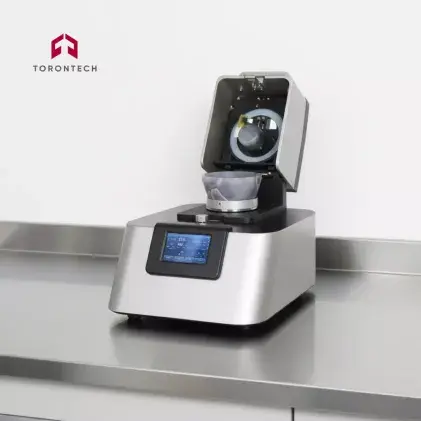
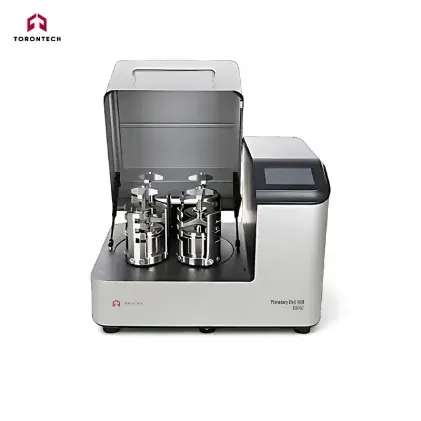
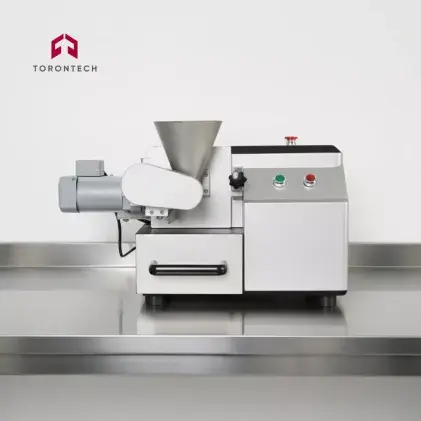
The Complete Guide to Planetary Ball Mills & Features
A high-quality planetary ball mill is the absolute bedrock for any serious lab. If you need to turn stubborn, rock-hard materials into cloud-fine dust, a high-energy planetary mill isn't just a luxury—it’s a non-negotiable asset.
In this guide, we break down the clever mechanics that make these machines tick, stack them up against old-school milling gear, and share why our planetary ball mills get the job done right every single time.
Key Takeaways
- Extreme Speed and Nano-Precision: By utilizing a unique dual-rotation setup, Torontech planetary ball mills generate massive friction and high-velocity impacts to crush materials down to the nanometer level in a fraction of the time required by standard rotary drums.
- Strict Contamination Control: Lab teams can swap between specialized grinding jars, like ultra-hard Tungsten Carbide or pure Zirconia, ensuring zero cross-contamination for highly sensitive pharmaceutical or advanced ceramic samples.
- Unmatched Operational Flexibility: We have engineered these systems to easily handle standard dry processing, liquid-assisted wet grinding, and even processing under an inert gas blanket to protect highly reactive materials.
- Predictable Production Scaling: Because these machines apply exact, repeatable physical forces to every sample, transitioning from a tiny benchtop experiment to a high-volume manufacturing run becomes a smooth, completely predictable process.
How Do Planetary Ball Mills Actually Operate? (The Basic Physics)
If you want to grasp why Torontech planetary ball mills are so incredibly effective at what they do, you've got to look at the way the internal components actually twirl. From where we’re sitting in the engineering office, that "planetary" swirl is what makes ou4 BM20 and its siblings a step above the rest.
The core mechanism is essentially a large spinning "sun wheel" with grinding jars mounted slightly off-center. The main wheel spins one way, while the jars themselves spin the opposite way on their own. Planetary ball mills operate by rotating jars on a sun wheel while the jars themselves rotate around their own axes, creating high-energy collisions between grinding balls and the material.
This complex motion results in intense mechanical forces that reduce particle size and enable mechanochemical synthesis, with energy transfer depending on parameters like ball size, filling ratio, rotation speed, and jar geometry. We’ve found that this wild back-and-forth action creates a chaotic mix of heavy-duty physics-based spinning forces that old-fashioned mills can't even dream of touching.
- Intense Friction: As the speed picks up, the heavy grinding balls inside start aggressively scraping against the inner walls. We think this deep friction is the secret sauce for getting softer materials perfectly smooth and even.
- The High-Velocity Impact: The balls constantly jump off the wall and zip across the jar, striking the sample with a massive amount of sheer physical force.
We’re convinced that it’s this double-whammy of heavy friction and high-velocity impact that lets a planetary ball mill break things down to microscopic sizes in a tiny fraction of the time it takes the old-school way.
Planetary Ball Mill vs. The Standard Rotary Mill
When folks are kitting out a new lab, they often ask us if a planetary model is actually worth the extra budget compared to a basic rotating drum. Compared to standard rotary mills, planetary ball mills achieve higher collision intensities due to their dual rotation system, allowing finer grinding and more efficient energy use at laboratory scale.
While the older drums or something like our heavy-duty Hammer Mill CB1000 are fine if you’re just churning out huge piles of simple aggregate, we’re certain that the pinpoint precision of a planetary setup is something you just can't do without if you're serious about your R&D.
| Feature | The High-Energy Planetary Mill | The Standard Drum Mill |
|---|---|---|
| Primary Action | Heavy impact + friction (Coriolis forces) | Simple tumbling and falling over |
| Smallest Particle Size | Ultra-fine nano-scale particles (< 0.1 µm) | Chunky micron-sized grains (10-50 µm) |
| Working Speed | Incredibly fast (minutes or hours) | Slow and steady (hours or even days) |
| Perfect For | High-level research and making new alloys | Churning out cement or mining rocks |
| G-Force Output | Up to a massive 100 times gravity | Just regular old gravity |
Need a comprehensive list of technical specifications for the folks in the purchasing office? Grab the Torontech Planetary Ball Mill Spec Sheet PDF Right Here!
Why Torontech Planetary Ball Mills Are Actually a Massive Advantage
In our professional view, putting your budget into a high-tier planetary ball mill is an absolute no-brainer that’s going to save your team a mountain of headaches and wasted capital later:
- Incredibly Tiny Particles & Perfect Accuracy: We’ve seen that the chance to hit that nano-scale mark is the #1 reason why people who know their stuff pick Torontech laboratory ball mills.
- Exceptionally Fast Processing: We’re big believers that time is the one thing you can’t get back in a lab. The high rotational speeds of a planetary ball mill mean you get way more work done in a single day.
- Unmatched Process Versatility: Advantages of planetary ball mills include incredible versatility for dry or wet milling, cleanability, moderate cost, and high suitability for process development in various industries such as pharmaceuticals and materials science.
- Keeping Your Samples Pure: We’re sticklers for purity. With all sorts of different jar materials, we can help you make sure your samples stay completely uncontaminated.
- Scaling Up Without the Stress: We’ve found that getting the exact same result every time without fail makes moving from a tiny lab test to a full-on production run way less painful.
- Handling a Bit of Everything: Whether you’re grinding things dry, wet, or freezing them out, we’ve put planetary ball mills together to tackle pretty much anything you throw at them.
Where Industry Pros Are Actually Using Planetary Ball Mills
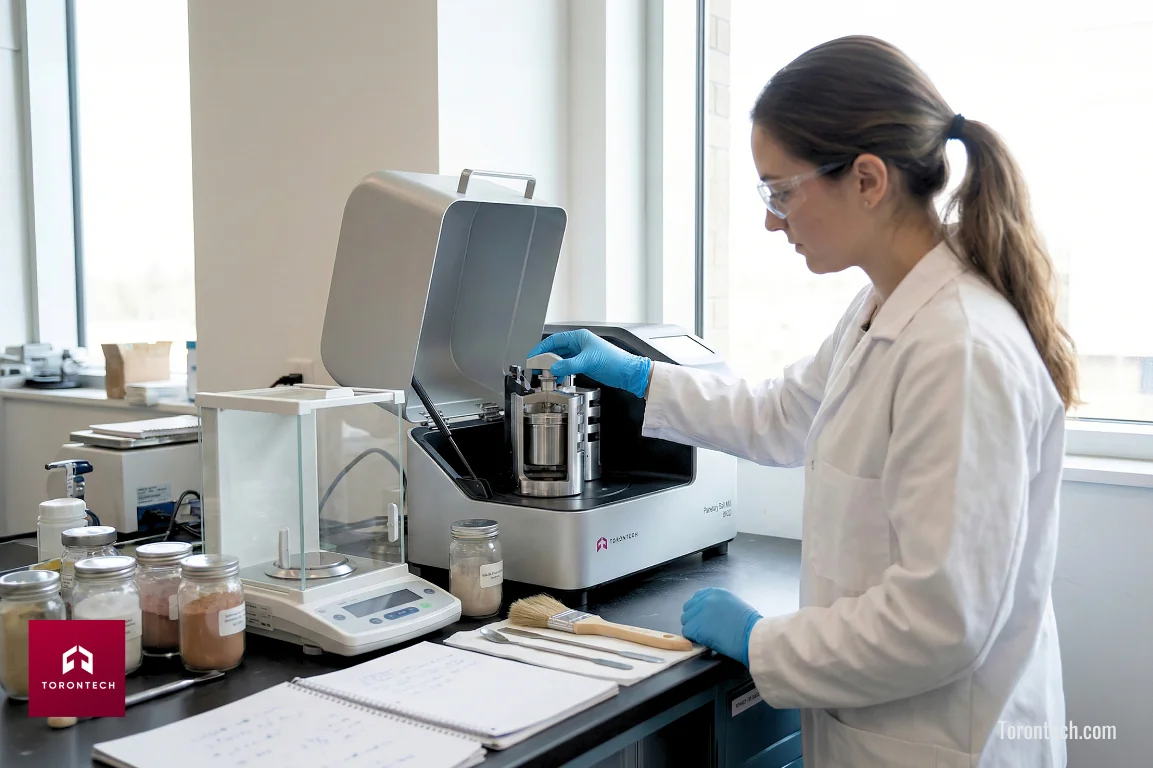
We’ve seen laboratory planetary ball mills become the absolute go-to tool for a huge variety of professional jobs. Here is how we see different teams making the most of Torontech milling equipment:
Developing New Metals & Materials
This is the big one, especially for cooking up new alloys. A standard use case involves a metallurgical team turning hard tungsten carbide into a fine powder in less than 45 minutes using the high-energy BM6Pro, a process that conventionally takes all day.
Pharmaceuticals & Medicine
We’re convinced that getting things perfectly blended is the key to making sure medicine actually works the way it’s supposed to. For instance, a typical facility might blend active ingredients with excipients to guarantee maximum absorption rates in new tablet formulas.
Geology and Mining
We usually point people this way if they need to turn ores or minerals into a fine dust for high-tech chemical checking. A common scenario is a mining outfit pulverizing rocky ores into uniform dust to get accurate chemical readings during quality checks.
Food and Beverage Testing
We’ve found these mills are a sheer perfection for getting food samples smooth without cooking them by accident. Think about a commercial lab mashing up complex grains into smooth pastes to test for nutritional density without generating accidental friction heat.
Agricultural Science
We see a ton of value here for prepping leaves, seeds, or dirt to figure out how to grow better crops. A standard setup might process dry soil and tough seed casings to figure out exact nitrogen levels for the next planting season.
Cosmetic & Personal Care
We think the real secret to great-looking makeup is getting the colors blended down to that microscopic level. Consider a skincare lab mashing raw mineral pigments down to a microscopic scale so a new foundation blends perfectly smooth on the skin.
Internal Electronics & Engineering
We’re really enthusiastic about how planetary ball mills are helping create the next generation of battery components and computer chips. A standard application involves grinding lithium compounds to exact specifications to test out new battery prototypes. We usually see teams grab the NM200 for this, since it’s specifically built to hit that ultra-fine 100 nm mark.
Environmental Testing
We think a heavy-duty planetary ball mill is essential for grinding up soil or old computer scrap to see what can be saved. A common test involves grinding up discarded circuit boards to figure out exactly how much copper and gold can be recovered.
Ceramics and Glass
We see laboratory ball mills as a total must-have for making the ultra-fine powders needed for high-end ceramics. For example, a production lab might prepare ultra-fine silica powders to bake high-end, shatter-resistant glass.
Advanced Operating Modes: Dry, Wet, and Inert Gas
Whether you’re looking to perform standard dry grinding or you need to process reactive samples under a blanket of argon, a Torontech planetary ball mill can be configured for almost any environment. We have plenty of different ways to run these cycles depending on your sample's chemistry.
Since there’s so much to cover regarding specialized setups, we’ve put together a comprehensive guide on dry vs. wet grinding modes that you should definitely check out if you’re planning a specific R&D workflow: Wet vs Dry Ball Milling: Which Method Do You Need?
Choosing Your Jars and Balls: A Professional's Teaser
Picking the right container is the make-or-break moment for your purity levels. From heavy-duty Stainless Steel for general work to Zirconia for metal-free dental ceramics, your choice of materials defines the success of your grind.
Recent innovations include modified jar designs to enhance milling efficiency by increasing high-energy impacts and multi-chamber vials for simultaneous synthesis of multiple samples, broadening their application scope significantly.
We’ve written a separate, detailed cheat sheet on selecting jar and ball materials that breaks down exactly which materials to pair with your samples to avoid wear and contamination. It’s a must-read before you finalize your order.
How to Pick the Right Ball Mill
Picking the perfect model can feel like a heavy task to take on, but we usually tell people to keep their eyes on four specific technical specs to make sure the planetary ball mill fits their daily workflow:
How Much Material Are You Processing?
We suggest figuring out how much you're going to grind in a day before you pull the trigger. Our models go from compact setups like the Micro Ball Mill GT300 all the way up to larger 4-station capacity monsters like the BM40. We’ve found that cramming too much into a jar is the fastest way to get a crummy result.
For instance, a boutique lab testing 10-milliliter batches of rare botanical extracts is going to need a much smaller benchtop setup than a pilot plant trying to churn through three liters of cement mix every morning.
What Are You Starting With, and What's the Goal?
We think it’s a total must to make sure the planetary ball mill can handle your starting material (usually under 10mm) and has enough grunt to reach that dust-like finish you’re after. As an example, feeding 15-millimeter chunks of raw granite into a laboratory mill built exclusively for 5-millimeter pebbles is a surefire way to break the internal components.
How Many Samples Can You Spin at Once?
In our experience, getting things done is all about doing more than one thing at a time.
If you have a pile of different samples to run, we’re big fans of the 4-station models (like the BM40 or the upgraded BM20Plus) because they literally double how much you get done compared to the 2-station ones. Consider a battery testing facility running 50 separate chemical variations a day; they usually grab a 4-station setup to slash their total processing time in half.
How Fast Can It Spin?
Rotational speed directly equals kinetic energy. Modeling and simulations using discrete element methods help us understand the energy transfer and optimize operating conditions like rotation-to-revolution speed ratios for maximum efficiency.
We’ve noted that those top-tier speeds (up to 800 RPM) are the difference between finishing in minutes or waiting around all day, especially with the tough stuff. A team trying to crush incredibly tough titanium alloys needs those top-tier speeds to finish the job before lunch, whereas a group grinding soft chalk can get away with a much slower, cheaper motor.
Securing Your Lab's Future With Torontech Ball Mills
At Torontech, we know our planetary ball mills (like the standard BM20 and the extreme fineness NM200) are the absolute best choice for processing your materials. With smart features like bi-directional spinning and heavy-duty cooling for 24/7 operation, our built-like-a-tank engineering will help you hit production goals you didn't think possible. Seriously, what dedicated researcher could resist a setup this spot on?
Ready to get your lab geared up with some serious processing capability?
References:
- Broseghini, M., D’incau, M., Gelisio, L., Pugno, N., & Scardi, P. (2020). Numerical and experimental investigations on new jar designs for high efficiency planetary ball milling. Advanced Powder Technology, 31, 2641-2649.
- Broseghini, M., Gelisio, L., D’incau, M., Ricardo, C., Pugno, N., & Scardi, P. (2016). Modeling of the planetary ball-milling process: The case study of ceramic powders. Journal of The European Ceramic Society, 36, 2205-2212.
- Burmeister, C., & Kwade, A. (2013). Process engineering with planetary ball mills. Chemical Society Reviews, 42(18), 7660-7.
- Fadonougbo, J., Szczepańska, K., Baran, A., Wyrębska, I., Płatek, P., Janiszewski, J., & Polański, M. (2025). Combinatorial synthesis of solid-state hydrogen storage materials using a modified planetary ball mill. International Journal of Hydrogen Energy.
- Kho, H., Bae, S., Bae, S., Kim, B., & Kim, J. (2014). Planetary Ball Mill Process in Aspect of Milling Energy. Journal of Korean Powder Metallurgy Institute, 21, 155-164.
- Kim, K., Kim, Y., & Choe, S. (2025). New Challenge on Determination of the Reasonable Rotation to Revolution Speed Ratio for the Mechanical Activation of Boron Concentrate in Planetary Ball Mill. World Journal of Applied Chemistry.
- Rodriguez, V., Ribas, L., Kwade, A., & Tavares, L. (2023). Mechanistic modeling and simulation of a wet planetary ball mill. Powder Technology.
- Rosenkranz, S., Breitung-Faes, S., & Kwade, A. (2011). Experimental investigations and modelling of the ball motion in planetary ball mills. Powder Technology, 212, 224-230.