Zirconia vs Tungsten Carbide vs Agate: Expert Guide
Your analytical success begins with precise sample preparation.
At Torontech, we advocate for a strategic approach: pairing high-performance machinery with the correct grinding media ensures you maximize your capital investment and achieve superior data.
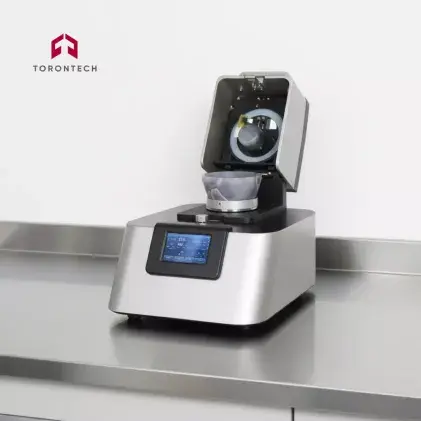
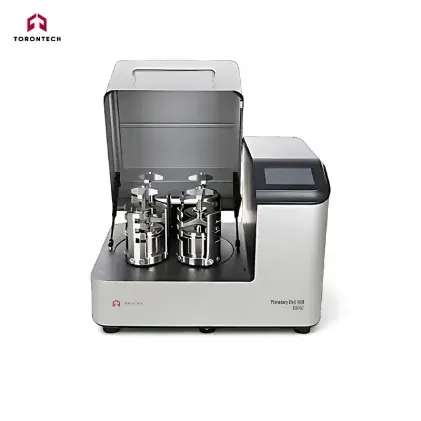
Today, we examine the three industry standards (Zirconia, Tungsten Carbide, and Agate) to help you select the ideal match for our cost-effective Planetary Ball Mills.
Key Takeaways
- The Golden Rule: Your grinding media must always be harder than the sample you are processing to prevent expensive equipment damage.
- Zirconia: The intelligent, versatile choice for 80% of general laboratory tasks due to its balance of high durability and moderate cost.
- Tungsten Carbide: A significant investment that delivers unmatched kinetic energy and speed, essential for mining and heavy industrial throughput.
- Agate: The mandatory selection for trace metal analysis (XRF) or pharmaceutical purity where chemical inertness is the priority.
- Strategic Value: Combining Torontech ball mills with the specific media for your application lowers your long-term operational costs.
The Unavoidable Physics: The Mohs Hardness Rule
Before discussing specific materials, here is the operational rule you cannot ignore: The grinding media must be harder than the sample being processed.
We observe laboratories neglecting this fundamental principle far too often. If your sample is harder than the grinding ball, the ball will degrade, introducing abrasive grit into your sample and damaging your equipment.
Hypothetical Failure: Consider the logistical error of attempting to grind Silicon Carbide (Mohs 9) using Agate balls (Mohs 7). The Agate would inevitably fail, abrading into the mix and contaminating the expensive sample with silica dust instead of pulverizing it.
We strongly urge you to verify your sample against these benchmarks before finalizing any purchase:
- Tungsten Carbide: ~9.0 Mohs (Hard enough to pulverize nearly any substance)
- Zirconia: ~8.5 Mohs (Sufficiently tough for most ceramics and minerals)
- Agate: ~6.5–7.0 Mohs (Appropriate for softer materials, soils, and biological samples)
1. Zirconia (Yttria-Stabilized): The Versatile Performer
Zirconia (ZrO2) is the primary choice for laboratories requiring equipment that resists wear while maintaining sample integrity. Unlike standard ceramics, Yttria-Stabilized Zirconia (YSZ) is remarkably tough and resists fracturing under stress.
Why choose it? It eliminates metallic contamination. If you are processing white ceramics or sensitive biological materials where grey metallic residue from steel balls would be a failure, Zirconia is the correct solution.
How does it perform? It is dense (~6.0 g/cm3), meaning it impacts with significantly more force than porcelain or agate ever could.
Our Perspective: We consider Zirconia the intelligent choice for 80% of general laboratory applications. It may not possess the extreme hardness of Tungsten, but the balance between durability and price makes it the clear winner for versatile workloads. It is the "daily workhorse" media, making it the natural partner for our BM6Pro or BM20, a setup we see in countless labs handling everything from basic ceramics to complex pigments.
Practical Application: For instance, when manufacturing high-purity cathode powders for lithium-ion batteries, introducing even microscopic iron contaminants from steel balls creates a risk of electrical shorts. Zirconia neutralizes this threat completely.
Ideal For: Electronic pastes, ceramics, biological tissues, and battery materials.
2. Tungsten Carbide: The Heavyweight Contender
When you are contending with the hardest materials on earth, you require media that delivers superior impact. Tungsten Carbide (WC) is dense, heavy, and unrelenting.
Why choose it? Pure kinetic energy. It possesses a density of approx. 14.9 g/cm3 (nearly double the weight of steel), meaning these balls strike with immense force. We are talking about reducing hard substances to fine powder in record time.
How does it perform? It drastically reduces the duration required to grind abrasive materials. However, that extreme weight demands a machine with a high-torque drive. Running massive WC jars on underpowered units is a recipe for motor burnout, which is why we engineered robust models like the BM40 and BM20Plus to handle this specific load without hesitation.
Our Perspective: We will be transparent: Tungsten Carbide represents a significant investment. However, if your facility prioritizes throughput, the ability to process hard samples in minutes rather than hours justifies the expenditure. For mining applications, operating without it places you at a disadvantage.
Practical Application: Take a high-volume mining laboratory processing rigid granite samples as a case study. While standard media might require hours to pulverize a batch, Tungsten Carbide achieves the necessary fineness in minutes, effectively multiplying daily throughput.
Ideal For: Mining ores, metallurgy, glass, and heavy industrial applications demanding speed.
3. Agate: The Purity Specialist
Agate (99.9% SiO2) is a naturally occurring form of quartz, renowned for its chemical inertness. It is the selection you make when sample purity is the single most critical variable.
Why choose it? It remains chemically neutral. Agate ensures your samples do not acquire unwanted contaminants, particularly metallic ones that would distort spectrometric analysis.
How does it perform? It is lighter (~2.6 g/cm3) and requires more time to grind hard materials, but that gentle action is exactly what is required for soft materials sensitive to thermal degradation.
Our Perspective: Agate is a specialized tool, yet essential for specific protocols. We advise every client performing trace metal analysis (such as XRF) to utilize Agate exclusively. In our experience, the extended grinding time is a minor trade-off for the certainty that your sample remains uncontaminated by the jar itself.
Practical Application: In X-Ray Fluorescence (XRF) analysis, where the objective is isolating trace elements, utilizing a steel jar would introduce metallic background noise. Agate remains spectrally invisible, guaranteeing the data reflects the sample composition alone.
Ideal For: Pharmaceuticals, cosmetics, food testing, and XRF preparation.
The Comparison: Zirconia vs. Tungsten Carbide vs. Agate
| Feature | Zirconia (YSZ) | Tungsten Carbide (WC) | Agate (SiO2) |
|---|---|---|---|
| Density | High (~6.0 g/cm3) | Extremely High (~14.9 g/cm3) | Low (~2.6 g/cm3) |
| Hardness | Very Hard | Ultra Hard | Moderate |
| Durability | Excellent | Exceptional | Good |
| Primary Advantage | No metal residue; durable | Speed & Impact; crushes rocks | Pure & Clean; inert |
| Target Sector | Bio-tech, Ceramics, Electronics | Mining, Metallurgy, Construction | Pharma, Food, Environmental |
Operational Advice
1. Optimizing Efficiency: The Rule of Thirds
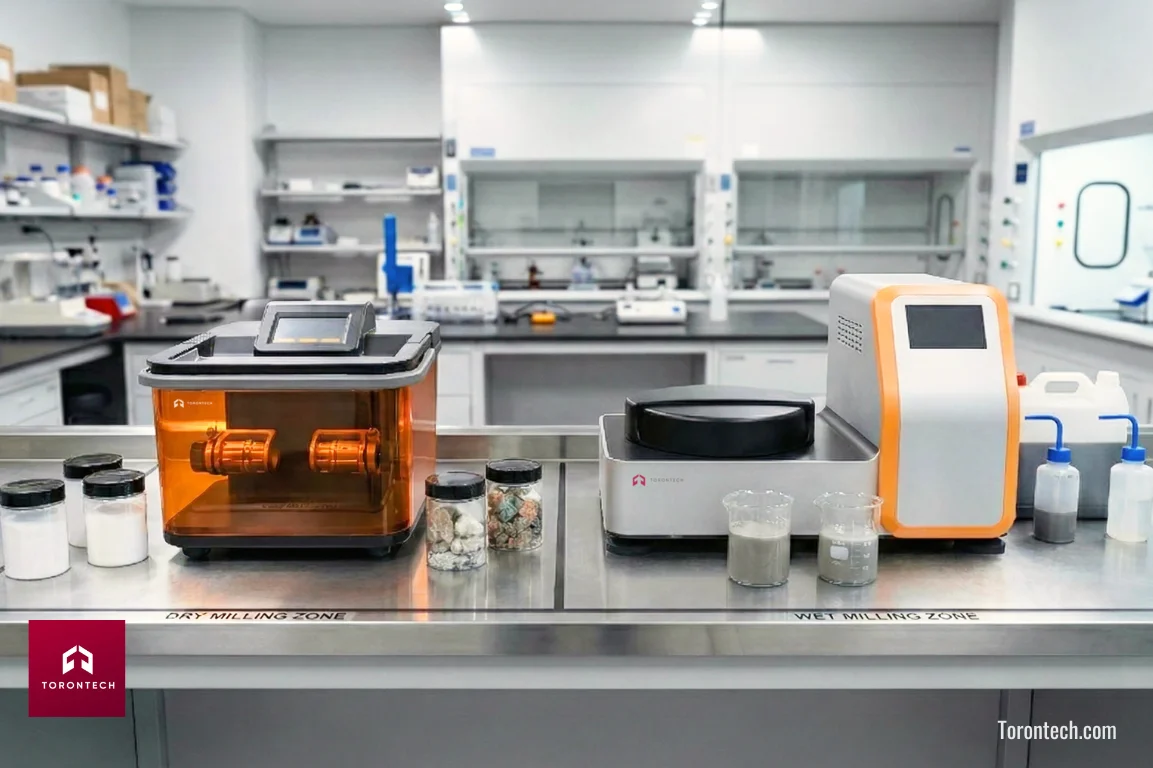
To achieve a grind that maximizes efficiency and value, filling the jar correctly is mandatory. We have observed countless times that overfilling the jar is the primary cause of poor results and operator frustration.
- 1/3 Sample Material
- 1/3 Grinding Media (Balls)
- 1/3 Empty Space (This volume is required for the balls to move and generate impact energy)
Pro Tip: utilizing a mixture of ball sizes (such as 10mm and 20mm together) yields superior results. We find that large balls fracture coarse chunks while small balls refine the powder—a highly effective combination.
2. Extending Equipment Lifespan
Proper maintenance protects your capital investment.
- Agate: Avoid thermal shock. Do not heat these jars rapidly or place them in an oven immediately following a cold grind. They will fracture.
- Tungsten Carbide: Despite its extreme hardness, the binder can oxidize. Dry them thoroughly after wet grinding to prevent surface degradation.
- Zirconia: Extremely durable but susceptible to damage when impacting empty walls. Our critical advice: Never operate a Zirconia jar without sample material inside to cushion the impact.
Torontech: Strategic Choices for Superior Results
The choice between Zirconia vs. Tungsten Carbide vs. Agate is not about which is "best," but rather which is correct for your application.
At Torontech, our Planetary Ball Mills (including the BM Series and NM200) are engineered to extract maximum performance from these materials. By pairing our intelligent, safety-focused mills with the right media, you secure premium North American quality that extends equipment life and lowers your cost-per-sample.
Related article: The Complete Guide to Planetary Ball Mills & Features
- Select Tungsten Carbide if you require speed and are processing hard ores.
- Select Agate if you require absolute purity for food or pharmaceuticals.
- Select Zirconia if you require a durable, contamination-free all-rounder.
Ready to improve your efficiency? Review our range of cost-effective Planetary Ball Mills and identify the optimal solution for your laboratory.
References:
- Marques, F., Fontaine, M., Gilbin, A., Escolle, B., & Picart, P. (2024). Experimental investigation of coatings efficiency in micro-ball-end milling of pre-sintered 5Y-TZP ceramic. The International Journal of Advanced Manufacturing Technology, 131, 935 - 953.
- Wang, Y., Lam, W., Luk, H., Øilo, M., Shih, K., & Botelho, M. (2020). The adverse effects of tungsten carbide grinding on the strength of dental zirconia.. Dental materials : official publication of the Academy of Dental Materials.
- Di Nardo, T., & Moores, A. (2019). Mechanochemical amorphization of chitin: impact of apparatus material on performance and contamination. Beilstein Journal of Organic Chemistry, 15, 1217 - 1225.
- Pei, L., Zhao, C., Zhao, R., Li, G., Yu, M., & Zhang, S. (2020). The kinetics and efficiency of batch ball grinding with cemented tungsten carbide balls. Advanced Powder Technology, 31, 2412-2420.