Wet vs Dry Ball Milling: Which Method Do You Need?
Is the choice between wet ball milling vs. dry ball milling stalling your lab's progress? It is a critical decision. While the machines often look identical, the physical interactions inside the jar are completely distinct.
As North American experts, Torontech is here to analyze the essential difference between dry and wet grinding so you can determine exactly which configuration aligns with your goals.
Key Takeaways
- Dry Ball Milling is the faster, more efficient choice for general size reduction and materials that react with moisture.
- Wet Ball Milling is essential when you need ultra fine nanometer particles or must prevent clumps from forming.
- Media Wear increases significantly in wet environments, requiring durable materials like Zirconia instead of stainless steel.
- Torontech Planetary Ball Mills offer the versatility to switch between both wet and dry modes in a single high energy machine.
The Basic Idea: How This Process Functions
Before we compare the two, let’s look at the shared mechanism.
Essentially, you have a jar, you load in dense grinding balls (manufactured from Zirconia, steel, Agate, or whichever material suits your protocol), you add your sample, and you rotate the container with significant force. All that tumbling and impact energy fractures your material into smaller fragments.
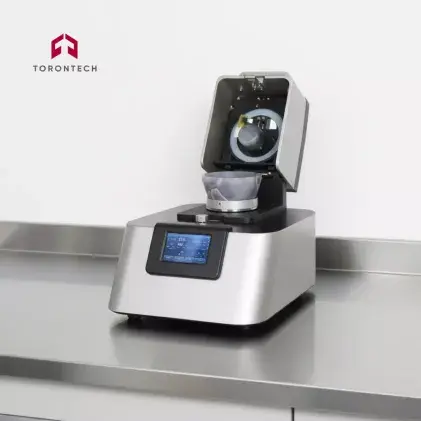
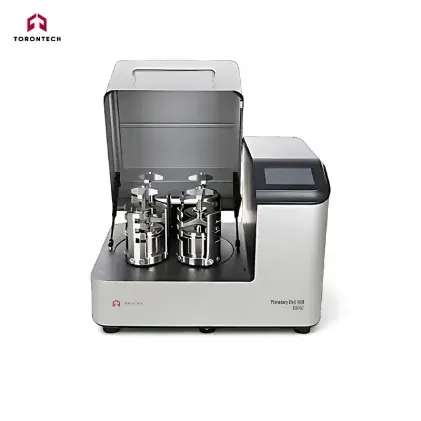
Both wet and dry ball mills, like Torontech’s versatile Planetary Ball Mill BM Series (BM6Pro, BM20, BM40), utilize this high-intensity planetary motion to deliver the impact needed for efficient size reduction.
However, the critical variable is the environment. Performing this in ambient air (dry) versus a liquid suspension (wet) alters the results dramatically.
Read more: The Complete Guide to Planetary Ball Mills & Features
What is Dry Ball Milling?
Consider this the standard, direct approach. You are grinding powders with absolutely no liquid involved. The particles are reduced strictly through mechanical impact and friction.
Because there is no viscous fluid to cushion the blow, the kinetic energy transfer from the grinding media to the sample is immediate and intense. The balls cascade and cataract inside the jar, delivering high-velocity strikes that shatter brittle structures almost instantly.
Why You Might Prefer It:
- Materials That React with Moisture: Some chemical compounds are unstable and hydrolyze instantly if they contact water or solvents. If your material behaves this way, dry milling is your primary option.
- Operational Efficiency: It is a more streamlined workflow. Since there is no liquid medium involved, you eliminate the requirement for a subsequent drying phase (like spray drying or filtration) after the cycle is complete.
- Sufficient for General Applications: If you aren't attempting to achieve sub-micron particle sizes that require electron microscopy to verify, dry milling performs the task exceptionally well.
Common Candidates for this Method:
You will typically see this method applied to cement clinker, solid fuels like coal or coke, pharmaceutical tablets, and hard mineral ores where the goal is simply size reduction rather than dispersion.
For rapid, small-scale dry grinding of these samples, compact units like the Micro Ball Mill GT300 are often the go-to choice for quick lab prep.
What is Wet Ball Milling?
This is where the process becomes more specialized. You utilize the same jar but introduce a liquid (perhaps water, ethanol, or isopropanol) to transform your powder into a fluid suspension.
The liquid functions as more than just a bath; it acts as a vehicle, carrying the particles into the direct path of the grinding media. This ensures that every fraction of the sample is subjected to the grinding action, preventing "dead zones" where powder might otherwise sit untouched in a dry jar.
The Advantages of Wet Grinding Over Dry Grinding
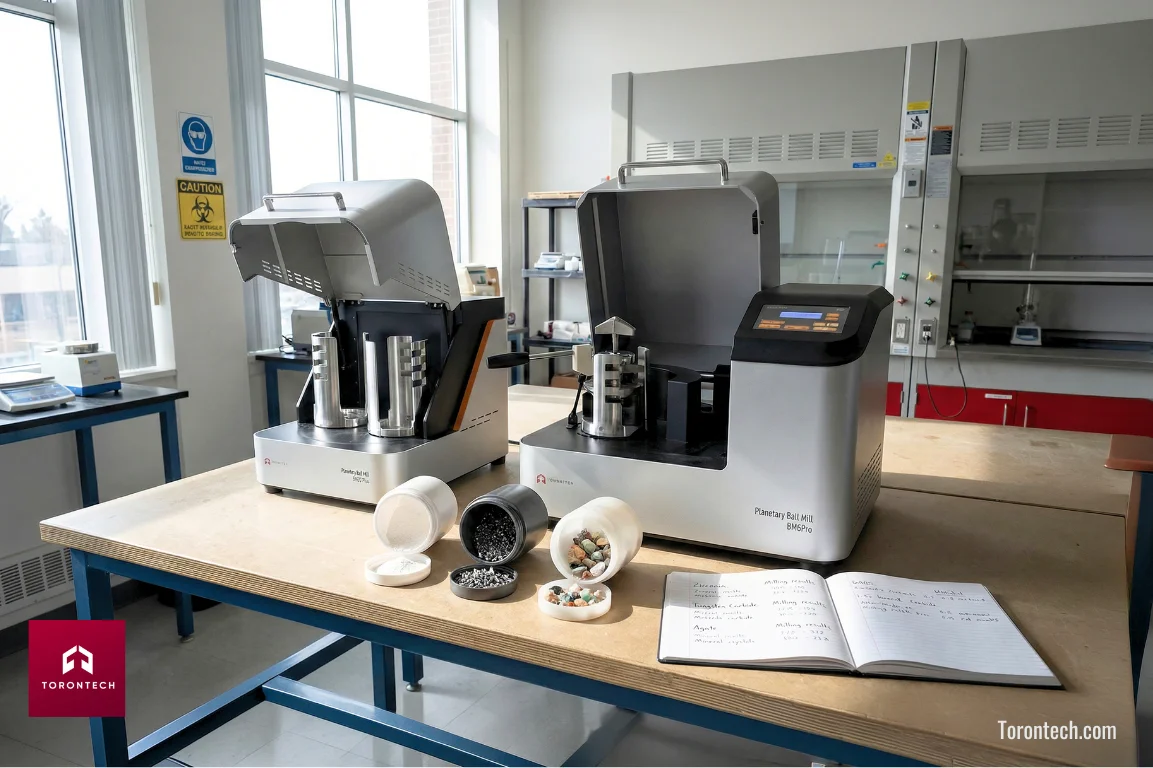
If you are targeting those extremely minute particle sizes (in the nanometer range), wet milling is objectively the superior method. Here is why it stands out:
- Prevents Re-Agglomeration: When you pulverize powder into microscopic dust, the particles generate static charges and attempt to bond back together. The liquid in wet milling neutralizes that interaction, keeping particles suspended and separate.
- Significantly Finer Results: Because the particles remain dispersed, high-precision units like our High-Performance Mini Planetary Ball Mill NM200 can impact individual fragments much more effectively. You achieve a far more consistent and finer powder than dry milling could typically produce.
- Maintains Thermal Stability: The friction from grinding generates heat. The liquid functions as a coolant, dissipating that energy. This is vital for heat-sensitive materials that might degrade or char under high temperatures.
- Cleaner Laboratory Environment: The liquid dampens the noise of the colliding media and prevents hazardous particulate dust from becoming airborne.
Common Candidates for this Method:
This approach is standard for metal oxides, battery electrode slurries, catalysts, ceramic precursors, and pigments where homogeneity is just as important as particle size.
Critical Formulation Factors: Solvents and Additives
Optimizing wet milling requires attention to chemistry. You must select the appropriate components:
- The Liquid Medium: You need a solvent that will not corrode your jar lining or degrade your sample.
- The Dispersant (Surfactants): Frequently, you will add a surfactant to ensure the slurry remains homogenous and does not separate during the process.
Difference Between Wet and Dry Ball Mill Efficiency vs. Wear
When we evaluate the difference between wet and dry ball mill performance, wet milling is generally more energy-efficient for achieving fine sizes. For the most challenging slurries where standard tumbling isn't enough, advanced Omni-Directional Planetary Ball Mills can solve sedimentation issues by adding multi-dimensional movement to the mix.
However, there is a distinct cost: it accelerates the wear rate of your consumables. The fluid dynamics in wet milling create a highly abrasive environment. The slurry acts almost like liquid sandpaper, constantly eroding the surface of your grinding balls and jar walls far faster than dry powder ever would.
This means you aren't just battling friction; you are often fighting chemical corrosion too, which can weaken the media surface and make it prone to cracking over time.
Monitoring Your Grinding Media
Since wet environments can be corrosive and highly abrasive, standard stainless steel balls often cannot withstand the conditions long-term. They may rust or contaminate the batch.
- For Dry Milling: Standard stainless steel is typically durable enough and cost-effective.
- For Wet Milling: You typically need to invest in higher-grade materials. We recommend Zirconia, Agate, or Tungsten Carbide. These materials are extremely dense and chemically inert, preventing rust or sample contamination.
Comparison Summary: Wet Ball Milling vs Dry Ball Milling
| Feature | Dry Ball Milling | Wet Ball Milling |
|---|---|---|
| Target Particle Size | Microns (µm) | Nanometers (nm) to Sub-micron |
| Agglomeration | High probability | Minimal probability |
| Processing Time | Faster (direct process) | Longer (requires drying phase) |
| Heat Generation | High friction heat | Temperature controlled |
| Media Wear | Minimal impact | Higher (requires Zirconia/Agate) |
| Best For | Hydrophobic materials | Heat-sensitive & nano-scale tasks |
Who Uses What? (Industry Reference)
Different sectors have distinct requirements. Here is a breakdown of common applications:
- Pharmaceuticals: Predominantly Dry Milling. Manufacturers often must keep moisture away from active ingredients to maintain stability, particularly when processing crystalline drugs or blending dry excipients.
- Ceramics & Glass: Exclusively Wet Milling. They require that ultra-smooth, homogenous dispersion to produce defect-free materials, such as sintered zirconia or optical glass.
- Battery Technology: Wet Milling is standard here. You need a perfect slurry to manufacture electrodes—specifically for materials like Lithium Iron Phosphate (LFP) or graphite composites—that offer high performance and safety.
- Paints & Pigments: Wet Milling is essential. The goal is smooth color consistency without any coarse textures, which is critical when dispersing Titanium Dioxide (TiO2) or organic dyes.
- Nanotechnology: Wet Milling is the primary method for synthesizing nanoparticles, as it effectively prevents re-agglomeration at the molecular level.
- Food & Agriculture: Dry Milling is the standard for pulverizing grains, seeds, and dried plant tissue for nutritional analysis.
- Mining & Geology: Dry Milling is typically utilized for initial assay preparation and bulk sample reduction of quartz, limestone, or gold ores where ultra-fine sizes are less critical.
Making the Strategic Choice with Torontech
You understand your material properties better than anyone, and you shouldn't have to compromise between performance and budget.
At Torontech, our portfolio of Ball Mills (from the compact BM6Pro to the heavy-duty BM40) is engineered to handle both wet and dry grinding with precision. Our programmable, high-energy mills allow you to switch protocols seamlessly, giving you total versatility in a single instrument.
Need a cost-effective solution? Explore our innovative ball milling technology today, and let us help you configure the perfect setup for your workflow.
References:
- Wang, K., Zhang, C., Zhao, W., Zhang, A., Sheng, Q., & Liu, J. (2025). Effects of dry and wet ball milling on physicochemical properties of foxtail millet.. Food chemistry, 483, 143916.
- Školáková, T., Kutějová, A., Školáková, A., & Zámostný, P. (2025). The hidden impact of wet and dry milling processes on pharmaceutical surfaces.. International journal of pharmaceutics, 125870.
- Sun, Y., Sun, P., Niu, S., Shen, B., & Lyu, H. (2024). Atmosphere matters: The protection of wet ball milling instead of dry ball milling accelerates the electron transfer effect of sulfurized micron iron/biochar to Cr (VI). Chemical Engineering Journal.
- Jung, H., Sohn, Y., Sung, H., Hyun, H., & Shin, W. (2015). Physicochemical properties of ball milled boron particles: Dry vs. wet ball milling process. Powder Technology, 269, 548-553.
- Yuan, Y., Zhang, N., & Hu, X. (2020). Effects of wet and dry ball milling on the physicochemical properties of sawdust derived-biochar. Instrumentation Science & Technology, 48, 287 - 300.
- Huang, F., Wang, H., Chen, J., & Yang, B. (2018). Dry ball milling and wet ball milling for fabricating copper–yttria composites. Rare Metals, 37, 859-867.
- Leewatchararongjaroen, J., & Anuntagool, J. (2016). Effects of Dry-Milling and Wet-Milling on Chemical, Physical and Gelatinization Properties of Rice Flour. Rice Science, 23, 274-281.