Spin Coating vs Sputtering: Picking the Best Method
At Torontech, we know that nailing a perfectly smooth and uniform film layer gives your high-tech hardware a massive leg up. Choosing between spin coating vs sputter coating is simply about finding the right piece of gear that fits your materials like a glove without draining your bank account.
If you’re weighing a spin coater vs sputter coater, here is our straight-shooting take on why both are total winners in the right setup.
Key Takeaways
- Material Match: Spin coaters are your go-to machines for liquid polymers and resins, while sputter coaters take the crown for solid metals, alloys, and hard ceramics.
- Precision and Shape: If you have a perfectly flat surface, spin coating works beautifully. For complex, bumpy, or three-dimensional parts that need atomic-level accuracy, sputtering is the clear winner.
- Cost Breakdown: Spin coaters save you money upfront but require expensive specialized liquids. Sputter coaters ask for a larger initial investment but offer highly predictable, manageable long-term operating costs.
Technical Overview: Spin Coating
Think of spin coating like the most high-speed, technically advanced pottery wheel you’ve ever seen.
You start by depositing a small puddle of liquid material, usually a polymer or some kind of resin, right in the middle of a flat base. Then, you spin that base at speeds that would make your head swirl (we’re talking thousands of rotations every single minute).
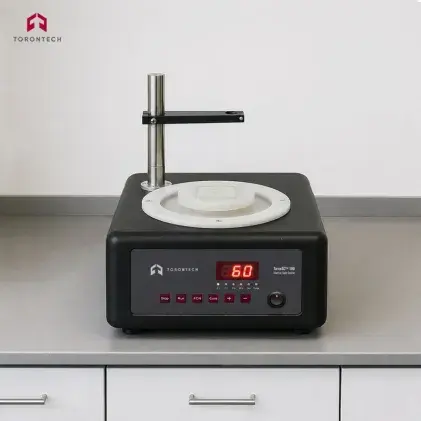
That spinning force flings the liquid outward until it leaves behind a highly uniform, defect-free layer from edge to edge. When operating equipment like our Spin Coater - ToronSC™ Series, we’ve found that getting that thickness exactly where you want it depends almost entirely on how thick the liquid feels and how fast you let it rip.
Research confirms that final film thickness is a direct result of spin speed, time, viscosity, and solution concentration.
Core Applications for Spin Coating:
- Putting down light-sensitive liquids to trace out those incredibly tiny circuits on computer chips.
- Layering on bendable plastics to build the next generation of screens that fold right up.
- Making protective, glare-busting finishes for the camera lenses inside your phone.
Technical Overview: Sputter Coating
Sputtering is a whole different beast. Instead of sloshing liquids around, this happens inside a massive, sealed metal vacuum box. It’s a "dry" process where you don't have to worry about even a hint of soggy residue anywhere.
You take a solid chunk of high-grade metal, like gold or platinum, and blast it with high-speed gas bits. This knocks atoms off that chunk so they fly through the air and stick to your part like they were always meant to be there.
We’re going to call it: this is the top-tier way to get a layer that’s insanely thin and tough enough to stay put through the harshest testing. This physical vapor deposition method generally produces metallic or inorganic films with highly controlled thickness and superior uniformity.
Related article: Sputter Coater for SEM: Important Insights You Must Know
Core Applications for Sputter Coating:
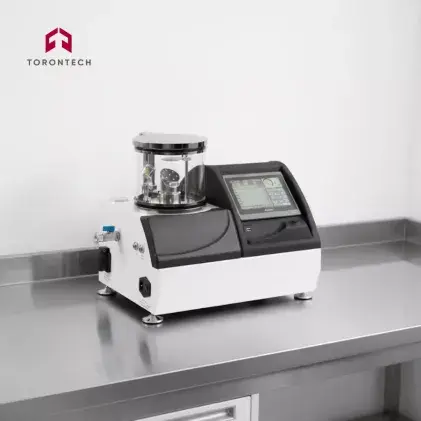
- Prepping a piece of raw biological tissue so an electron microscope can grab a crystal-clear picture of it (a task perfectly suited for a compact unit like our Desk Sputter Coater - DSR1).
- Depositing precisely controlled, nanometer-scale gold layers to connect the microscopic wiring inside a processor.
- Applying that incredibly hard, scratch-rejecting layer you find on luxury watch faces.
Comparative Summary: Spin Coating vs Sputtering
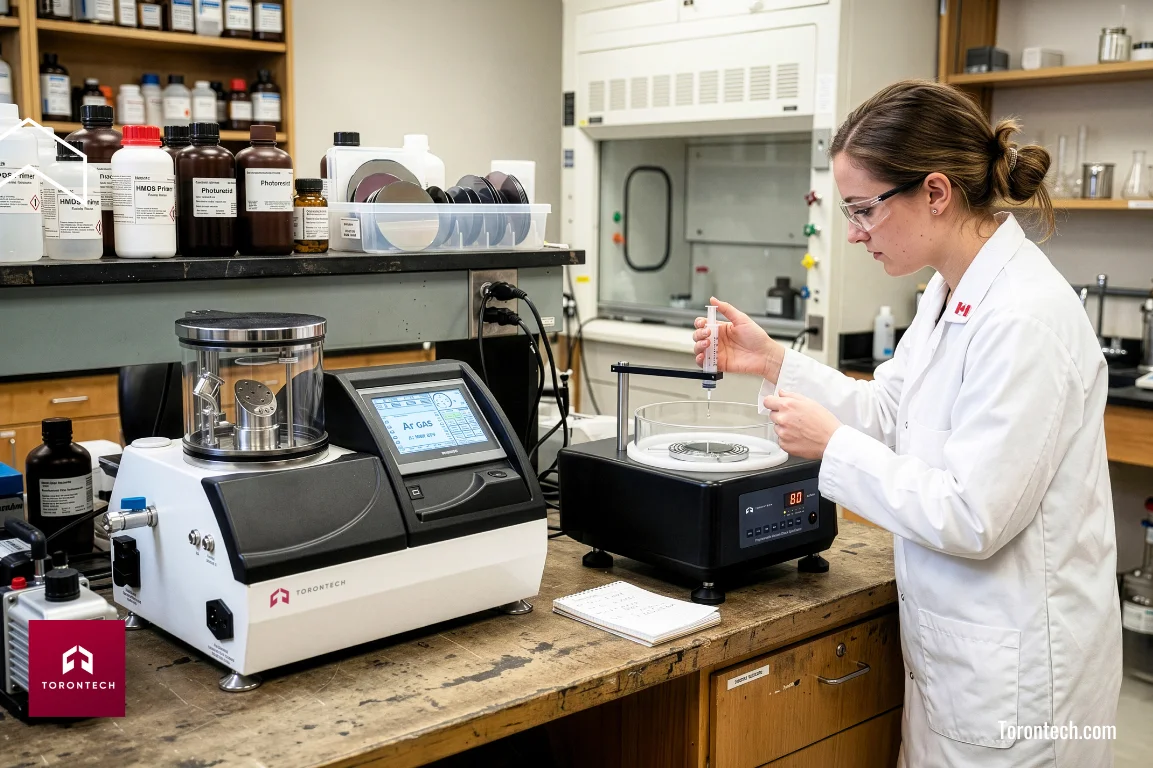
If you’re in a rush, here is how we see these two stacking up:
| Feature | Spin Coating | Sputter Coating |
|---|---|---|
| Materials Used | Liquids, resins, and gooey polymers | Solid metals, alloys, and hard crystals |
| Part Shape | Best for things that are flat as a pancake | Great for bumpy, 3D, or weirdly shaped bits |
| Layer Thickness | Thicker layers (like a coat of paint) | Ultra-thin (down to the sub-nanometer level) |
| Adhesion Quality | Decent; depends on the drying process | Exceptional; uses kinetic energy bonding |
| Environment | Atmospheric pressure (requires fume extraction) | High-pressure vacuum chamber |
Key Performance Differences
To get a handle on why the spin coating vs sputtering debate matters, you have to look at how they handle the actual work day-to-day. Here is our breakdown of the key factors:
1. Material Compatibility
Spin Coating: This path is built for anything that can be melted or dissolved into a liquid formulation. We find it’s the go-to for plastics and organic polymers, like when a team needs to lay down a liquid polymer for a bendable heart-rate sensor.
Sputter Coating: We see this as the true "do-it-all" machine. It handles the hard stuff, like metals, alloys, and ceramics, that you just can’t readily dissolve into a solvent. It’s the obvious pick if a lab needs to deposit a pure sheet of titanium for a medical joint replacement.
2. Substrate Geometry and Topography
Spin Coating: If your base is flat as a pancake, like a silicon disc, this works like a charm. However, we’ve seen that if there are any valleys or holes, the liquid tends to pool in the low spots and go thin on the peaks.
Sputter Coating: This tech wraps around every edge like a second skin. Sputtered films often result in smoother surfaces with lower roughness compared to spin-coated ones. Think of a lab coating a micro-gear with dozens of sharp teeth; sputtering covers every nook and cranny where spin coating would just fill in the gaps and ruin the shape.
3. Precision and Thickness Control
Spin Coating: This is great for thicker, protective layers, but it’s a bit more "ballpark" when it comes to being super exact.
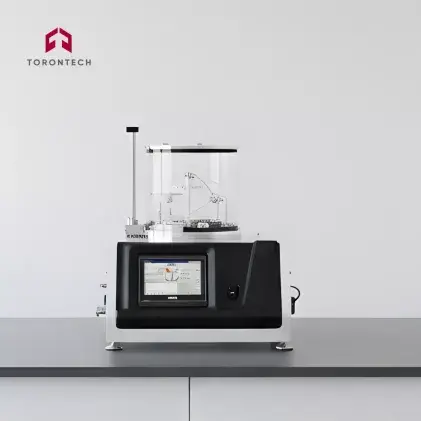
Sputter Coating: In our opinion, this is the winner for precision by a long shot. If a research group needs a highly precise, five-nanometer platinum layer for a chemical reaction, a sophisticated unit like our High-Vacuum, Double-Magnetron Target Sputter Coater/ Thermal Evaporator-DST2-TG hits that mark dead-center. In fact, sputtered platinum films have shown much lower sheet resistance than those made by spin coating.
4. Adhesion and Mechanical Durability
Spin Coating: The bond here is decent, but it relies on how the material dries and sticks to the surface.
Sputter Coating: Because this method literally slams atoms onto the surface with a ton of kinetic energy, the layer stays stuck. Comparative studies show that sputtered films, like zinc sulfide, exhibit higher carrier concentration and lower resistivity compared to spin-coated alternatives.
5. Production Scalability
Spin Coating: This is a fantastic pick for quick, one-off tests in the lab. Spin coaters are simpler devices and often more accessible for solution-processed materials.
Sputter Coating: While the vacuum equipment is more complex, utilizing something like our Load-Lock Equipped Coating System ToronTS-450 makes it the smarter long-term bet for high-quality inorganic films.
Practical Implementation: Case Studies
To make this super concrete, let’s look at how typical labs actually use these machines on a daily basis.
Scenario A: Curved Display Development
A team is putting together a brand-new kind of television screen that curves. They are working with liquid organic materials. Spin coating is their absolute best friend here because it smoothly spreads that liquid goo across the flat glass base before they bake it solid.
Scenario B: Aerospace Material Shielding
A research crew is building a heat-rejecting shield for satellite parts. They need a layer of ceramic that can survive the absolute worst conditions space has to offer. Sputtering is the only realistic option because they have to use solid chunks of incredibly tough material and blast them onto a surface that isn't perfectly flat.
Economic Analysis: Investment and TCO
We think the choice between a spin coater vs sputter coater usually comes down to what it costs to keep your lab running.
- Spin Coaters: These don't cost a fortune to buy at first. But we always tell our partners to watch out for the price of the specialized liquids and the headache of managing chemical waste.
- Sputter Coaters: You’ll pay more to get one in the door because of all that vacuum tech. But we’ve found they are surprisingly easy on the wallet over time. Your main costs are just electricity and the metal targets, which makes your long-term planning much easier.
Torontech: Optimized Solutions for Your Laboratory
At the end of the day, the best tech is simply the one that fits your daily workflow like a glove. At Torontech, we’ve spent twenty years providing smart, fresh tech that’s actually cost-effective to labs across North America.
Whether you need the dead-on accuracy of our Sputter Coaters and Vacuum Coating Systems like the DSR1 or high-end DST2-TG, or the quick flow of our ToronSC™ Series Spin Coaters, we’ve got you covered.
Why settle for "good enough" when you can have a setup that’s spot on? Check out our full line of Sputter Coaters and Vacuum Coating Systems today, or reach out to our team to find the Torontech solution that fits your budget perfectly.
References:
- Birnie, D. (2004). Spin Coating Technique.
- Butt, M. (2022). Thin-Film Coating Methods: A Successful Marriage of High-Quality and Cost-Effectiveness—A Brief Exploration. Coatings.
- Chang, H., & Lai, Y. (2016). Morphology, structure and properties of diamond-like carbon films prepared by spin coating and RF magnetron sputtering. Materials Technology, 31, 10 - 16.
- Kalafatis, A., Theofylaktos, L., & Stergiopoulos, T. (2024). Spin coating on a budget: A 3D-Printed all-mechanical alternative for cost-effective thin-film deposition. HardwareX, 19.
- Moraes, R., Gonçalves, R., Stegemann, C., Sobrinho, A., D., A., , D., Massi, M., Leite, D., & Saito, E. (2014). COMPARISON BETWEEN SPIN COATING AND MAGNETRON SPUTTERING Pt THIN FILMS AIMING SOLAR CELLS.
- Mustafa, H., & Jameel, D. (2021). Modeling and the main stages of spin coating process: A review. Journal of Applied Science and Technology Trends.
- Shah, S., Ali, N., Habib, Z., Taimoor, S., Mehboob, N., & Rehman, F. (2024). Comparative Study of Zinc Sulfide Thin Films Fabricated by Spin Coating and Rf Magnetron Sputtering as a Buffer Layer for 2nd Generation Photovoltaics. Key Engineering Materials, 992, 41 - 50.
- Tyona, M. (2013). A theoritical study on spin coating technique. Advances in materials research, 2, 195-208.