Guide to Fiber Optic Tensile Strength & Testing
Fiber optics are the high-speed engines of global connection. We believe that with the right approach to structural integrity, these incredible tools can provide decades of flawless service.
This guide walks through the technical essentials of tensile strength and testing to help you build a network that truly lasts.
Key Takeaways
- Physical stress is the enemy: Glass fibers transmit data brilliantly but snap easily under pressure. Structural components like aramid yarns do the heavy lifting to keep your network alive.
- Conduits multiply the danger: Dragging cables through winding underground pipes creates massive friction spikes. Running serious physical tests beforehand is a total necessity to prevent ruining the internal glass.
- The math is mandatory: Field teams must calculate pulling tension using cable weight, total length, and friction limits to keep the installation safe and successful.
- Standardized testing is non-negotiable: If your testing gear does not strictly follow global rules like IEC 60794-1-2 Method E1, your data is essentially useless for international projects.
Defining Tensile Strength in Fiber Optic Infrastructure
What we call the tensile strength of fiber optic cable is essentially the absolute limit of how much force you can apply before those small glass fibers inside begin stretching, bending poorly, or simply failing altogether. Since glass doesn't stretch like a piece of copper wire, the heavy lifting has to be managed by the structural elements of the cable, such as aramid yarns or incredibly stiff central strength members.
Let's throw some actual numbers at this to show the difference. A 5.6 mm tight-buffer cable with dielectric strength elements has a maximum tensile strength of 1.85 kN, while a 6.5 mm Kevlar-reinforced cable can reach 3 kN with a 2% maximum strain.
Many outside plant (OSP) cables are specifically built for around 600 lbf, or approximately 2.7 kN, of maximum pull. Specialized deep-submarine cables even use proof-test strains around 2.2% to guarantee fiber strength under intense deep-water loads.
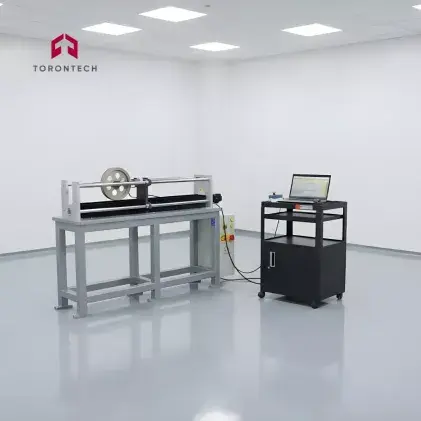
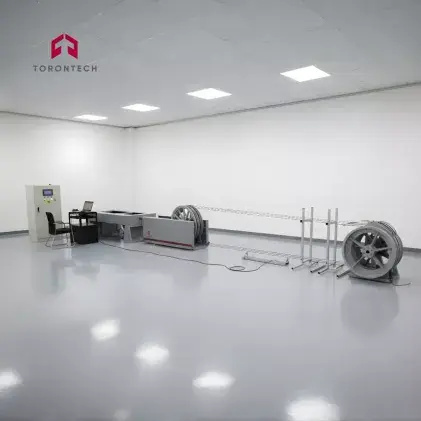
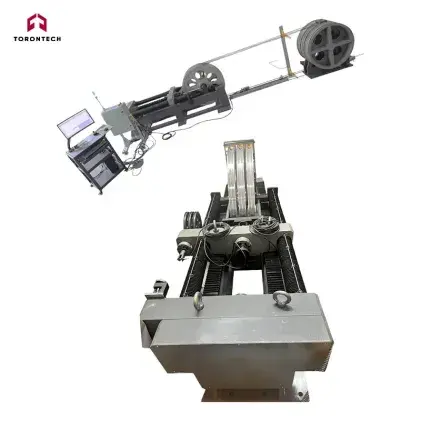
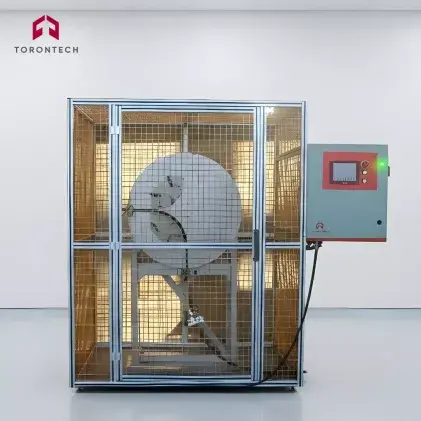
This broad spectrum of requirements is exactly why we test varying loads using systems like our TT-OFCT-ID Series and our heavy-duty TT-OFCT-OD Series machines. It is also worth noting that ambient temperature changes can alter cable mechanical stress by several percent due to the differing thermal expansion rates of aramid and glass elements.
In our view, pulling a cable past its limit is one of the primary reasons for networks going dark. It causes that frustrating signal drop or, in the worst-case scenario, a total break that leaves everyone disconnected. That’s why we’re always encouraging teams to keep a sharp eye on these two specific numbers:
- Maximum Installation Tension (Short-Term): The absolute maximum force you can apply while you’re actively pulling and installing the cable.
- Maximum Operating Tension (Long-Term): The leftover stress the cable can sustain for years without failing (think about aerial cables getting battered by high winds or heavy ice buildup).
Tensile Performance During Conduit Installation
One of the most intense stress tests a cable will ever face is being pulled through a pipe in a building or underground.
When you’re trying to determine the tensile strength of fiber optic cable through conduit, you have to account for the challenging reality of significant friction. Most fiber optic cables allow roughly 1,800 to 4,500 Newtons (400 to 1,000 lbf) of pulling tension, and exceeding this limit during conduit pulls risks severe microfractures and higher light attenuation.
Take a standard commercial job as a prime example: dragging a line through 500 feet of underground PVC pipe that features two sharp 90-degree bends. In a straight line, the pull is relatively straightforward. But the second the cable hits those bends, the friction spikes so intensely that the pulling tension effectively doubles or triples.
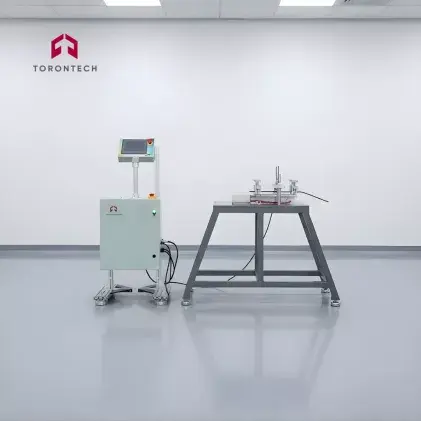
As the cable moves through those narrow, winding pipes, every single turn acts like a force multiplier. If the pull becomes more intense than what the cable is rated for, the outer skin might warp, and the glass inside is effectively ruined. This is exactly why we suggest running sample lines through an Optical Fiber Cable Abrasion Testing Machine, like our TT-OFCA Series, or checking bend fatigue with a Repeated Bending Tester, such as the TT-OFCRB Series, before a single inch goes into the ground.
To further mitigate risks, axial load control and careful monitoring using winches with tension limits are highly encouraged for OSP cables during placement. We believe conducting a dry run with serious testing is a total necessity before you start placing cables into conduits. It’s the only way to prevent a highly expensive setback during the build.
Calculating Pulling Tension for Field Success
Teams in the field and the professionals procuring the gear often need to figure out how to calculate tensile strength of optical fiber cable so they don't accidentally compromise the entire project. While manufacturers establish the baseline in a lab, these field estimates tell you how much physical force you’ll need for a specific pull.
Engineers typically compute the maximum tensile force and stress using the cross-sectional area of the strength members and their Young’s modulus. For specialized embedded sensing cables, the interface shear strength is even estimated from maximum force and embedded length.
The basic installation math utilizes several different components:
- W: The weight of the cable per foot or meter.
- L: The total length of the pull you're planning.
- f: How much friction exists between the cable skin and the pipe material.
For a straight pull, the mathematical approach is usually T = W x L x f.
Here is a quick hypothetical breakdown to show exactly how this works in practice. Say you have a cable weighing 0.5 pounds per foot (W), a pull length of 1,000 feet (L), and a friction coefficient of 0.4 (f). Your formula looks like this: T = 0.5 x 1000 x 0.4. That leaves you with 200 pounds of pulling tension required.
But once you add bends, the calculation becomes much more demanding, and you have to include extra stress factors for every degree of that turn. In our experience, these math models are useful, but they’re only as effective as the real-world data you feed them.
That’s why we’re big fans of performing actual physical pulls to establish accurate, safe-to-use ratings. For teams dealing with mixed environments, a machine like our TT-OFCT-IDOD is perfect for validating these formulas across different cable types.
Criteria for Selecting Tensile Testing Equipment
To be 100% certain about the numbers you’re including on your spec sheets, you need a testing setup that is completely accurate. But how to choose tensile testing machine for fiber optic cable? We believe anyone making the purchase should look at these four critical factors:
1. Strict Compliance with International Standards
For us, this is a non-negotiable requirement. The machine has to strictly adhere to IEC 60794-1-2 Method E1, which is the global benchmark for cable pulling tests. Additionally, standards for single fibers, such as ASTM C1557 and D3822, provide important procedures for strain correction that must be factored in.
This focus on international standards is exactly why we build our combo units, like the TT-OFCT-IDOD, to meet ASTM E4, ISO 7500-1, EN 10002-2, and JIS B7721 guidelines. If the equipment doesn't meet these rules, the data it produces is essentially useless for international projects.
2. Application-Specific Equipment Selection
We suggest making sure the tester actually matches what you are producing. Do you need something for lighter indoor cables, like the TT-OFCT-ID Series, heavy-duty outdoor lines, like the TT-OFCT-OD Series, or a versatile combo rig? Getting a machine that's too weak or overly bulky for your specific product line is a mistake you want to avoid.
3. Integrated Precision and Automated Data Tracking
A dedicated tensile machine for optical fibers and cables must use special grips to avoid damage and slippage while accurately measuring stress and strain behavior.
For specialized sensing cables, improved setups even utilize dual displacement measurement systems to correct for slippage and strain transfer loss at the grips, ensuring accurate strain coefficients. We highly recommend looking for these high-precision sensors and software that track the pull and signal loss simultaneously.
Look at a typical factory floor scenario to see why this matters. A high-speed tester running automated software catches a tiny micro-bend defect during a routine batch pull. Because the system flags the issue instantly on the monitor, the line shuts down immediately.
That one automated catch prevents shipping a flawed 10,000-meter spool to a client, saving the company thousands of dollars in returns and protecting their reputation.
4. Long-Term Reliability and Technical Support
Top-tier mechanical test benches are built around a stretching table with controlled displacement and independent tension monitoring up to the rated maximum, guaranteeing reliability. Laboratory gear is a significant investment.
We believe in partnering with a team known for creating equipment that stays reliable and who actually provides support when you need assistance. You need a setup that is tough enough to handle thousands of tests without losing its accuracy.
Optimize Fiber Reliability with Torontech Tech
Network reliability begins in the lab. We believe testing gear should be just as precise as the infrastructure it supports.
Our focus is providing sophisticated technology to ensure your components pass every mandate. Professional testing shouldn't be a heavy financial burden.
Stop leaving cable strength to chance. Upgrade your lab with our cost-effective systems. Explore our full range of OFC Testers here, and let our team find the exact setup for your requirements.
References (Click to expand)
- An, P., Wei, C., Tang, H., Deng, Q., & Fang, K. (2021). An Improved Calibration Method to Determine the Strain Coefficient for Optical Fibre Sensing Cables. Photonics.
- Boev, M., Ko, H., Chunyu, S., Lin, Y., & Min, Y. (2020). Design of Optical Cables Intended for Laying Inside Buildings and Zone Communication. 2020 Systems of Signals Generating and Processing in the Field of on Board Communications, 1-4.
- Carr, J., & Saikkonen, S. (1986). The Principles of Strength and Fatigue in Optical Fibers. OCEANS '86, 294-294.
- Crandall, A., Herron, C., & Washburn, R. (2005). Control of Axial Load Forces on Optical Fiber Cables during Installation.
- Da Silveira, R., Buras, M., Filho, A., Fernandes, J., & Futai, M. (2025). Laboratory Tests Using Distributed Fiber Optical Sensors for Strain Monitoring. Sensors (Basel, Switzerland), 25.
- Engelbrecht-Wiggans, A., & Forster, A. (2022). Analysis of Strain Correction Procedures for Single Fiber Tensile Testing. Composites Part A: Applied Science and Manufacturing.
- Kiforuk, S. (2022). INFLUENCE OF THE AMBIENT TEMPERATURE ON THE MECHANICAL TENSION OF THE OPTICAL CABLE. Zbìrnik naukovih pracʹ Odesʹkoï deržavnoï akademìï tehnìčnogo regulûvannâ ta âkostì.
- Miyajima, Y., Ohnishi, M., Kawata, O., Ishihara, K., & Negishi, Y. (1985). Fiber strength assurance for deep-submarine optical-fiber cable using the proof-testing method. Journal of Lightwave Technology, 3, 248-255.
- Olshansky, R., & Maurer, R. (1976). Tensile strength and fatigue of optical fibers. Journal of Applied Physics, 47, 4497-4499.
- Vyas, M., & Gunn, D. (1976). Tensile testing machine for optical fibres and cables. Optics Communications, 18, 563-566.
- Weitz, G. (1986). Prediction and Minimization of Fiber Optic Cable Pulling Tensions. IEEE J. Sel. Areas Commun., 4, 686-690.
- (2000). Prediction and Minimization of Fiber Optic Cable Pulling Tensions.