Densitometer vs Spectrophotometer: Color Control Guide
In industries like print, packaging, and paint, color consistency isn't a "maybe" it is exactly how you stay in business. When setting up your quality control, you eventually hit a fork in the road: densitometer vs spectrophotometer.
At Torontech, we’re convinced that picking the right tool is the secret to a smooth workflow and a happy bank account. Here is how each piece of hardware ticks and how to spot the one that fits your daily grind.
Key Takeaways
- Densitometers track ink thickness: Think of these as high-tech rulers. They are built specifically to keep your printing presses running consistently by monitoring exactly how much ink is hitting the page.
- Spectrophotometers read the color's DNA: These function like advanced electronic eyeballs. You absolutely need one of these if you are formulating inks in a lab or trying to perfectly match a very strict brand logo.
- Densitometer vs spectrophotometer choice matters: While both measure light, one focuses on process control while the other focuses on exact color communication.
- Spectrodensitometers do the heavy lifting of both: Modern hybrid devices give you the best of both worlds in a single unit, delivering incredible accuracy for your production floor without costing an absolute fortune.
How a Densitometer Works
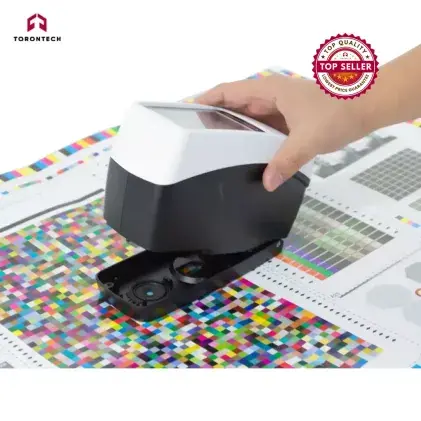
We’re going to call it, this is basically a high-tech ruler for your ink. A densitometer is a tool built for one job: figuring out how much light is being soaked up or transmitted by a surface.
To put it in plain English, it tells you exactly "how thick" that layer of ink or coating really is. While we focus on print, these tools are also used for things like photographic film analysis and even estimating bacterial populations.
Instead of trying to see the "vibe" of a color like a human would, this thing measures the light bouncing off the page through a set of red, green, and blue filters.
Primary Applications:
- Pressroom Control: People running the machines lean on these to make sure the CMYK ink isn't being laid on too thick or too thin.
- Technical Metrics: It’s the top choice for checking things like dot gain, contrast, and how well one ink sits on top of another.
- Production Consistency: It’s perfect for making sure the very first sheet looks just like the ten-thousandth one.
Our Take: We think a densitometer is a total workhorse for keeping the machine under control, but it’s blind to the difference between a specific brand’s "sunset red" and a random "cherry red." It just doesn't see color that way. When comparing a densitometer vs spectrophotometer, you have to remember that a densitometer cares about ink volume, not the exact shade.
At Torontech, we know these tools are excellent for semi-quantitative analysis, especially when they include features for background correction to improve accuracy. Think about churning out a 50,000-piece direct-mail run. You just need the black text to stay crisp and the photos to avoid turning into muddy puddles.
That’s exactly what this tool is built for, and it’s a big reason why we engineered the Torontech Color Densitometer - TT-Densito528™ to lock down those essential ink thickness metrics.
How a Spectrophotometer Works
This one is more like a full-blown electronic eyeball. A spectrophotometer is a way more advanced piece of kit. Instead of just glancing at light through three filters, it scans the whole rainbow (usually from 400 to 700 nanometers) to see how much light reflects at every single point.
By checking the light at every wavelength, it grabs the literal "fingerprint" of a color. It turns that info into a math problem, giving you numbers that let you talk about color without any guesswork. This tech is a big deal in dental shade matching and graphic arts because it stays steady even when lighting or the person looking at it changes.
Primary Applications:
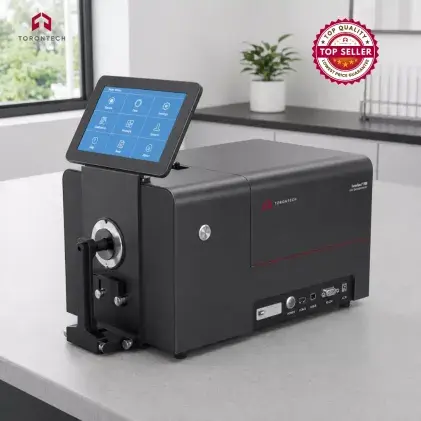
- Color Formulation: Labs use these to build perfect recipes for ink and paint from scratch. For this kind of heavy-duty lab work, we often point to stationary units like our High Precision Benchtop Color Spectrophotometer - ToronSpec™ 800 Series to get those baseline numbers absolutely perfect.
- Spot Color Verification: If you’re making boxes for a big brand, you need this to prove their signature blue is exactly what they asked for.
- Component Matching: Used in cars and makeup to make sure every piece looks like it belongs to the same set.
Our Take: In our opinion, this is the ultimate tool for anyone who needs to prove their colors are spot-on. In the debate of densitometer vs spectrophotometer, the spectrophotometer is the one that gives you the heavy-duty data you need to pass a strict quality check every single time.
For instance, consider assembling a high-end sports car. You absolutely must prove that the shiny plastic bumper perfectly matches the painted metal doors. This gadget gives you the exact math to back up that perfect match, providing reproducible results that ignore external factors like observer variability.
Quick-Reference: Densitometer vs Spectrophotometer Comparison
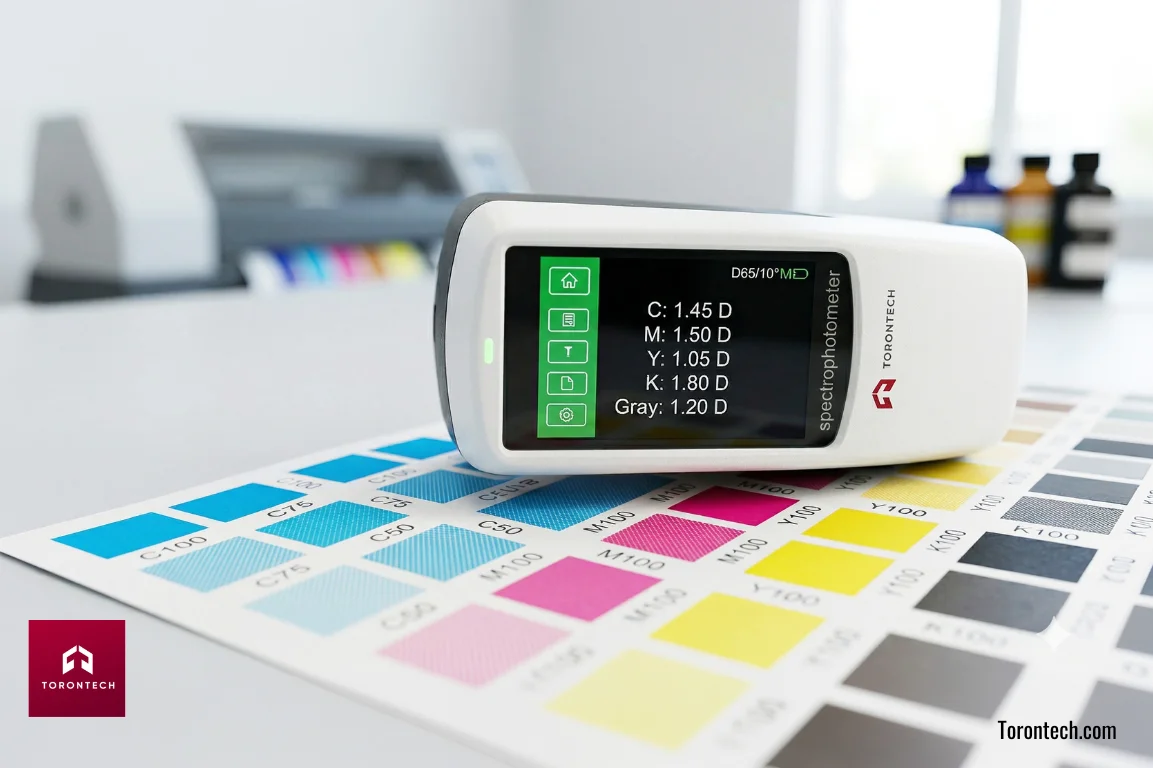
If you need a fast breakdown of the measurement approach for a densitometer vs spectrophotometer, here is how they look side-by-side:
| Feature | Densitometer | Spectrophotometer |
|---|---|---|
| Primary Measurement | Overall optical density (absorbance/transmission) | Detailed spectral info across multiple wavelengths |
| Data Output | Density, Dot Gain, Contrast | Lab values, Delta E, Spectral curves |
| Best For | Keeping the machine steady | Matching brand colors & lab work |
| Operator Skill | Fast and easy for anyone | Needs a bit more brainpower to read |
| Investment | Usually easy on the wallet | Usually costs a bit more |
Industry Use Cases
High-Volume Commercial Printing
Big shops doing massive runs love densitometers to keep things steady and stop the ink from drifting. We think the whole point here is just keeping the press running without any hiccups.
Say you are knocking out miles of newspaper or a mountain of basic grocery store circulars; you just need to ensure the ink layers stay consistent. While a densitometer vs spectrophotometer comparison shows that densitometers are simpler for spot-color matching in basic printing, spectrophotometers offer way more versatility for complex jobs.
Packaging and Labels
This work absolutely needs a spectrophotometer. Brands won’t settle for "close enough" on their logos. In our view, being able to prove the shade is right is just part of the job here.
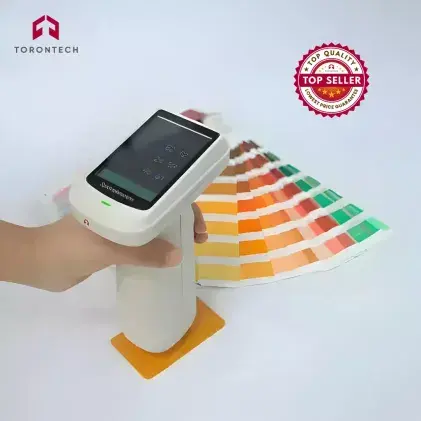
Picture trying to match a famous soda brand's specific, trademarked red across glossy cardboard boxes, matte paper coupons, and stretchy plastic shrink wrap. You have to nail it on every single material, and grabbing a handheld unit like our Portable Color Spectrophotometer – Colorimeter ToronSpec™ 700D makes that happen right on the production floor.
Ink and Coating Formulation
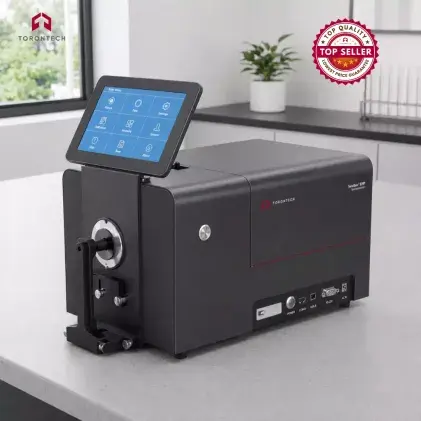
The folks who actually mix the ink use these to make sure every bucket they sell is perfect before it even leaves the building. Before a 50-gallon drum of custom neon green ever gets loaded onto a shipping truck, the lab techs use high-end gear, such as the Benchtop Spectrophotometer ToronSpec™ 820P for Reflectance and Transmittance, to guarantee the formula is spot-on to the very last drop.
Selection Criteria: A Quick Checklist
Still scratching your head over the densitometer vs spectrophotometer choice? We suggest checking these boxes to see where you land.
Choose a Densitometer if:
- Your main goal is quick density or color intensity measurements.
- You want something fast that your team can use without a long manual.
- You’re watching your budget and just need to make sure the ink stays thick enough.
Choose a Spectrophotometer if:
- You’re constantly chasing custom colors that have to be perfect.
- Your customers ask for reports proving the color is exactly right.
- You’re printing on difficult substrates like foil, clear plastic, or textured paper.
- You’re mixing your own inks in-house.
The Hybrid Solution: Spectrodensitometers
In the old days, you had to buy two different gadgets to get the whole story, which was a total pain for your budget. But we’ve noticed that things have changed for the better. Combining both methods can sometimes yield better results depending on the application.
Today’s smartest tools (often called spectrodensitometers) use a top-tier sensor to grab all that color data, but they’re smart enough to show you the simple density numbers too. We believe this is the way to go for any shop that wants the best of everything in one hand, offering the all-in-one capability that modern production lines actually need.
Achieve Color Excellence with Torontech
Choosing a color tool shouldn't mean picking between "good enough" and "bank-breaking." For 20 years, Torontech has focused on smart gear built differently and deals that won’t empty your pockets. We highly recommend the TT-Densito528™ for shops that need results without the fortune-level price tag.
It’s built with a high-end spectral sensor that hits the mark every single time, seriously, the consistency is sheer perfection (dE*ab ≤ 0.02). Whether you’re on Android, iPhone, or Windows, your team will love how easily it syncs to the cloud to share reports instantly.
Ready to stop guessing and start getting perfect color? Explore the Torontech TT-Densito528™ right now to see how our cost-effective, innovative technology can make your production floor look like a million bucks.
References:
- Kumari, K., Sathiya, S., & Sikander, A. (2025). A Comprehensive Review on Real-Time Viscosity and Density Measuring Sensors. MAPAN, 40, 287 - 309.
- Betancourt, A., Saldaña, J., & Grandinetti, J. (2024). Comparison of tooth shade determination using two methods: visual and spectrophotometric. Odontologia (Montevideo).
- Slavin, M. (1965). Range and Error of Densitometers for Emission Spectroscopy. Applied Spectroscopy, 19, 28 - 30.
- De Villiers, D., & Van Wamelen, D. (1965). A Simple Densitometer for Semi-Quantitative Analysis. Applied Spectroscopy, 19, 59 - 60.
- Lv, X. (2018). Color Matching Method of Three Wavelengths Based on Density Measurement. The 21st IAPRI World Conference on Packaging.
- Longsworth, L. (1936). The Estimation of Bacterial Populations with the Aid of a Photoelectric Densitometer. Journal of Bacteriology, 32, 307 - 328.
- Rood, P. (1994). Practical instrumentation for graphic arts color measurement. SPIE, 2171.