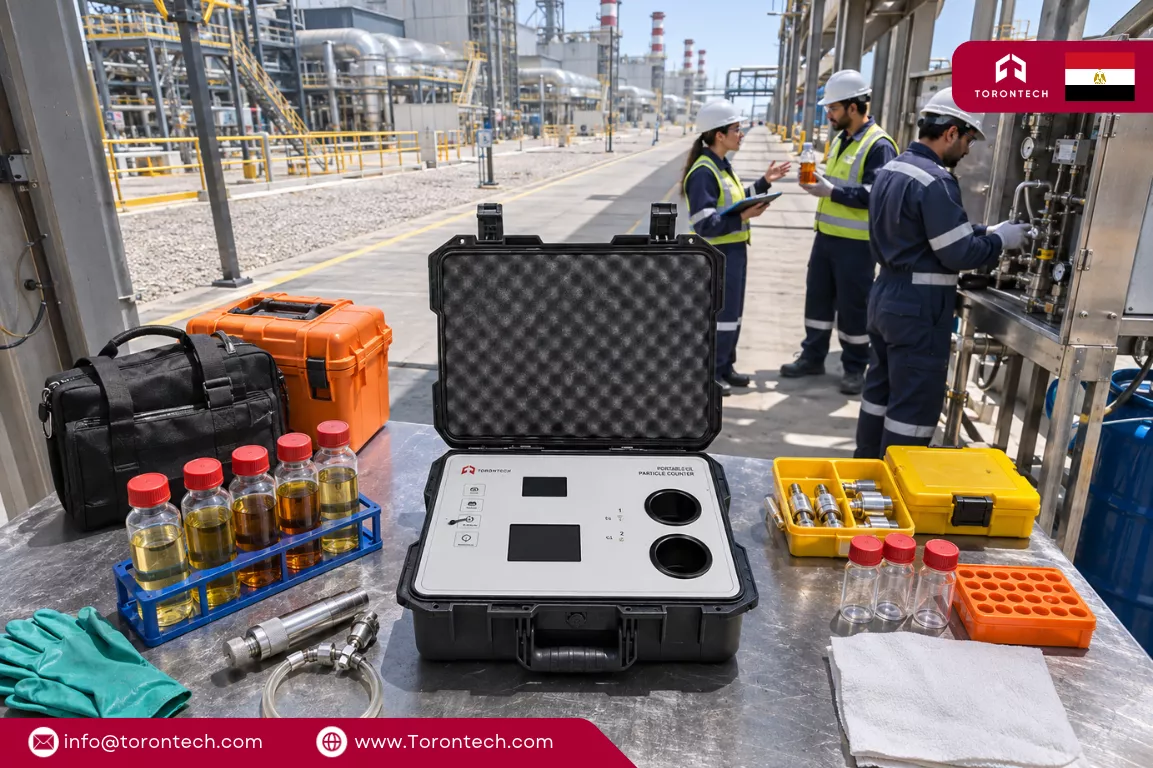
Oil Particle Counters for Egypt's Power, Refining, and Industrial Plants
A turbine bearing in Upper Egypt rarely fails without warning. Fine particles, many smaller than 10 microns, circulate in lube and hydraulic oil for weeks, scoring servo valves and wearing journals long before a vibration alarm forces a shutdown.
An oil particle counter in Egypt gives maintenance teams that early warning. The Torontech ToronOPC liquid and oil particle counter series sizes and counts solid contaminants in hydraulic, turbine, lubricating, and transformer oil, then reports results to ISO 4406, NAS 1638, and SAE AS4059.
Where Fluid Cleanliness Protects Uptime in Egypt
Egypt's grid leans heavily on large gas turbines. The Siemens-built Beni Suef, Burullus, and New Capital combined cycle plants added 14.4 GW together, with eight gas turbines at each site serving roughly 40 million people.
Every one of those units depends on lube oil and hydraulic control oil held within tight cleanliness limits. Routine particle counting helps reliability engineers catch filter bypass, seal wear, or dust ingress during the spring khamsin season before contamination reaches critical clearances.
Refining is the second major driver. The ANOPC diesel complex in Assiut reached roughly 88% completion in 2026, with trial operations targeted for year-end and planned output of 2.8 million tons of Euro 5 diesel per year.
New hydrocracking units, compressors, and pump trains need baseline oil data from day one. As a result, flushing verification and commissioning acceptance both rely on accurate, repeatable particle counts.
Industrial growth adds a third layer. The Suez Canal Economic Zone (SCZone) attracted about $7 billion across 117 projects in fiscal year 2025/26. Those new factories bring hydraulic presses, injection molding lines, and automated equipment that all run on clean fluid.
How Laser Light-Blocking Counting Works
ToronOPC instruments use a laser light-blocking method, also called light obscuration. As oil flows through a narrow sensing zone, each particle interrupts the laser beam and reduces the light reaching a photodetector.
The instrument then converts each signal drop into an equivalent particle diameter and tallies the count in each size channel. Because it measures particles individually, the method delivers quantitative size distribution data rather than the visual estimate a patch test provides.
Choosing an Oil Particle Counter in Egypt by Application
The right format depends on where the oil sits and how often you need data. Portable units suit route-based sampling across dispersed assets, while inline monitors deliver continuous trending on critical systems.
| Model | Format | Key Capability | Typical Egyptian Application |
|---|---|---|---|
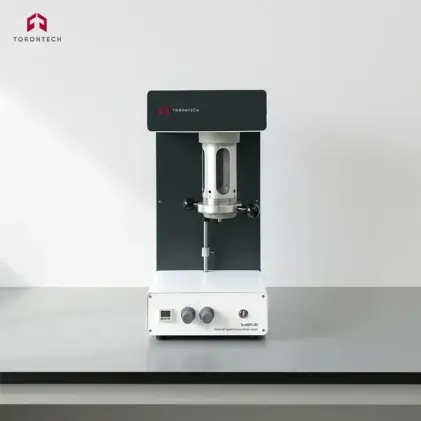
| ToronOPC VES | Laboratory | Syringe pump sampling, up to 64 channels | Refinery and utility oil labs |
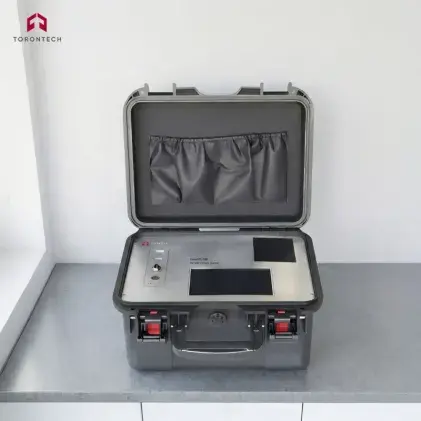
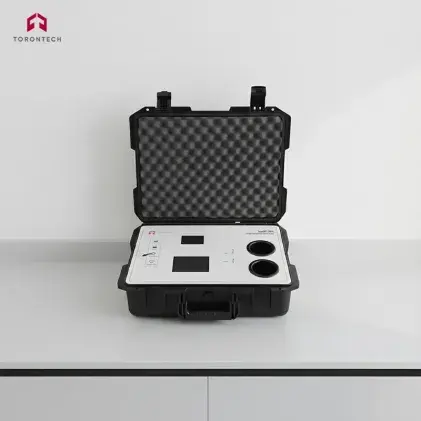
| ToronOPC 300W | Portable, battery powered | 1 to 500 µm across 32 channels | Field checks on transformer and turbine oil |
| ToronOPC-OL2 | Inline online monitor | 16 channels, 0.2 to 10 MPa standard | Continuous trending on lube and hydraulic skids |
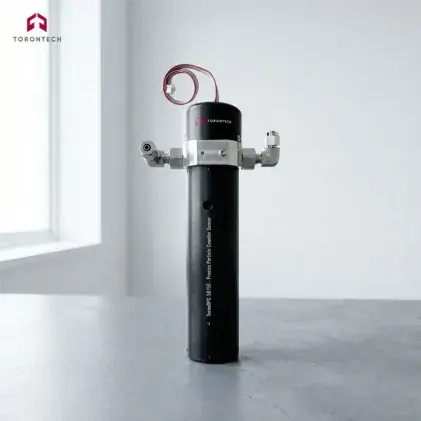
| ToronOPC-50/50 | Sensor module | Light-blocking sensor for integration | Custom inline or laboratory monitoring setups |
For example, field crews covering substations along the Nile Delta grid can carry a portable liquid and oil particle counter that handles both bottle samples and inline connections. It also tests aviation kerosene and gear oil, which suits airport and port maintenance teams.
Before specifying a unit, confirm these points with your reliability or lab team:
- Fluid type: hydraulic, turbine, lubricating, transformer insulating oil, or fuel
- Sampling mode: bottle sampling in the lab, pressurized line connection, or both
- Condition data: optional moisture, viscosity, and temperature sensing for a fuller picture
- Data handling: onboard storage, USB export, and optional printing for audit records
Reporting Cleanliness to ISO 4406, NAS 1638, and SAE AS4059
Cleanliness targets only work when everyone reads the same code. ToronOPC counters report to ISO 4406, NAS 1638, and SAE AS4059, the classification systems that turbine, hydraulic, and aviation OEMs commonly cite in their oil specifications.
This matters in Egypt because plant equipment arrives from European, American, and Asian manufacturers, each with a preferred code. A single instrument that reports all three lets engineers compare readings directly against every OEM limit in the fleet.
Calibration traceability matters as well. Most models in the range, including the ToronOPC 300W and ToronOPC-OL2, also list ISO 11171 and ISO 4402 calibration methods, which supports defensible results for internal audits and customer reviews.
For plants running a central control room, the ToronOPC-OL2 online particle counter feeds data straight into existing systems. It offers RS485 Modbus RTU, Ethernet with Modbus TCP, isolated 4 to 20 mA outputs for DCS or PLC links, and relay alarms at configurable thresholds.
Build a Contamination Monitoring Program With Regional Support
New turbines in the Delta, hydrocracking units in Assiut, and factories across SCZone share one maintenance reality: clean oil extends component life. Particle counting turns that principle into trended data your team can act on.
Torontech supports buyers in Egypt through Torontech ME FZE in Dubai, which coordinates quotations, model selection, and shipment. The team can help you match sampling modes, size channels, and data outputs to each asset class, from transformer fleets to turbine lube skids.
To scope an oil particle counter in Egypt for your plant or laboratory, reach out to the Torontech team for a consultation. You can also call +971 488 19252, email me@torontech.com, or write to Meydan Grandstand, 6th floor, Meydan Road, Nad Al Sheba, Dubai-261440, UAE.