





Portable XRD Analyzer – X-ray Diffractometer – SHINE Research Edition
The Portable XRD Analyzer – X-ray Diffractometer – SHINE Research Edition is integrating XRD, XRF, and computer software technologies. It enables the analysis of samples through X-ray diffraction, providing insights into material composition and internal structure, including crystal phase identification and trace elements.
With simple sample preparation and high precision measurements, it offers a comprehensive understanding of crystal integrity, making it a primary method for studying phase and crystal structure in materials.
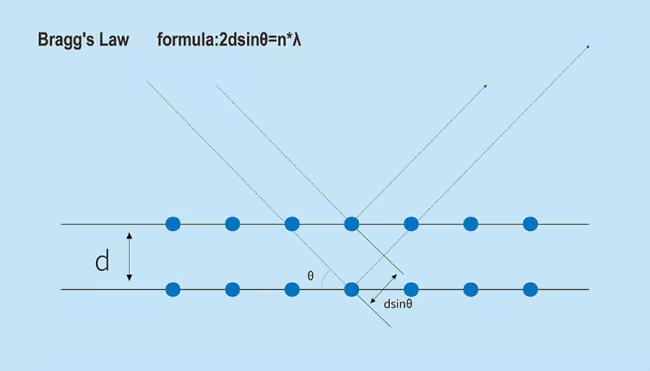
Utilizing transmission geometry technology, SHINE directs X-ray beams through the sample location. A micro-focus X-ray tube emits beams through a collimator, irradiating powder particles in the sample pool. A unique vibration system ensures increased exposure of crystal powder particles to the X-ray beam, adhering to Bragg's law. The fixed sample size in the pool maintains resolution stability, crucial for low-density materials like drug samples, where higher resolution is achieved compared to instruments utilizing reflective geometry.
The Portable XRD Analyzer – X-ray Diffractometer – SHINE Research Edition supports bio-pharmaceutical research, environmental monitoring, geology and prospecting, metallic compound chemistry, catalyst development, and teaching laboratories.

Bio-pharmaceutical

Environmental Monitoring

Geology and Prospecting

Research and Education
Metallic Compound

Chemistry and Catalysts
Portable
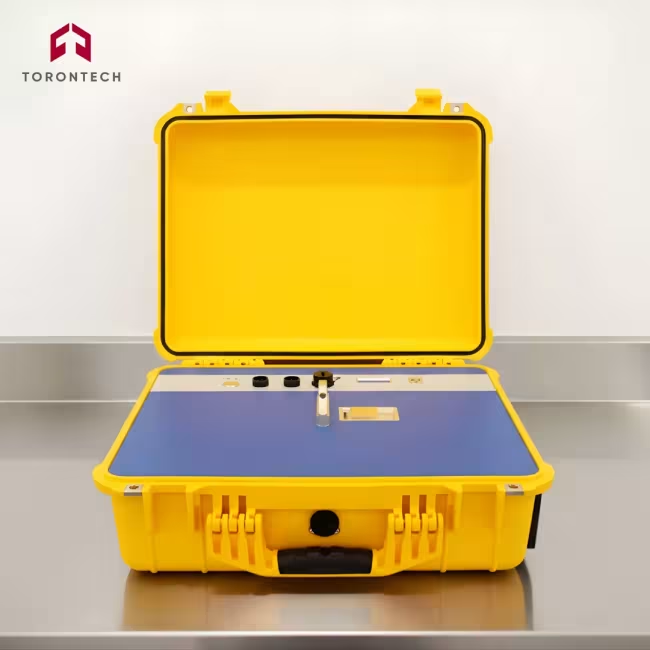
The Portable XRD Analyzer – X-ray Diffractometer – SHINE Research Edition features an all-in-one waterproof and dustproof design, eliminating the need for mechanical moving parts. It is lightweight, compact, and easy to carry, facilitating seamless scientific research in both laboratory and field settings.
Integration
XRD is seamlessly integrated with XRF technology, allowing for simultaneous collection of X-ray photon data from both methods during each test. This comprehensive approach provides detailed information on material composition, phase, and structure, thereby improving the accuracy of test results.
Easy-Operation
The Portable XRD Analyzer – X-ray Diffractometer – SHINE Research Edition is user-friendly, requiring no calibration and offering automatic detection. It provides real-time display of full spectrum diffraction, automatic phase analysis, and generates quantitative results with just one key operation.
Sample preparation is simple
For a single analysis, only about 20 mg of sample is required to achieve high-quality test results. Sample preparation, including crushing, filtering, and sampling, can be completed in just 3 minutes without the need for molding, pressing, or scraping for uniformity.
Data transmission
The Portable XRD Analyzer – X-ray Diffractometer – SHINE Research Edition achieves high-speed connection with a laptop computer via USB, Bluetooth, and WIFI, enabling real-time control and phase analysis of SHINE.
Safety
The Portable XRD Analyzer – X-ray Diffractometer – SHINE Research Edition undergoes professional multiple protective radiation treatments to ensure there is no radiation leakage in any direction during measurement.
X-ray diffraction (XRD) identifies the crystalline structure of a material, which reveals what phases or compounds it contains. Because every crystalline substance has a unique atomic arrangement, XRD acts like a fingerprint reader for solids.
Bragg's Law and Diffraction
The analyzer directs a beam of X-rays at the sample. The atoms in a crystal are arranged in regular planes, and these planes reflect the X-rays. When the path difference between rays reflected from adjacent planes equals a whole number of wavelengths, the rays reinforce and produce a strong diffracted beam. This condition is described by Bragg's law, where n times the wavelength equals 2d times the sine of theta, and d is the spacing between crystal planes.
From Diffraction Pattern to Identity
The instrument measures the angles and intensities of the diffracted beams to build a diffraction pattern. Each crystalline phase produces a characteristic set of peaks, so comparing the pattern against reference databases identifies the phases present and can reveal crystallite size and strain. This makes XRD a core tool for material identification and quality control.
XRD resolution | 0.2°@2θ FWHM |
Scope of XRD | 5-55°2θ |
The detector | 2000 X 256 pixel, 2d, level 3 Pelter refrigeration CCD |
X-ray tube target | Cluster microfocal spot X-ray tube, Cu or Co, Cr, Fe, Ni, Mo, Ag, W target (optional according to test sample) |
X-ray tube voltage | Maximum 50kV, 0-50kV adjustable |
X ray tube power | Maximum 40W, 0-40W adjustable |
XRF energy resolution | 127eV@8keV |
XRF detection range | Mg—U |
Cooling Method | Water Cooling |
Sample particle size | Sample particle <150um (100 mesh sieve) |
Sample weight | about 20mg |
Working temperature | -10°C-35°C |
Weight | 15KG |
The power supply | Lithium ion battery or power adapter |
Size | 50×40×18.8cm(L×W×H) |
CrystalX analysis software language | English and other languages |