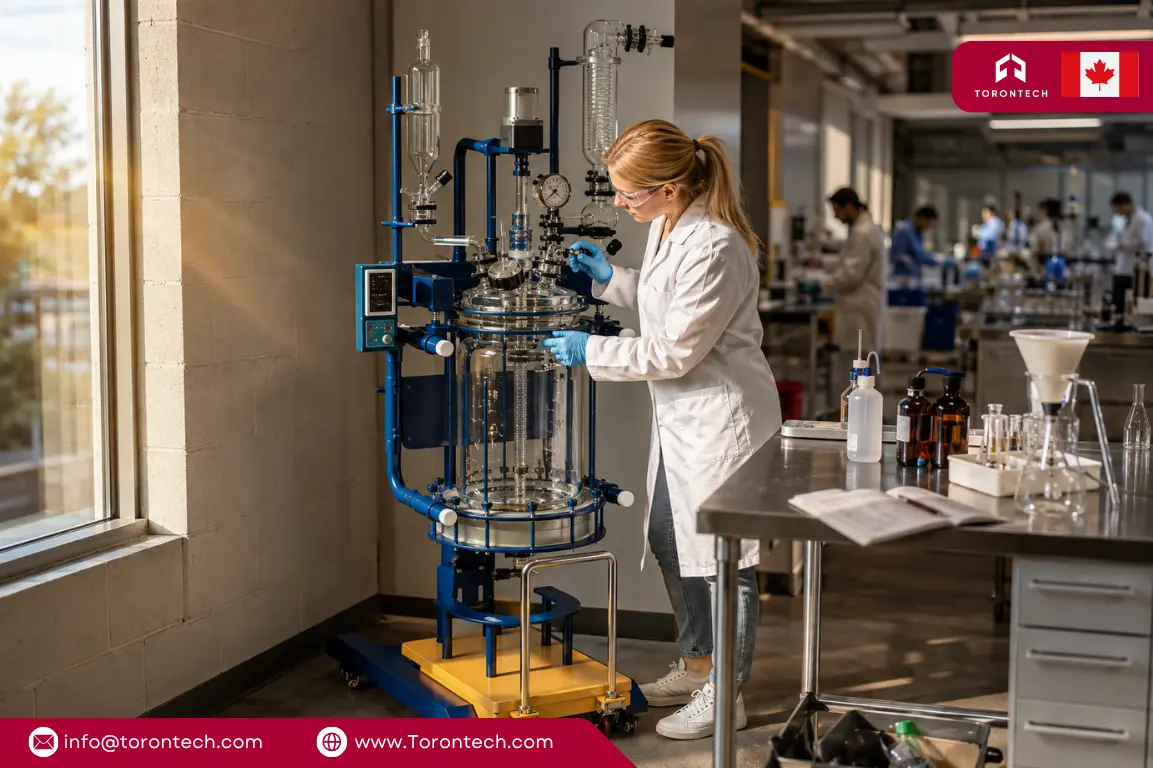
Scale Chemistry Safely With a Glass Reactor in Canada
A reaction that behaves perfectly in a 500 mL flask often falls apart at ten liters. Heat transfer slows, exotherms run away, and yields drift batch to batch. Canadian process chemists hit this wall constantly.
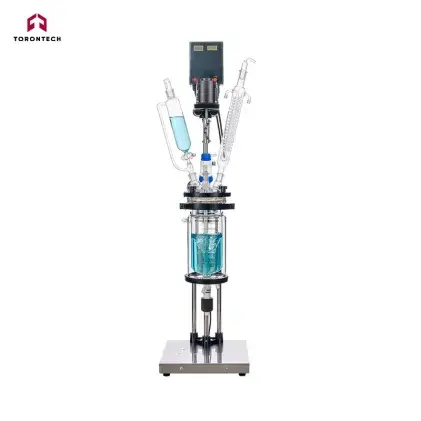
A glass reactor in Canada closes that gap. Torontech supplies a complete range of glass reactors from 1L bench units to 200L pilot vessels, built in borosilicate glass 3.3 with jacketed control from -80 to +250°C.
Where Canadian Chemistry Teams Put These Vessels to Work
Demand in Canada comes from three directions at once, and each one wants a different vessel size.
Pharmaceutical process development leads. Federal support through the Biomanufacturing and Life Sciences Strategy has expanded domestic capacity, and the Critical Medicines Production Centre is bringing small-molecule synthesis onshore. Ontario and Quebec now host dense CDMO clusters running kilogram-scale API campaigns.
Battery materials follow closely. The National Research Council's Critical Battery Materials Initiative, anchored at its Mississauga advanced materials facility, targets scale-up from gram to kilogram batches. Precursor co-precipitation depends on tight thermal control and steady agitation.
Natural product processors form the third group. Licensed extractors working under Health Canada rules run winterization, decarboxylation, and solvent recovery in jacketed vessels, usually at larger working volumes.
| Sector | Typical Process | Common Vessel Size |
|---|---|---|
| Pharma and CDMO development | API synthesis, crystallization | 1L to 20L |
| Battery and critical minerals | Precursor precipitation, digestion | 5L to 50L |
| Extraction and natural products | Winterization, decarboxylation | 20L to 100L |
| University and NRC laboratories | Reaction kinetics, polymer synthesis | 1L to 10L |
Electrical Approval and Hazardous Area Planning
Canadian buyers underestimate this step more than any other. Imported laboratory equipment cannot simply be plugged in and energized.
Provincial electrical authorities require either a recognized certification mark or a field evaluation before approval. CSA SPE-1000 is the model code that governs that field evaluation, and inspection bodies accredited by the Standards Council of Canada carry it out. Build the timeline into your procurement schedule.
Voltage matters too. Standard units ship at 220V/50Hz, and 110V builds are available, so confirm the configuration at the order stage rather than after delivery.
Solvent handling areas add another layer. Where your facility classifies a room as a hazardous location under the Canadian Electrical Code, explosion-proof models become relevant.
The Ex versions add an explosion-proof motor, frequency converter, and cable conduit, and they raise stirring speed to 1400 rpm. Verify the rating against your own area classification before specifying.
Matching Configuration to Your Process Stage
Torontech builds several configurations, and picking the right one usually comes down to batch size and how often operators need access to the vessel.
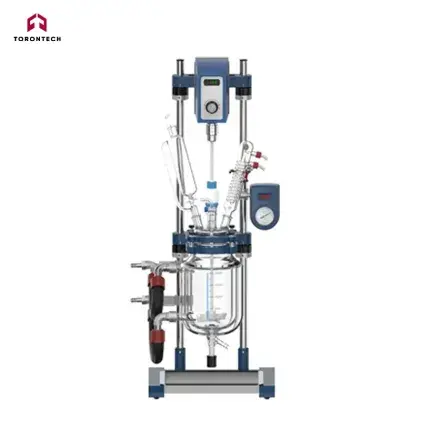
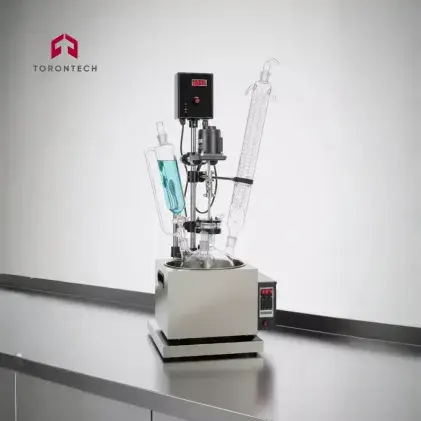
- Desk-top jacketed: 1L to 5L vessels for synthesis, reflux, and concentration on a bench or in a fume hood. Explore the desk-top jacketed glass reactor range for early development work.
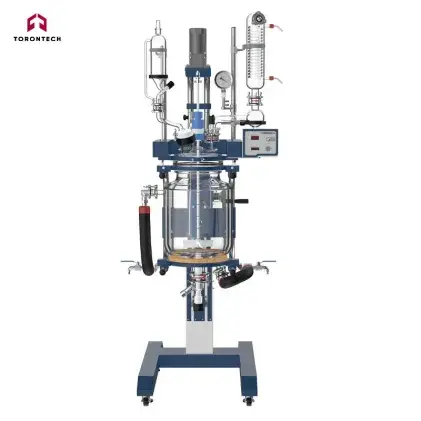
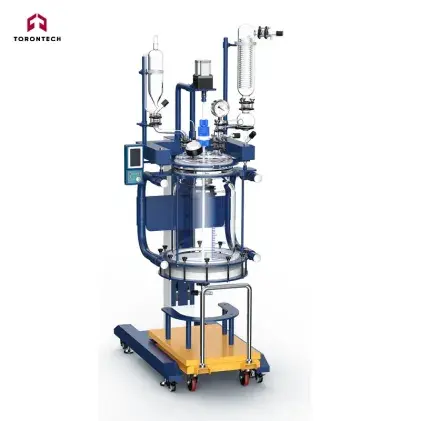
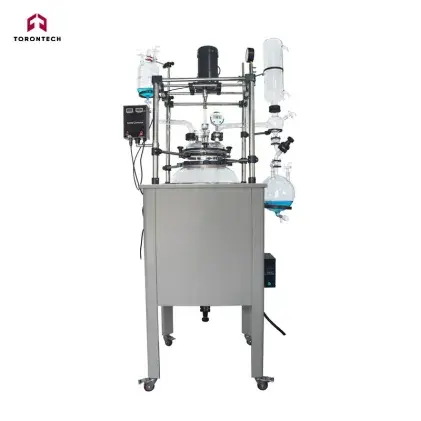
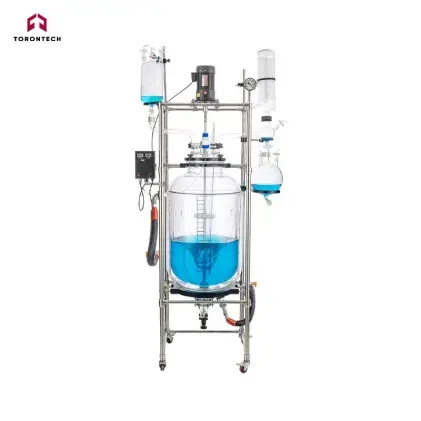
- Pilot-scale jacketed: 10L to 200L systems that bridge laboratory results and production. The pilot-scale jacketed glass reactor line covers clinical batch quantities and process validation.
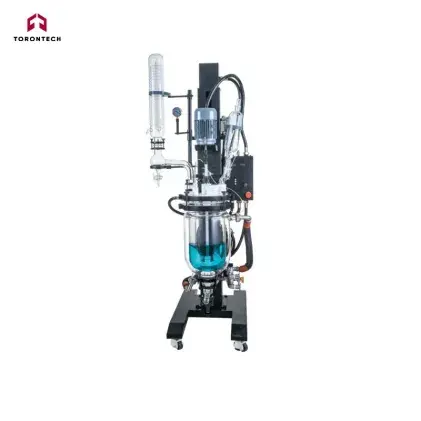
- Lifting and jacketed lifting: the frame raises the vessel for faster cleaning, discharge, and sampling between runs.
- Lifting jacketed filter: combines reaction and filtration in one footprint, which suits crystallization workflows that would otherwise need a separate filter.
- Single-layer: desk-top and pilot versions with a heating bath, a cost-effective choice when you do not need cryogenic control.
How to Specify a Glass Reactor in Canada
Once you have narrowed the configuration, a handful of parameters decide whether the system performs on day one.
- Working volume versus nominal volume: size the vessel for roughly 70 percent fill so headspace handles foaming and reflux.
- Chiller and heater duty: jacket volume runs from 200 mL on a 1L unit to 40L on a 200L unit. Your circulator must match that load across the full -80 to +250°C range.
- Vacuum requirement: the PTFE and fluororubber double seal supports a vacuum degree of 0.098 MPa for distillation and low-temperature evaporation.
- Agitation: standard motors reach 450 rpm, which suits most viscous slurry and precipitation work.
- Ceiling clearance: pilot units stand up to 2,800 mm tall, so measure the room before the crate arrives.
Temperature measurement accuracy of ±1°C holds across the range, which matters for crystallization windows where a two-degree swing changes crystal habit. Full specifications for each model sit on the individual product pages.
Plan Your Canadian Installation With Torontech
Canadian laboratories are scaling up faster than at any point in the past decade, driven by onshoring in pharmaceuticals and by the Canadian Critical Minerals Strategy. The bottleneck is rarely the chemistry. It is getting a properly configured, properly approved vessel into the room.
Buying a glass reactor in Canada is easier when the supplier is here. Torontech Inc. operates from Toronto, so quotations, voltage builds, and shipping run domestically. Our team can walk through jacket duty, port layout, and hazardous area questions first.
Tell us your target batch size, solvent system, and facility constraints, and reach out to the Torontech team for a configuration recommendation and a quotation.