Measure Viscosity Without a Viscometer: A DIY Guide
We work with businesses across dozens of industries, and we see how a fluid's properties can dictate the success of a production run. The core issue is often viscosity—a liquid's refusal to flow. Think about the stark difference between honey and water.
Water is cooperative; it pours instantly from a container, is easy to pump, and mixes without much effort. Honey, on the other hand, fights you every step of the way. It clings to the sides of a vat, stretches, and flows at a crawl, demanding more energy and time to move from point A to point B. Getting a handle on that specific property is a critical piece of the puzzle.
While specialized equipment is the best solution, we know it isn't always within arm's reach. Knowing some practical methods for how to measure viscosity without a viscometer, essentially performing a simple viscosity test on the spot, is a valuable skill for any technician or plant manager.
The Practical Methods for a Quick Check
In our professional opinion, a calibrated viscometer is the only path to true accuracy. However, as a company that specializes in precise measurement, we understand that if you need a fast, directional reading, these techniques can provide a rough idea. This kind of DIY viscometer approach has its place, but it's vital to know its limitations from a business perspective.
| The Method | Best For | The Upside | The Downside |
| The Efflux Cup | Thinner liquids like paints or inks. | Simple, inexpensive, and fast. | Very sensitive to temperature; not for thick materials. |
| The Falling Sphere | Demonstrating viscosity concepts clearly. | Makes the physics of flow easy to see. | Needs a transparent container; ineffective with opaque liquids. |
| The Inclined Plane | A quick, side-by-side comparison of multiple fluids. | Extremely easy to set up and see a relative difference. | The least precise; can be messy; only offers a simple ranking. |
| Simple Observation | An immediate, gut-feeling assessment on the line. | The ultimate viscosity measurement without equipment. | Entirely subjective; produces no quantifiable data for reports. |
1. The Efflux Cup (or Funnel) Method
We've seen this used countless times for a rapid "good enough" check on the production floor. It's a simplified version of what certified industrial tools like the Zahn or Ford cup do.
- What you need: A funnel or a cup with a precisely drilled hole, a stopwatch, and your liquid sample.
- The process: Block the opening, fill with a set volume, then release the liquid and start the timer. Measure the time it takes to fully drain.
- The result: A low-viscosity fluid will exit quickly. We find this is the most practical method to estimate viscosity for thin materials, but it's often where the need for a more controlled, professional tool becomes obvious.
Related article: High Viscosity vs Low Viscosity: A Complete Guide
2. The Falling Sphere Method
This technique is an excellent visual demonstration of fluid dynamics, perfect for when you need to check fluid thickness in a way anyone can understand.
- What you need: A tall, clear cylinder, a small, dense sphere, a stopwatch, and your sample.
- The process: Fill the cylinder. Mark a start and finish point on the side. Drop the sphere and time its transit between the two marks.
- The result: The sphere travels faster through lower-viscosity liquids. While it’s a fantastic demonstration, it can't deliver the hard numbers needed for a batch report.
3. The Inclined Plane Race
Frankly, we view this more as a qualitative experiment than a true measurement.
- What you need: A smooth, angled surface and droppers for your samples.
- The process: Prop one end of the surface up. Place an equal-sized drop of each fluid at the top and release.
- The result: The fluid that reaches the bottom first is the least viscous. It’s simple, but in our view, the least reliable for any professional judgment.
4. Simple Observation
This is the most intuitive method. Your team likely does this already when they judge a mixture by how it pours or coats a paddle. It’s the most basic form of qualitative viscosity measurement, based purely on experience.
The Hard Truth: Why DIY Methods Are Insufficient for Business
 While these field methods are resourceful, let’s be direct: for any professional application, they are inadequate. Relying on them for quality control is not just imprecise; our experience shows it can lead to significant, costly errors.
They Lack Repeatability and Reliability
In a professional operation, a test result has to be dependable. With these methods, small variations in technique will produce different results for the same sample. This inconsistency is a critical failure for quality assurance. Achieving absolute repeatability is one of the main reasons companies decide to invest in professional equipment from a supplier like Torontech.
They Don't Generate Defensible Data
"Fifteen seconds to drain" is not a number you can put on a Certificate of Analysis. The industry runs on standardized units like Centipoise (cP). You need these units to prove your product meets specifications, and a homemade test simply can't provide them.
You Can't Account for Temperature Variation
We cannot overstate this: a small temperature shift can cause a major change in viscosity. A sample tested on a cool morning can appear completely different in a warm afternoon production environment. This is why we made precise temperature control a non-negotiable feature in our ToronVisc™ line—we know how much temperature impacts real-world results.
They Don't Predict In-Process Performance
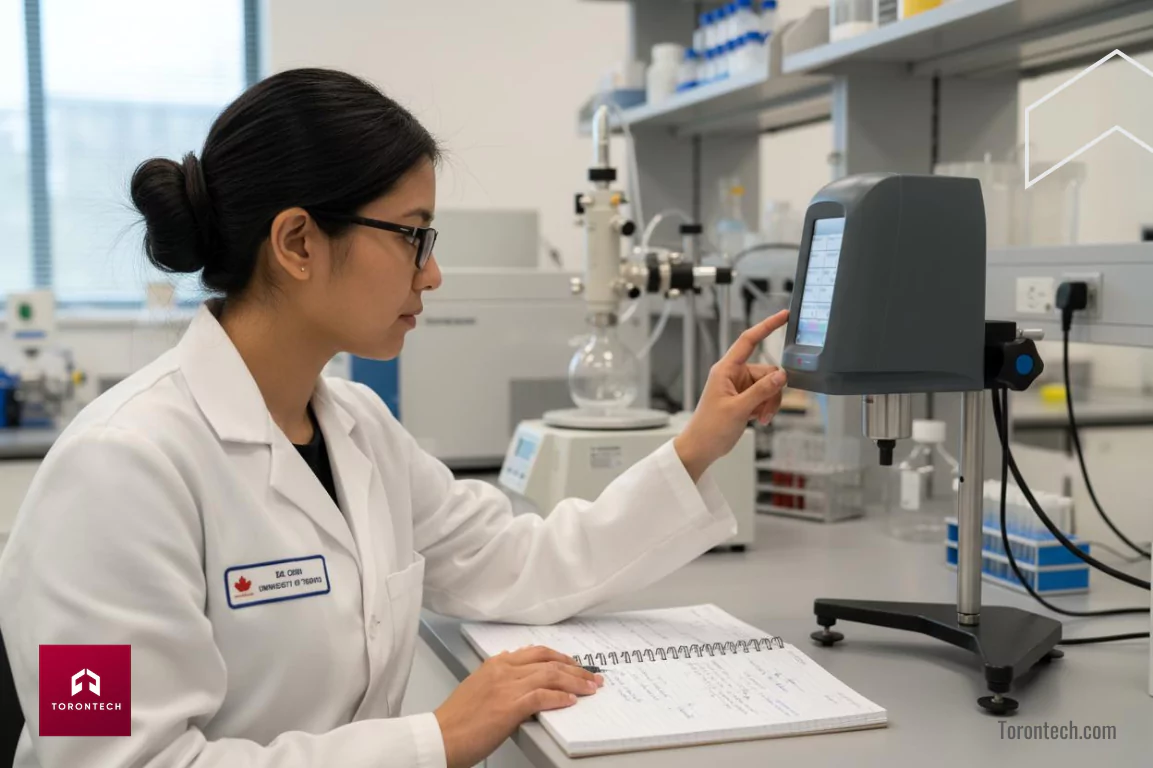
Many materials are non-Newtonian, meaning their viscosity changes under stress. A simple DIY test only measures a fluid at rest. It tells you nothing about how your product will perform when being pumped or sprayed. A rotational viscometer can test at various speeds to give you a complete performance profile, a risk that we help our clients avoid every day.
Cost-Effective Viscosity Control by Torontech
We believe these manual methods to measure viscosity at home or in the field are excellent for rough estimates and training. However, for the reliable, auditable results a business needs to protect its reputation and bottom line, a professional viscometer is the only appropriate tool.
At Torontech, we have built our business on solving the challenge of finding high-precision equipment that respects your budget. When you are ready to move past estimation and into accuracy, we can help.
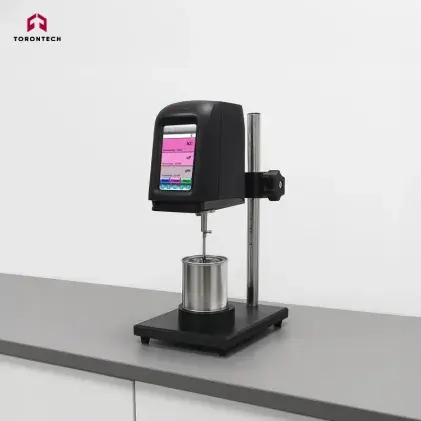
We offer a comprehensive, cost-effective line of our ToronVisc™ viscosity meters, from versatile digital models to specialized Krebs Stormer Viscometers. We designed them for demanding environments where precision is a requirement, not a luxury. Let us help you remove the guesswork from your quality control.
Need the Right Viscosity Measurement?
Explore cost-effective Torontech viscometers for precise, reliable results.
References
- Yingying, Z., Liu, C., Huang, X., Qian, X., Wang, L., & Lai, P. (2021). Low-consumption photoacoustic method to measure liquid viscosity. Biomedical optics express, 12 11, 7139-7148. doi.org/10.1364/boe.444144
- Khatir, B., & Golovin, K. (2021). Ultrasmall Volume Single-Droplet Viscometry: Monitoring Cornering Instabilities on Omniphobic Polydimethylsiloxane Brushes. Langmuir : the ACS journal of surfaces and colloids. doi.org/10.1021/acs.langmuir.1c01622
- Esfahani, I., & Sun, H. (2022). A droplet-based micropillar-enhanced acoustic wave (μPAW) device for viscosity measurement. Sensors and Actuators A: Physical. doi.org/10.1016/j.sna.2022.114121
- Meffan, C., Menges, J., Mak, D., Dolamore, F., Fee, C., Nock, V., & Dobson, R. (2023). A versatile capillaric circuits microfluidic viscometer. Sensors and Actuators A: Physical. doi.org/10.1016/j.sna.2023.114497
- Lenzen, P., Dingfelder, F., Müller, M., & Arosio, P. (2024). Portable Microfluidic Viscometer for Formulation Development and in Situ Quality Control of Protein and Antibody Solutions. Analytical Chemistry, 96, 13185 - 13190. doi.org/10.1021/acs.analchem.4c02099
- Ge, Y., Huang, X., Zhang, B., Song, Z., Tang, X., Shao, S., Guo, L., Liang, P., & Li, B. (2025). Measurement of fluid viscosity based on pressure-driven flow digital-printed microfluidics. The Analyst. doi.org/10.1039/d4an01550a
- Esfahani, I., Ji, S., & Sun, H. (2023). A Drop-on-Micropillars (DOM)-Based Acoustic Wave Viscometer for High Viscosity Liquid Measurement. IEEE Sensors Journal, 23, 24224-24230. doi.org/10.1109/JSEN.2023.3309757