

Ash Content Tester for Petroleum Products
Ash Content Analyzer for Petroleum Products TT-482
Ash Content Tester for petroleum products TT-482 complies with the ASTM D482 Standard Test Method for Ash from Petroleum Products and ASTM D874 Standard Test Method for Sulfated Ash from Lubricating Oils and Additives.
Torontech's Ash Content Analyzer for Petroleum Products is utilized for determining ash content in the range of 0.001–0.180 mass % in distillate and residual fuels, gas turbine fuels, crude oils, lubricating oils, waxes, and other petroleum products. Any ash-forming materials present are typically regarded as undesirable impurities or contaminants. The apparatus is suitable for petroleum products that do not contain added ash-forming additives, including certain phosphorus compounds.
Ash Content Analyzer for Petroleum Products TT-482 Application
The primary application of the Ash Content Analyzers for Petroluem Products TT-482, a muffle furnace, is to determine the amount of inorganic, ash-forming materials in petroleum products. It is used for two key tests:
- Ash Content (ASTM D482): To measure non-combustible impurities and contaminants (such as dirt, rust, and catalyst fines) in fuels, crude oils, and waxes.
- Sulfated Ash (ASTM D874): To measure the metallic additive content in new lubricating oils.
In both cases, the test provides a critical measure of product purity and composition.
Key Industries
- Petroleum Refining: This is a fundamental quality control test for refineries. They must ensure that products like fuels, crude oil, and waxes are free from inorganic contaminants to meet commercial specifications and prevent downstream operational issues.
- Lubricant Manufacturing: The sulfated ash test (ASTM D874) is an essential quality control step for lubricant blenders. It verifies that the correct amount of metallic additive (e.g., detergents, anti-wear agents) has been included in the final product, which is critical for the lubricant's performance.
- Power Generation: Power plants that operate on gas turbines or heavy residual fuels use this test to check their fuel for ash-forming contaminants. These contaminants can cause severe corrosion and deposit buildup on high-temperature components like turbine blades, leading to costly damage and reduced efficiency.
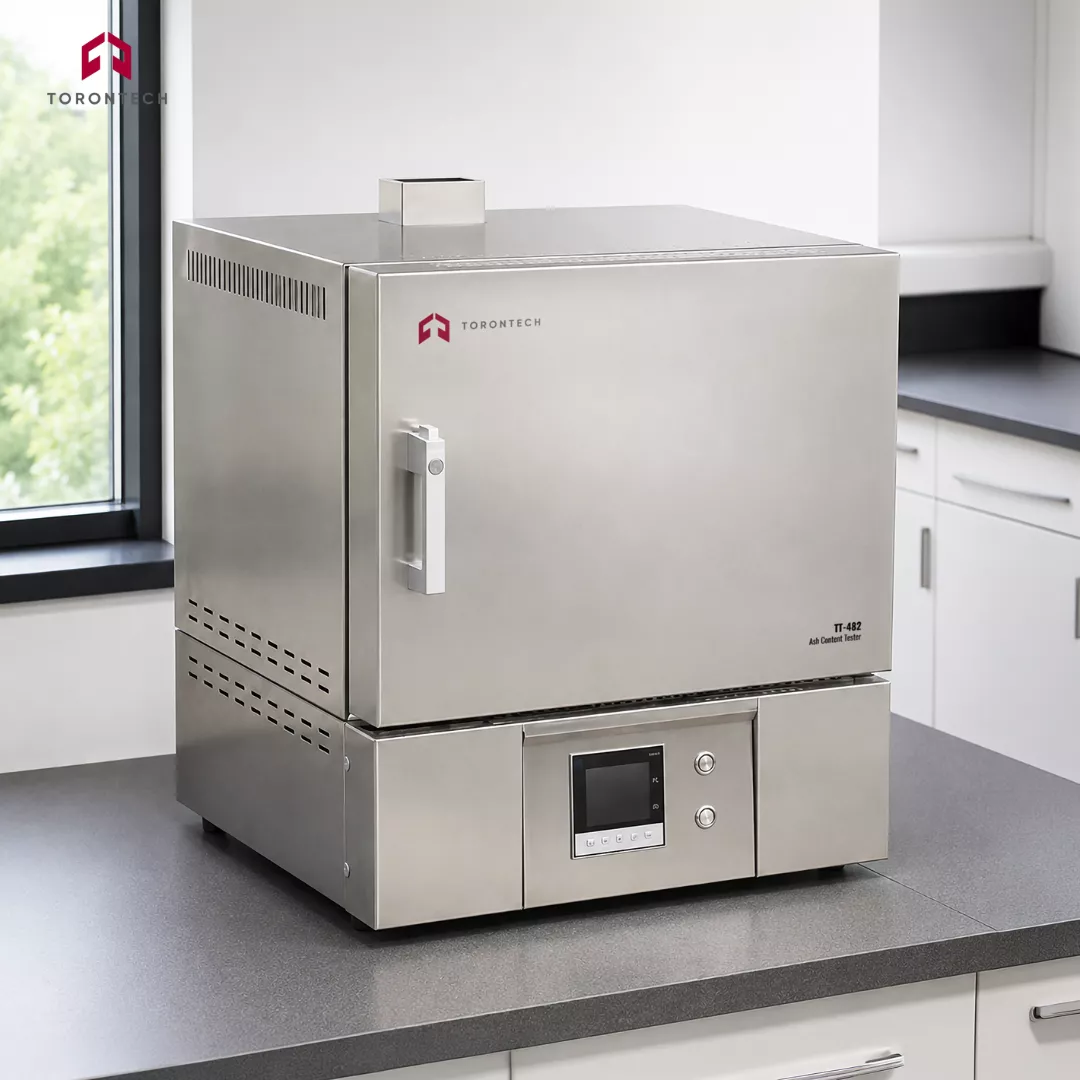
Ash Content Tester for Petroleum Products TT-482 Feature
- The inner furnace features a sealed structure, with high-temperature resistant lightweight refractory material used for the furnace mouth and door.
- The insulating layer between the inner furnace and the furnace shell is composed of refractory fiber and expanded perlite products. Even if the temperature inside the furnace reaches 775℃, there are only trace amounts of heat on the outer shell.
- The furnace door uses a clip-on structure, requiring only one action to close or open, in accordance with the quick take requirements of ASTM D482 standard.
Ash Content Analyzer for Petroleum Products TT-482 Specification
1. Rated voltage: AC220V±10%, 50Hz. (110V also available)
2. Heating power: 5000W.
3. Temperature control mode: Temperature controller.
4. Temperature measurement mode: Nickel-chromium—Nickel-silicon galvanic couple.
5. Temperature control precision: ±5℃.
6. Temperature control range: 100~1200℃.
7. Ambient requirements: Temperature: 5~40℃.
8. Humidity: ≤85%.