Single vs Twin Screw Extruder: An Expert Comparison
Choosing the right extruder is a critical decision that directly influences production efficiency, product quality, and profitability.
The debate between a single screw vs twin screw extruder is central to this choice, especially for demanding tasks like plastic recycling. Understanding their core differences is the key to selecting the right plastic recycling machine for your operation.
Key Takeaways
- Mechanism Differences: Single screw extruders rely on friction and drag flow to move material, whereas twin screw extruders utilize positive displacement for precise control over difficult feedstocks.
- Best Use Cases: Choose a single screw machine for straightforward, continuous products like PVC pipes. Opt for a twin screw system when you need high-intensity mixing for compounding, masterbatches, or recycling.
- Cost vs. Efficiency: Single screw models offer a lower initial purchase price and simpler maintenance. Twin screw models require a higher investment but often reduce long-term costs through superior efficiency and product quality.
- Torontech’s Solution: We provide cost-effective, innovative technology for both methods, ranging from standard Single Screw Extruders to advanced Twin Screw Extruder Machines and integrated recycling lines.
At a Glance: Comparing Single vs Twin Screw Extruders
For those who need a straightforward summary, this chart lays out the essential differences. This quick overview is a great starting point when comparing single vs twin screw extruders.
| Key Feature | Single Screw Extruder | Twin Screw Extruder |
|---|---|---|
| Material Conveyance | Relies on friction against the barrel wall | Uses intermeshing screws for positive transport |
| Mixing & Blending | Basic melting and pumping action | Exceptional, high-intensity mixing action |
| Handling Feedstocks | Less effective with powders & fluff | Excellent for a wide variety of feedstocks |
| Degassing & Venting | Limited capability | Superior performance for removing volatiles |
| Initial Investment | Lower upfront cost | A more significant capital expenditure |
| Operational Complexity | Simpler to operate and maintain | Requires a higher degree of process knowledge |
| Ideal Applications | High-volume runs of PVC pipes, window profiles, and smooth sheets | Complex tasks like glass-fiber reinforcement, color masterbatches, and devolatilizing mixed scrap |
Key Differences: Single Screw Extruder vs Twin Screw Extruder
To truly appreciate which machine fits your operation, you have to look at how they handle the material internally. The choice generally depends on the desired balance between cost, complexity, mixing efficiency, and product quality.
1. The Method of Material Transport
This is the fundamental design difference.
Single Screw
A single screw extruder is a simpler, less expensive machine that uses one rotating screw to melt and convey plastic material.
Its operation depends on the friction created between the plastic pellets and the heated barrel. This setup is perfect for continuous processes and straightforward tasks.
If you are running a continuous line of standard PVC piping or simple siding, our Single Screw Extruder is the practical, reliable workhorse you want. While traditionally limited in mixing, single screw extruders can achieve comparable dispersive mixing when equipped with specialized extensional mixing elements.
Twin Screw
This unit features two intermeshing screws that provide better mixing and higher flexibility.
The screws physically push the material forward with a great deal of control. In our view, this is the only way to go when the recipe gets complicated.
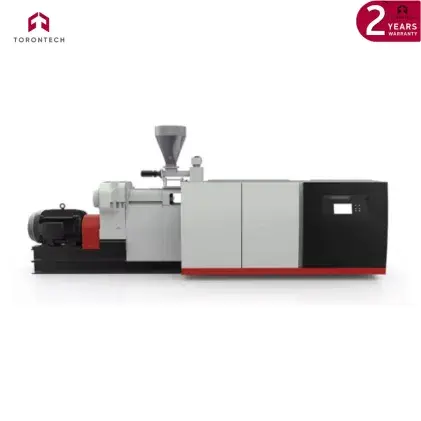
If you are trying to disperse fine powders for a color masterbatch or mix in glass fibers, our Twin Screw Extruder Machine utilizes enhanced shear and elongational flows to ensure every pellet is identical.
2. The Impact on Your Budget
The twin screw extruder vs single screw extruder conversation always involves financials.
Single Screw
The purchase price is more approachable, and maintenance is less complex. It is the cost-effective option for dedicated, high-volume production of simple products.
Twin Screw
While twin screw extruders generally offer superior mixing capabilities and process control, they are more complex and costly than single screw extruders. We encourage clients to think in terms of "cost per kilogram of on-spec product."
The sheer efficiency of a twin screw in complex applications—like compounding bioplastics—often delivers a faster return on investment through reduced waste.
A Key Technical Point: L/D Ratios and Shear
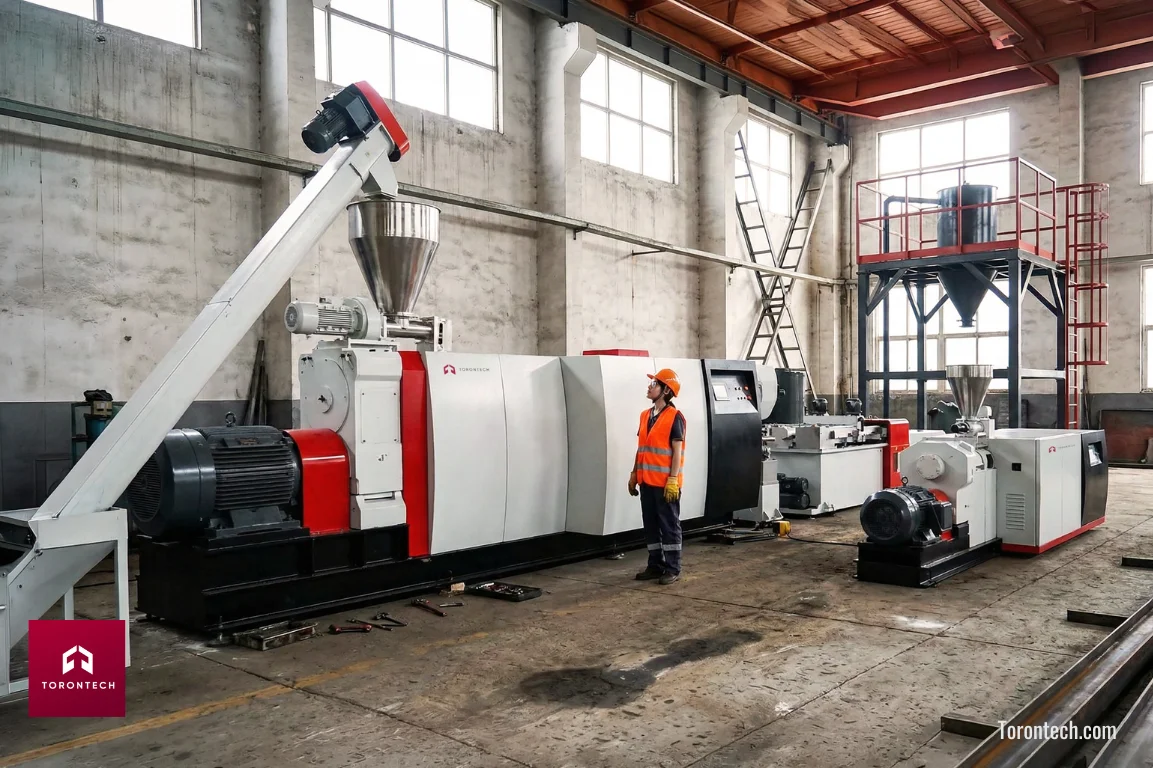
Beyond the number of screws, the Length-to-Diameter (L/D) ratio is a specification that has a major impact on performance, directly influencing the single screw extruder vs twin screw extruder decision. This ratio determines the "residence time," or how long the plastic is processed in the barrel.
- Short L/D (e.g., 20:1): Best for materials that are sensitive to heat.
- Long L/D (e.g., 40:1 or higher): Necessary for processes that require multiple stages in one machine.
We often find that the L/D ratio is a detail that can be overlooked. It is also important to note that while twin screw extruders provide excellent mixing, the high shear conditions can sometimes cause more polymer degradation compared to single screw extruders, potentially affecting the molecular weight of recycled materials.
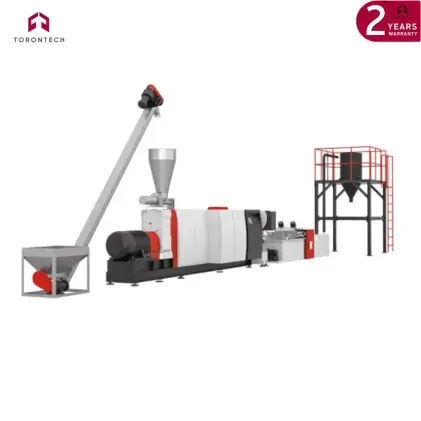
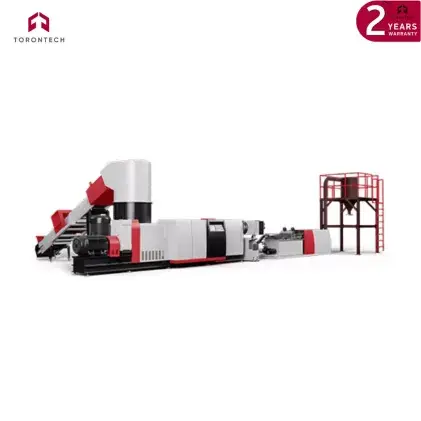
Our equipment, from the basic extruder to the advanced Shredder Extruder Recycling Pelletizing System, offers flexible configurations to ensure the machine is a perfect match for your application.
Applying This to the Demands of Plastic Recycling
Let's connect this to the business of processing scrap plastic, a core focus of our plastic recycling machinery.
Recycling feedstocks are notoriously inconsistent and often contain moisture. Any operator who has dealt with a batch of pellets ruined by trapped gas bubbles understands this challenge perfectly.
- Twin Screw Extruders: These machines are suitable for complex recycling tasks such as compatibilization and reactive extrusion. Their ability to effectively vent moisture makes them key for transforming variable scrap into a consistent raw material.
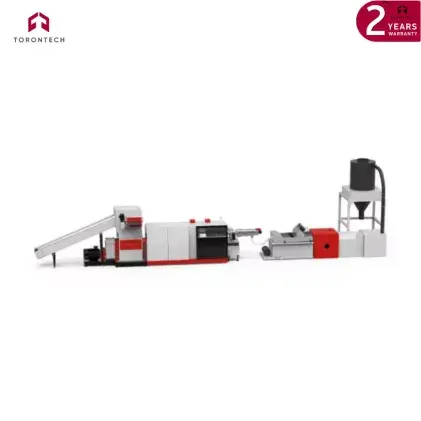
- Integrated Systems: Sometimes, a standalone screw isn't enough for fluffy or bulky waste. That is why we often recommend a Cutter Compactor Pelletizing System. It pre-conditions the material before it even hits the screw.
- Single Screw Extruders: While a reliable tool, this machine generally has lower flexibility than twin screw systems when handling complex blends. However, adapted versions are increasingly used for specific applications like supercritical fluid processing or 3D printing.
Torontech: The Right Extruder for Your Line
There is no single "best" machine in the single screw vs twin screw extruder debate. The objective is always to find the ideal balance between performance and budget to get the best possible return on your investment.
As a North American-based partner, Torontech offers the best of both worlds: globally competitive pricing on innovative machinery, backed by local support and accountability you can depend on. We're here to provide the cost-effective, high-performance solutions that will strengthen your entire production process.
Ready to find an extrusion solution that fits your operational needs?
Explore our lineup of Plastic Recycling and Processing equipment today. You can also contact our team to discuss how our innovative technologies can help you achieve your production targets.
References:
- Alotaibi, M., Aldhafeeri, T., & Barry, C. (2022). The Impact of Reprocessing with a Quad Screw Extruder on the Degradation of Polypropylene. Polymers, 14.
- Goto, T., Ashihara, S., Kato, M., Okajima, I., & Sako, T. (2012). Use of Single-Screw Extruder for Continuous Silane Cross-Linked Polyethylene Recycling Process Using Supercritical Alcohol. Industrial & Engineering Chemistry Research, 51, 6967-6971.
- Kallel, T., Massardier-Nageotte, V., Jaziri, M., Gérard, J., & Elleuch, B. (2003). Compatibilization of PE/PS and PE/PP blends. I. Effect of processing conditions and formulation. Journal of Applied Polymer Science, 90, 2475-2484.
- Okubo, H., Kaneyasu, H., Kimura, T., Phanthong, P., & Yao, S. (2021). Effects of a Twin-Screw Extruder Equipped with a Molten Resin Reservoir on the Mechanical Properties and Microstructure of Recycled Waste Plastic Polyethylene Pellet Moldings. Polymers, 13.
- Pandey, V., Chen, H., J., & Maia, J. (2021). Extension‐dominated improved dispersive mixing in single‐screw extrusion. Part 2: Comparative analysis with twin‐screw extruder. Journal of Applied Polymer Science, 138, 49765.
- Wagner, J., Mount, E., & Giles, H. (2005). 12 – Plastic Behavior in Twin Screw Extruders. Extrusion, 149-169.
- Zhang, Y., Bai, H., Mi, D., Zhang, L., Jiang, J., Yang, T., & Ren, Z. (2024). Mixing screw design and high density polyethylene toughening modification for recycled polypropylene based on screw 3D printing. Journal of Applied Polymer Science.